
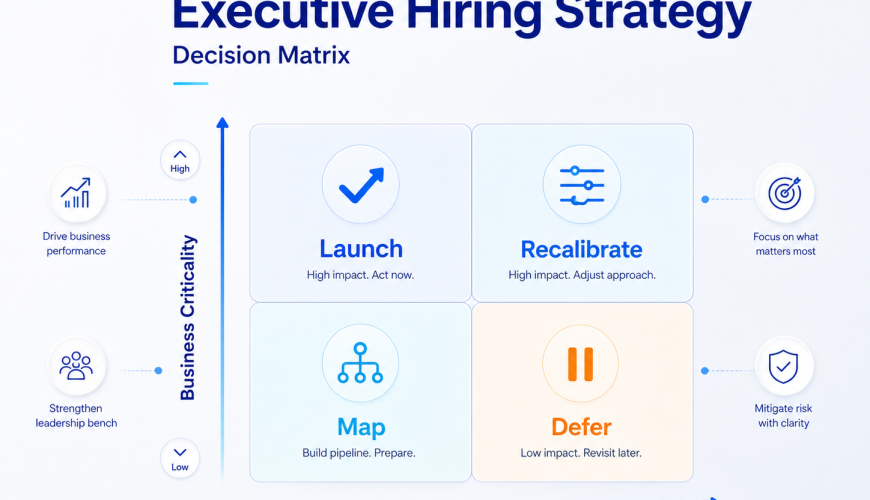
Vietnam entered H2 2026 with positive economic momentum, but an effective executive hiring strategy now requires more selectivity than simple confidence in market growth.
Gross domestic product increased by 7.83% year on year in the first quarter, compared with 7.07% in the same period of 2025, according to the National Statistics Office of Vietnam.
Hiring confidence has also remained positive, although employers are becoming more disciplined about where additional headcount can create meaningful value. ManpowerGroup’s Q3 2026 survey reported a Net Employment Outlook of 28% in Vietnam, down 19 percentage points from the previous quarter. Among the 265 employers surveyed, 49% expected to expand their workforce, while 21% anticipated reductions and 27% planned to maintain current staffing levels.
These signals do not describe a weak hiring market. They describe a more selective one.
For FDI companies and multinational operations in Vietnam, an H2 executive hiring strategy should therefore do more than identify which leadership positions remain vacant. It should determine whether those roles still reflect the company’s current business priorities, organizational structure and local talent-market conditions.
A disciplined mid-year review helps leadership teams decide which searches should proceed, which roles need to be recalibrated, which capabilities should be mapped for future succession and which positions should no longer remain in the plan.
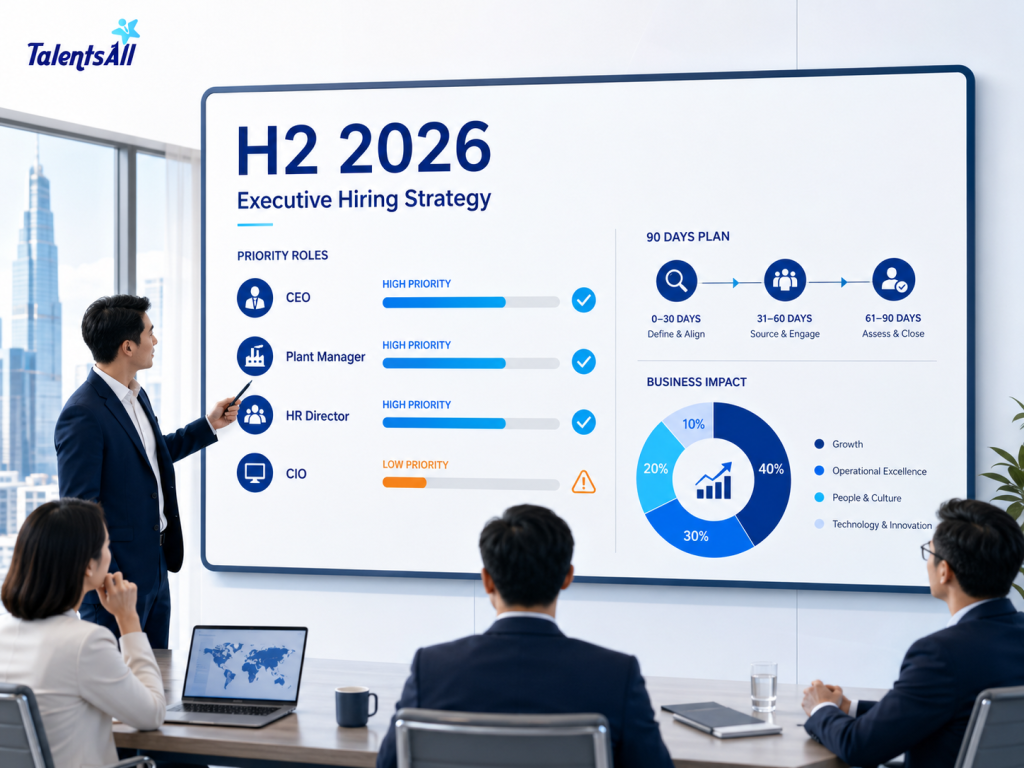
1. Why Your Executive Hiring Strategy Needs a Mid-Year Review
Annual workforce plans are built around forecasts. They reflect expected business growth, investment timelines, approved budgets and organizational priorities at a particular point in time.
By the middle of the year, some of those assumptions may remain valid. Others may have changed significantly.
A company may have delayed an expansion project, revised its commercial priorities, introduced new technology or centralized more decisions at regional headquarters. Responsibilities may have been redistributed among existing leaders, while a role originally designed for business expansion may now need to focus on stabilization, cost control or organizational transformation.
When the business context changes but the search brief does not, recruitment activity can continue without improving the probability of a successful appointment.
The decline in Vietnam’s Net Employment Outlook between Q2 and Q3 illustrates this more measured environment. Employers are still hiring, but they are increasingly differentiating between roles that directly support expansion and roles that can be delayed, redesigned or covered through existing resources.
For executive positions, this distinction is particularly important. A leadership search affects more than recruitment cost. It can influence business continuity, organizational confidence, customer relationships and the company’s ability to execute its H2 priorities.
2. Build the Executive Hiring Strategy Around Business Outcomes
A vacancy list tells leaders which positions are open. It does not show which appointments have the greatest impact on business performance.
Before approving an H2 executive hiring plan, the leadership team should define the business outcome attached to each proposed hire. A role may be critical because it must stabilize a factory, restore commercial performance, strengthen compliance, establish a technology capability or lead a market-entry project.
The expected outcome should be more precise than a general responsibility such as “manage the function” or “support company growth.”
For example, a company may define the purpose of an Operations Director as improving delivery reliability, reducing recurring operational escalation and building a stronger layer of functional managers within the first 12 months.
This statement provides a clearer basis for role design, candidate assessment and performance measurement than a conventional list of duties.
The same principle applies across industries. A Technology Leader may be required to reduce dependency on external vendors and establish a scalable internal platform. A Sales Director may be expected to rebuild key accounts and improve channel productivity. An HR Director may need to localize regional systems while strengthening the local management pipeline.
When the intended outcome is clear, the company can distinguish the capabilities that are essential from credentials that are merely preferred.
Further reading: Why Job Descriptions Fall Short in Executive Search
3. Identify Which Leadership Roles Protect H2 Performance
Not every senior vacancy should be treated as equally urgent.
A role becomes business-critical when its absence creates a direct constraint on execution. This may happen when no current leader owns an unresolved operational problem, when a key customer relationship lacks senior accountability, when a transformation programme cannot progress or when the organization faces material compliance exposure.
The practical test is not whether the position appears in the approved workforce plan. It is what happens if the position remains unfilled for another 90 days.
If the answer is limited operational inconvenience, the role may be suitable for succession mapping or a later search. If the consequences include delayed revenue, project disruption, unmanaged customer risk or excessive pressure on the current leadership team, the position should be treated as a business-continuity priority.
This approach prevents companies from assigning urgency based only on title or vacancy duration. It focuses leadership attention on the roles whose absence has a measurable effect on business performance.
Further reading: Retention Rate and the Cost of Replacing Senior Executives
4. Check Whether the Role Still Reflects the Business
Some executive searches become difficult because the organization has changed while the position has not.
A role initially designed for expansion may now need to manage stabilization. A functional leader may have acquired broader commercial responsibility. A Country Manager may have lost decision authority after pricing, investment or customer decisions were transferred to regional headquarters.
In such cases, the title may remain unchanged even though the mandate has become materially different.
This creates several recruitment risks. The company may approach candidates whose expectations do not match the actual authority of the role. Interviewers may assess candidates against different versions of success. Compensation may remain linked to the previous scope. Strong candidates may withdraw when they discover that the position is either broader or more restricted than the original brief suggested.
Before continuing the search, the organization should therefore clarify what the leader will own, what still requires regional approval and where accountability is shared across functions.
For FDI companies, this is particularly important because a globally familiar title does not always represent the same level of authority in the Vietnamese operation.
A Country Manager may carry full P&L accountability in one organization but operate primarily as a local representative in another. A Plant Manager may control production, quality, engineering and supply chain, or may be responsible only for daily production while critical decisions remain with regional functions.
An executive hiring strategy becomes more reliable when responsibility and authority are defined before the market is approached.
Further reading: Competency Framework Localization for FDI in Vietnam
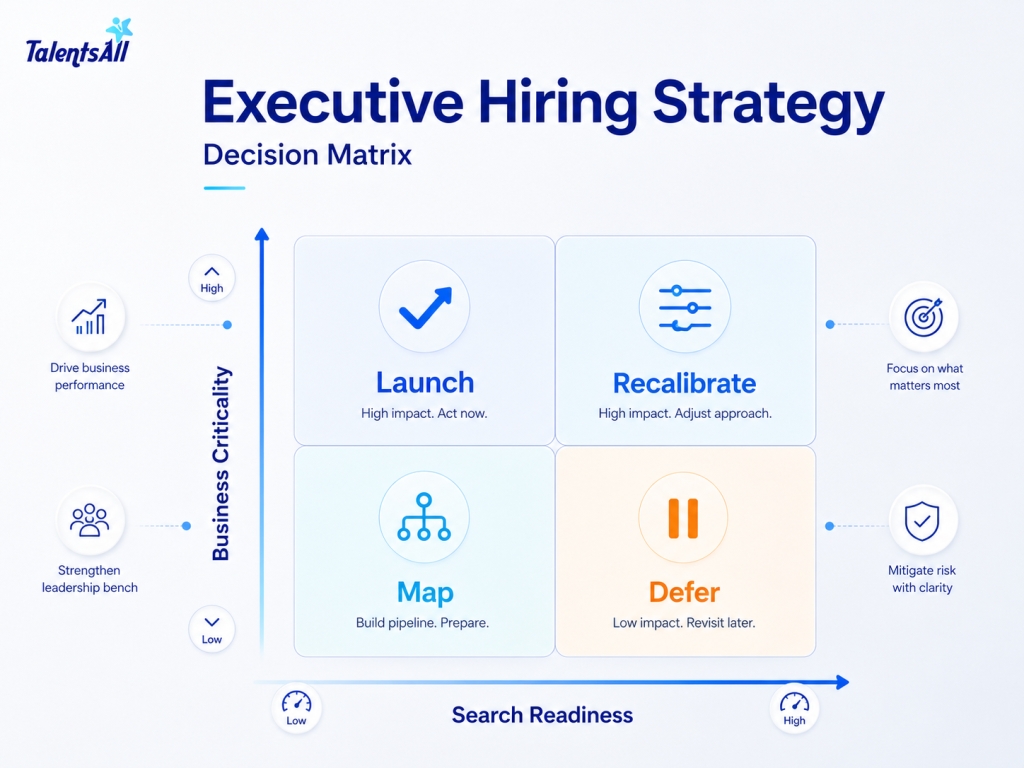
5. Four Decisions for Every Role in an H2 Executive Hiring Strategy
A mid-year review should not automatically result in a new search. Each role should lead to one of four decisions.
| Business condition | Recommended decision |
|---|---|
| The role is critical, clearly defined and supported by an approved budget | Launch the search |
| The role is critical but scope, authority or assessment criteria remain unclear | Recalibrate before approaching candidates |
| The capability is strategically important but the appointment is not yet urgent | Build a market map or succession pipeline |
| The business case, operating model or reporting structure remains uncertain | Defer or redesign the role |
5.1 Launch the Search
A search is ready to begin when the role is connected to a confirmed business priority, the expected outcomes are clear and the relevant stakeholders agree on how candidates will be assessed.
The organization should also have a realistic compensation range and a defined decision owner. Without these conditions, early sourcing may generate profiles, but it is unlikely to generate decision confidence.
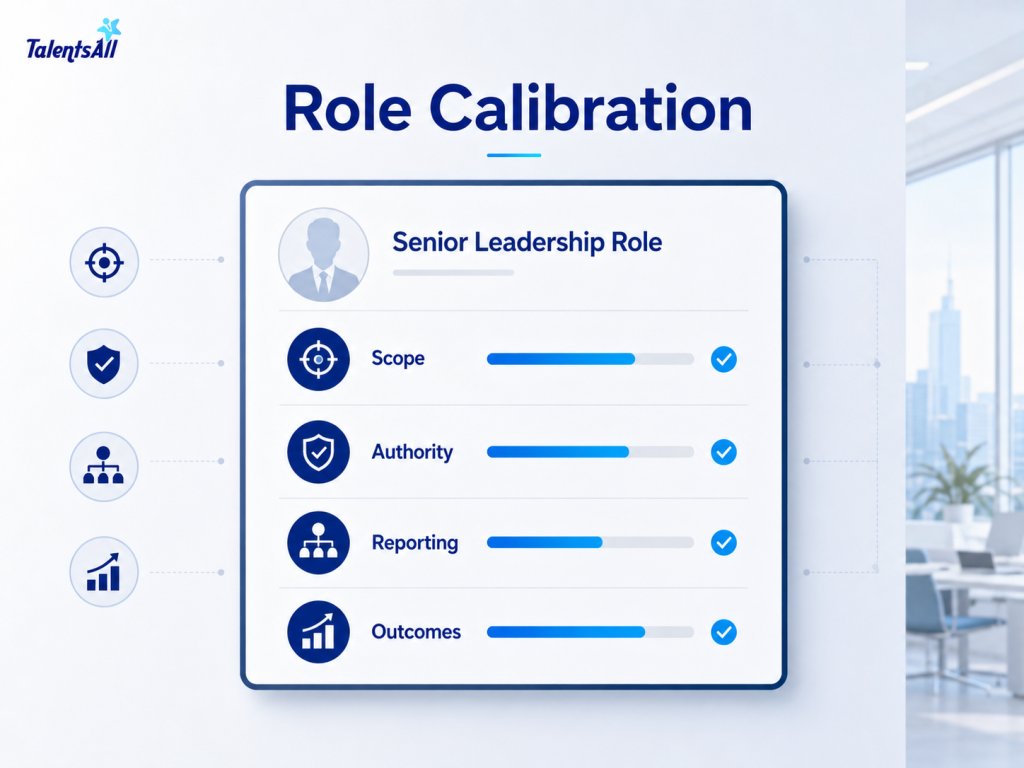
5.2 Recalibrate Before Entering the Market
Recalibration is necessary when the position matters but important questions remain unresolved.
Typical signs include responsibilities that have expanded beyond the original title, inconsistent expectations between local and regional leaders or previous candidates being rejected for reasons that were not included in the original brief.
A focused role-calibration discussion can resolve these issues before they become repeated delays during interviews.
5.3 Build a Market Map
Some capabilities should be explored before a formal vacancy exists.
Market mapping is appropriate when the organization anticipates expansion, identifies a succession risk or needs to understand whether the required leadership profile exists in Vietnam.
The objective is not to collect a large database of names. It is to understand the structure of the relevant talent market, including candidate availability, compensation expectations, mobility and possible adjacent-sector profiles.
5.4 Defer or Redesign the Position
Deferring a search is reasonable when the business case has weakened, the operating model remains unsettled or the responsibilities can be redistributed without material risk.
This should not be treated as a recruitment failure.
Launching a search before the organization understands what it needs creates a greater risk than delaying the process until the mandate is credible.
6. Test the Candidate Profile Against the Vietnam Talent Market
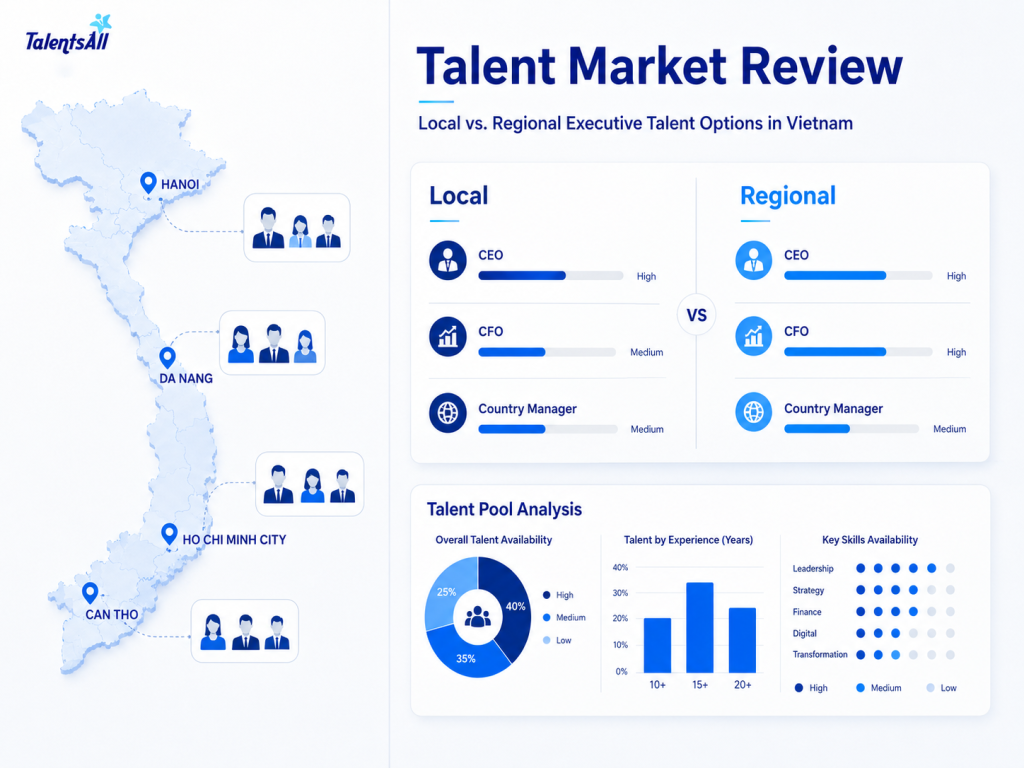
A limited shortlist does not automatically prove that Vietnam lacks qualified senior leaders.
The difficulty may come from an unnecessarily narrow industry requirement, compensation below the relevant market, a location that restricts candidate mobility or excessive capabilities combined into one position.
For example, an FDI company may search for a local leader with deep industry knowledge, regional exposure, transformation experience, strong English communication, commercial capability and an established local network.
Each requirement may be reasonable when considered separately. Combined, however, they may create a profile that very few candidates have had the opportunity to develop.
Before expanding the search outside Vietnam, companies should distinguish genuine capability scarcity from an overly restrictive search design.
A practical market assessment should compare local candidates with direct sector experience, leaders from adjacent industries with transferable capabilities, Vietnamese professionals currently working in regional roles and regional candidates who may consider relocation.
The purpose is not to lower standards. It is to understand which requirements protect business performance and which preferences unnecessarily reduce the talent pool.
Further reading: Executive Search in Vietnam: How Enterprise Leaders Reduce Hiring Risk
7. Align Compensation with Scope, Not Only with Title
Executive compensation should reflect the complexity and impact of the role.
Two positions with the same title may differ significantly in revenue responsibility, team size, number of locations, operational risk, regional exposure and decision authority. A salary benchmark based only on title can therefore create a false sense of market alignment.
When the expected mandate is broader than the approved compensation can support, the organization has several choices. It can increase the package, reduce the scope, phase the responsibilities or consider candidates with adjacent experience who can grow into parts of the mandate.
Continuing the search without addressing the mismatch usually produces more candidate conversations rather than stronger hiring outcomes.
For FDI organizations, the issue can become more complex when regional salary bands do not reflect the scope or scarcity of leadership talent in Vietnam. Internal equity remains important, but the company must also understand the point at which its compensation structure begins to exclude the relevant market.
Further reading: Compensation in Vietnam: How FDI Companies Can Avoid Costly Offer Mistakes
8. Strengthen the Executive Hiring Strategy with Clear Decision Governance
Even a well-designed role can become difficult to fill when decision governance is unclear.
Executive searches often involve the local CEO, regional leadership, HR, functional leaders and global stakeholders. Each participant may have a legitimate perspective, but the process becomes unstable when those perspectives are not translated into a shared assessment model.
Before interviews begin, the organization should agree on the role of each stakeholder. Some participants may assess technical or functional capability. Others may evaluate cultural and organizational fit. Budget approval may sit with a regional executive, while the final appointment decision may belong to the local Managing Director.
These roles should not remain implicit.
The company should also clarify which criteria are non-negotiable, which capabilities can be developed and which individual has authority to resolve disagreement.
Without this structure, candidate feedback can become a collection of personal impressions. The profile then changes after every interview, extending the search and weakening the candidate experience.
Further reading: Executive Recruitment Timeline Explained: What Long Hiring Processes Really Mean
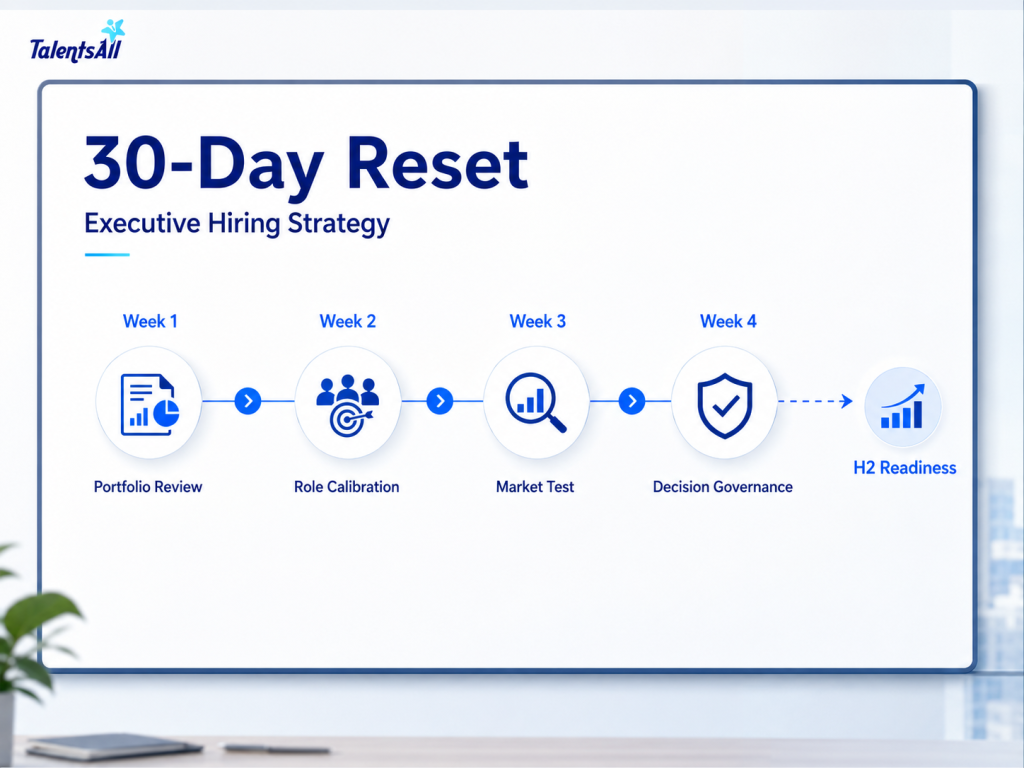
9. A Practical 30-Day Mid-Year Reset
A mid-year executive hiring review does not need to become a long consulting project. It can be completed within four focused stages.
Week 1: Review the leadership portfolio. The company identifies every open, planned and succession-sensitive senior role, then records the business priority, current coverage, vacancy risk and executive sponsor attached to each position.
Week 2: Recalibrate critical roles. For the highest-priority appointments, stakeholders confirm the expected 12-month outcomes, reporting relationships, authority, candidate trade-offs and approved compensation.
Week 3: Test the talent market. A targeted market map is used to examine candidate availability, local and regional options, mobility, compensation expectations and likely motivations. The purpose is to test the assumptions behind the search rather than generate a high volume of profiles.
Week 4: Confirm decision governance. Before candidates are formally approached, the organization agrees on the final decision owner, the purpose of each interview, the required assessment evidence and the conditions that would trigger another role recalibration.
This sequence helps the company resolve internal uncertainty before transferring it into the external candidate market.
10. What This Means for FDI Companies in Vietnam
Vietnam’s economic and hiring outlook remains broadly positive, but positive conditions should not be interpreted as a reason to accelerate every leadership appointment.
ManpowerGroup’s Q3 findings show that business expansion remains an important reason for workforce growth, while economic uncertainty is contributing to more cautious staffing decisions.
For FDI companies, the practical implication is that global workforce assumptions must be tested against the operating reality of the Vietnamese business.
A role that is standard at headquarters may require a different scope locally. A global competency model may need to be translated into observable business outcomes. A regional compensation band may not capture the premium attached to scarce local experience. A Vietnam-only search may be appropriate for one leadership mandate but too restrictive for another.
The objective is not to localize every requirement or compromise global standards. It is to determine how those standards can be applied in a way that produces effective local execution.
11. Executive Search as Decision Support
An executive search partner creates the greatest value before sourcing begins.
The first task should not be presenting candidate profiles. It should be testing whether the organization is ready to engage the market.
This may involve challenging an unrealistic combination of responsibilities, comparing local and regional talent pools, identifying compensation misalignment or helping stakeholders distinguish essential capabilities from preferred credentials.
When these questions are resolved early, the search becomes more focused and candidates receive a clearer, more credible opportunity.
When they remain unresolved, even a strong shortlist may not lead to a successful appointment.
Conclusion: Reset Before You Recruit
H2 2026 does not require companies to abandon their annual hiring plans. It requires them to test those plans against current business priorities, organizational readiness and local talent-market conditions.
A disciplined executive hiring strategy asks whether the role is still critical, whether the mandate is clear, whether the market can support the profile and whether the organization is prepared to make a decision.
The objective of a mid-year reset is not to slow recruitment. It is to prevent critical leadership searches from moving quickly in the wrong direction.
At TalentsAll, executive hiring is approached as a business decision before it becomes a sourcing assignment. For FDI and enterprise companies in Vietnam, this means aligning role scope, market reality, compensation and decision governance before a search enters the market.
TalentsAll – Connecting global talent with visionary companies to drive mutual success
Email: trang@talentsall.com.vn
Website: https://talentsall.com.vn
LinkedIn: https://www.linkedin.com/company/talentsall
Source Notes
Vietnam’s Q1 2026 GDP figure is drawn from the National Statistics Office of Vietnam. The statistic is used only to provide broad economic context and should not be interpreted as a direct indicator of executive hiring demand.
The Q3 2026 employment-outlook figures are drawn from the ManpowerGroup Employment Outlook Survey, based on responses from 265 employers in Vietnam collected between April 1 and April 30, 2026. The survey measures expected overall staffing changes rather than executive hiring specifically and is therefore used as a directional indicator of employer confidence.