
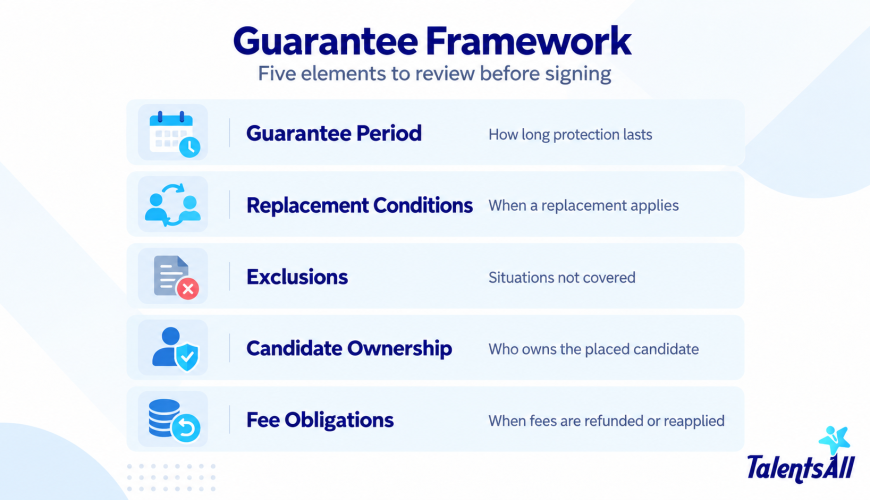
A recruitment agency guarantee should be evaluated on more than the number of months offered. Employers need to understand the replacement conditions, exclusions, candidate ownership, fee obligations and the situations in which the guarantee actually applies.
A six-month guarantee may sound stronger than a three-month guarantee. However, the real value depends on what happens if the candidate leaves and whether the agreement allows a practical replacement.
The better question is therefore not “Which agency offers the longest guarantee?” but “How much protection does this guarantee actually provide if the placement does not work out?”
1. What Is a Recruitment Agency Guarantee?
A recruitment agency guarantee is a contractual commitment that defines what the agency will do if a placed candidate leaves within an agreed period after joining. In many agreements, this takes the form of a replacement search under specified conditions.
The guarantee usually begins after the candidate starts employment and applies for a defined period. Its purpose is to create a clear process when a placement ends earlier than expected. However, the exact coverage depends on the written agreement between the employer and the recruitment agency.
This means the word “guarantee” should not be interpreted as a promise that every hire will stay for a fixed period. Instead, employers should read it as a set of agreed rules covering what happens after an unsuccessful placement.
1.1. Recruitment Guarantee Is Different From a Hiring Guarantee
A Recruitment Agency Guarantee usually covers the agency’s response after a placement ends, rather than guaranteeing that the employee will remain with the company.
No recruitment agency controls every factor after a candidate joins. Management changes, role expectations, counter-offers, personal circumstances and organizational conditions can all influence retention.
For that reason, the practical value of a guarantee lies in the replacement mechanism and the conditions attached to it. Employers should understand those conditions before assuming that a longer period automatically provides stronger protection.
1.2. The Written Agreement Matters More Than the Headline Period
The guarantee period is only one part of the clause. The written conditions determine whether the employer can actually use the guarantee when a placement fails.
Two agencies may both advertise a six-month guarantee, yet their agreements may work very differently. One may offer a straightforward replacement under clearly defined conditions. Another may include exclusions or time limits that make the protection narrower.
For employers reviewing the wider proposal, TalentsAll has also explained how to evaluate an Executive Search Proposal beyond the recruitment fee.
2. Why Is the Guarantee Period Alone Not Enough?
The length of a recruitment agency guarantee does not show the full level of protection. Employers also need to understand what triggers the guarantee, what is excluded and what obligations remain on both sides.
A longer period can look more attractive during supplier comparison because it is simple to measure. Three months, six months or another period can easily be placed into a procurement table.
The problem is that these numbers do not explain how the clause works in practice. A shorter guarantee with clear replacement conditions may provide more usable protection than a longer guarantee with several restrictions.
A long guarantee period has limited value when the employer cannot easily qualify for replacement under the written conditions.
For example, the agreement may require the employer to notify the agency within a specific timeframe. It may also exclude certain reasons for departure or make the replacement dependent on outstanding invoices being fully paid.
None of these conditions is automatically unreasonable. The important point is that employers should understand them before comparing guarantee periods.
2.2. Guarantee Does Not Replace Search Quality
A strong guarantee cannot compensate for weak search methodology, poor candidate assessment or an unclear hiring mandate.
The employer still needs the right candidate in the first place. If the search is built on a weak brief or the agency does not assess candidate motivation properly, a generous replacement clause only addresses the problem after the placement has already failed.
Therefore, guarantee should be evaluated as one layer of recruitment risk management. It should not become the main reason for choosing a supplier.
3. Five Elements Employers Should Check in a Recruitment Agency Guarantee
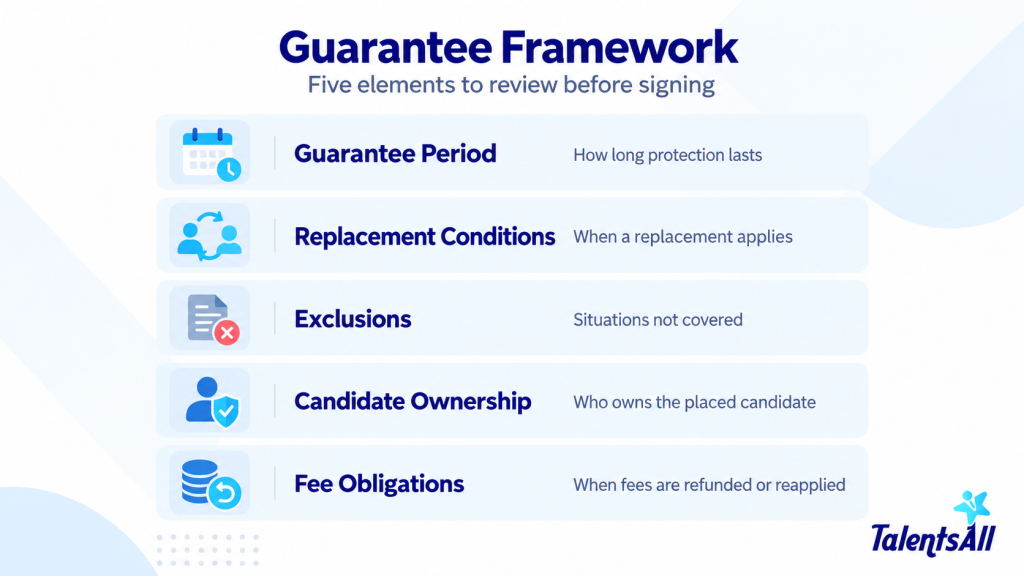
Employers should review five areas before signing: guarantee period, replacement conditions, exclusions, candidate ownership and fee obligations. Together, these elements show how the guarantee will work in practice.
3.1. Guarantee Period: When Does the Protection Start and End?
The Recruitment Agency Guarantee period should clearly define when coverage begins, how long it lasts and which event marks the end of the period.
In most discussions, employers focus on the number of months. However, the start date matters as well. The agreement should make clear whether the period begins on the candidate’s joining date or another agreed milestone.
Employers should also check whether any probation-related wording affects the guarantee. Clear dates reduce the risk of disagreement if a candidate leaves close to the end of the covered period.
3.2. Replacement Conditions: What Does the Agency Actually Provide?
Replacement conditions explain what the recruitment agency is required to do when the guarantee is triggered.
The agreement should state whether the agency will restart the search, provide a replacement candidate or offer another form of agreed remedy. It should also explain whether the replacement search must be for the same role and whether major changes to the mandate affect coverage.
This area deserves close attention because the word “replacement” can sound clear while leaving important operational questions unanswered.
3.3. Exclusions: When Does the Guarantee Not Apply?
Exclusions define the situations in which the agency is not required to provide a replacement under the original guarantee.
A candidate may leave because the role changed significantly after joining. The company may restructure, relocate the position or make the role redundant. In other cases, the employer may decide to terminate the employee for reasons unrelated to the original assessment.
The purpose of reviewing exclusions is not to remove every limitation. It is to understand where the agency’s responsibility ends and where the employer assumes the risk.
3.4. Candidate Ownership: Which Introduction Belongs to Which Agency?
Candidate ownership rules help determine which recruitment agency has the right to claim a successful introduction and how duplicate submissions are handled.
This becomes important when an employer works with several suppliers. A candidate may already exist in the company’s database or may have been introduced by another agency.
The agreement should explain how ownership is established and how long it remains valid. Clear rules can prevent fee disputes and make the guarantee easier to administer later.
Employers still deciding how to structure supplier coverage can also review TalentsAll’s analysis of working with one or multiple recruitment agencies in Vietnam.
3.5. Fee Obligations: Does Any Outstanding Payment Affect the Guarantee?
The guarantee clause should be read together with the payment terms because eligibility may depend on the employer meeting its commercial obligations.
Employers should understand when the recruitment fee becomes payable and whether late payment affects replacement coverage. Any additional cost connected with the replacement should also be clear before signing.
This is why recruitment guarantee and recruitment fee should not be reviewed as separate sections. They form part of the same commercial agreement.
4. Four Questions to Ask the Recruitment Agency Before Signing
The most useful questions test how the guarantee would work in a real placement failure rather than asking only how many months the agency provides.
4.1. What Exactly Triggers the Recruitment Agency Guarantee?
Employers should ask which situations qualify for replacement and which situations fall outside the guarantee.
A practical discussion can start with a simple scenario: the candidate joins, works for several weeks and then resigns. What happens next? The agency should be able to explain the process without relying on vague wording.
The answer should also distinguish between voluntary resignation, employer termination and business changes because these situations may be treated differently under the agreement.
4.2. What Happens After the Guarantee Is Triggered?
The employer should understand the operational steps that follow once a valid replacement request is made.
Will the agency restart the search immediately? Does the employer need to provide a new brief? Will the original role specifications remain valid, or can the mandate be adjusted based on what was learned from the first hire?
These questions matter because replacement is still a recruitment assignment. The process needs enough clarity to restart effectively.
4.3. Are There Any Exclusions or Conditions That Could Cancel the Guarantee?
Employers should ask the agency to explain the major exclusions before the agreement is signed, rather than discovering them after a placement fails.
This may include payment conditions, significant role changes or situations in which the candidate leaves because the employer changes the agreed scope. The goal is not to challenge every contractual condition. It is to make sure both sides interpret the clause in the same way.
TalentsAll’s guide on questions to ask a Headhunter before signing covers the broader supplier discussion before engagement.
4.4. Does the Replacement Guarantee Cover the Same Role and Fee?
Employers should clarify whether the replacement search must stay within the original mandate and whether any additional recruitment fee can apply.
A replacement may become more complicated if the company changes seniority, location, compensation or reporting lines after the first hire leaves. At that point, the agency may reasonably view the new search as a different assignment.
Clarifying this boundary before signing reduces uncertainty later and helps both sides distinguish a genuine replacement from a materially changed mandate.
5. When Is a Longer Recruitment Agency Guarantee Not Necessarily Better?
A longer recruitment guarantee is not automatically better when its conditions are more restrictive or when the extra coverage does not address the main hiring risk.
Consider two proposals. Agency A offers a six-month guarantee with several exclusions, while Agency B offers a shorter period with clearer replacement conditions. The longer period looks stronger on a comparison sheet, but the practical value depends on how likely the employer is to qualify for replacement.
This does not mean shorter guarantees are better. It means length and usability should be evaluated together.
5.1. When the Search Quality Is More Important Than Extra Guarantee Length
For difficult senior roles, stronger search and assessment may create more value than adding another month to the guarantee period.
An Executive Search firm that understands the mandate, engages the right talent market and tests candidate motivation may reduce risk before the candidate joins. That preventive value can matter more than additional replacement coverage after a failed placement.
Guarantee remains important, but it should support a strong search rather than substitute for one.
5.2. When the Employer Changes the Role After Hiring
A longer guarantee may provide little additional protection when the conditions of the role change materially after the candidate joins.
The business may change reporting lines, responsibilities, location or strategic priorities. If those changes contribute to the candidate leaving, the situation may fall outside the original recruitment mandate.
This is another reason to read exclusions carefully. The guarantee can only be evaluated properly when both agency and employer responsibilities are understood.
5.3. When the Main Risk Appears Before Placement
Some hiring risks are better addressed through role calibration and candidate assessment than through a longer post-placement guarantee.
If compensation is below market or the role lacks clear decision authority, those issues can reduce candidate commitment before the offer is accepted. A long replacement period does not solve the underlying problem.
In these situations, market feedback during the search may create more value than a stronger guarantee on paper.
6. How Should Employers Evaluate Guarantee, Fee and Search Quality Together?
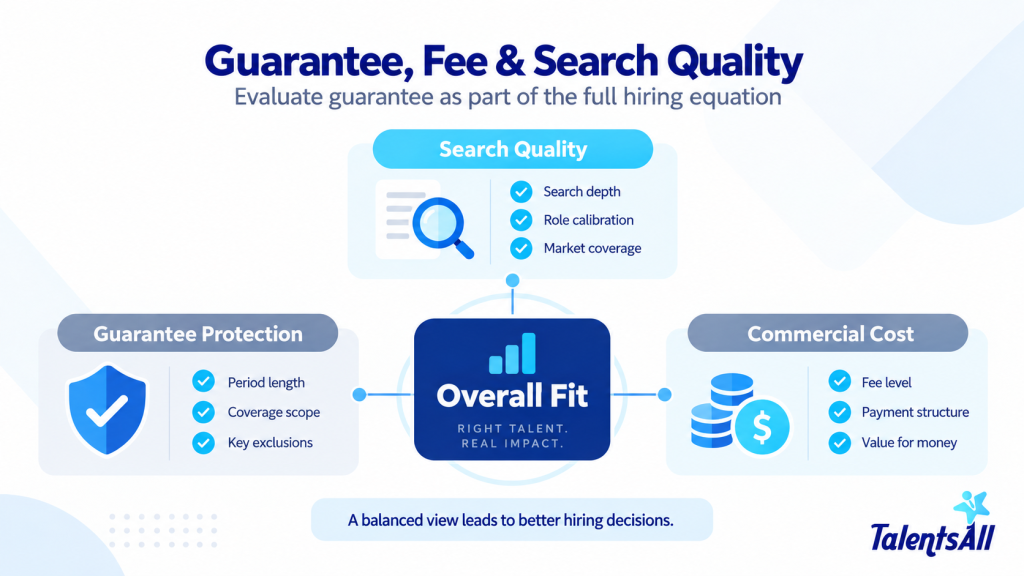
Recruitment guarantee should be assessed together with recruitment fee and search quality. Looking at only one of these areas can distort the supplier decision.
A useful comparison asks three different questions: What level of search does the agency provide? What does that service cost? What happens if the placement fails?
| Evaluation Area | Agency A | Agency B |
|---|---|---|
| Search Scope | 1–5 | 1–5 |
| Talent Market Coverage | 1–5 | 1–5 |
| Candidate Assessment | 1–5 | 1–5 |
| Consultant Involvement | 1–5 | 1–5 |
| Recruitment Fee | 1–5 | 1–5 |
| Guarantee Period | 1–5 | 1–5 |
| Replacement Conditions | 1–5 | 1–5 |
| Exclusions & Clarity | 1–5 | 1–5 |
| Overall Fit for the Mandate | 1–5 | 1–5 |
The scorecard does not replace judgment. Its purpose is to stop a single number, such as fee percentage or guarantee length, from dominating the entire decision.
6.1. Start With Search Quality
The first question should be whether the recruitment agency can realistically solve the hiring problem.
A generous guarantee has limited value when the supplier cannot reach the right candidates or understand the business mandate. Employers should first examine search scope, market access, consultant capability and candidate assessment.
Only after those areas are clear does it make sense to compare commercial protection.
6.2. Then Compare the Recruitment Fee
Recruitment fee should be evaluated against the depth of service rather than treated as an isolated percentage.
A lower fee can represent strong value when the mandate is straightforward. A higher fee may be justified when the role requires deeper research, passive candidate engagement or senior consultant involvement.
TalentsAll’s article on evaluating an Executive Search Proposal beyond the fee provides a more detailed framework for this comparison.
6.3. Finally, Test How the Guarantee Works in Practice
The final step is to ask whether the guarantee creates practical protection if the placement ends early.
This requires looking beyond the number of months. The employer should understand replacement conditions, exclusions, payment obligations and the process for restarting the search.
The strongest agreement is therefore not necessarily the one with the longest guarantee. It is the one where search quality, commercial terms and post-placement protection fit the mandate together.
7. Working With TalentsAll for Senior and Hard-to-Fill Recruitment
TalentsAll supports employers through Executive Search and Headhunting for senior, specialist and hard-to-fill roles, with a structured search process that continues through post-placement follow-up.
The recruitment process begins with understanding the mandate, target talent market and business expectations. Candidate engagement and assessment are then aligned with the specific needs of the role.
Post-placement follow-up is also part of the wider search process. Clear expectations before signing help both employer and recruitment partner understand what happens throughout the assignment.
Employers can review TalentsAll’s Executive Search process in Vietnam or explore TalentsAll Recruitment Services.
Hiring a senior or hard-to-fill role? Discuss the mandate, search approach and commercial structure with TalentsAll before starting the assignment.
8. Frequently Asked Questions About Recruitment Agency Guarantees
The questions below address common issues employers should clarify before relying on a recruitment guarantee.
8.1. What Is a Recruitment Agency Guarantee?
A recruitment agency guarantee defines what the agency will do if a placed candidate leaves within an agreed period and the conditions for coverage are met.
In many agreements, the remedy involves restarting the search or providing a replacement. However, the specific terms vary between agencies, so employers should rely on the written agreement rather than a general description of the guarantee.
8.2. Is a Six-Month Recruitment Agency Guarantee Better Than Three Months?
Not necessarily. A longer guarantee can provide more time coverage, but its value depends on the replacement conditions and exclusions.
A shorter period with clear and practical replacement terms may be more useful than a longer period with narrow eligibility. Employers should therefore compare both the length and the conditions.
8.3. Does a Recruitment Agency Guarantee Mean the Agency Refunds the Fee?
Not automatically. A guarantee may provide replacement rather than a refund, depending on the commercial agreement.
Employers should confirm the exact remedy before signing. The agreement should explain whether the agency provides another search, a replacement candidate or another agreed commercial solution.
8.4. What Can Make a Recruitment Agency Guarantee Invalid?
The answer depends on the agreement, but exclusions may relate to payment obligations, major changes to the role or circumstances outside the original recruitment mandate.
This is why employers should ask the agency to explain the key exclusions in practical language before signing.
8.5. Should Guarantee Be the Main Factor When Choosing a Recruitment Agency?
No. Guarantee should be one part of the supplier decision alongside search capability, consultant quality, candidate assessment and commercial terms.
The primary objective is still to make the right hire. A strong guarantee helps manage residual risk after placement, but it cannot replace a strong recruitment process.
8.6. Should Employers Review Guarantee Terms Before the Search Starts?
Yes. Guarantee terms should be clear before the recruitment agreement is signed.
Clarifying them early prevents different interpretations after a candidate joins. It also allows the employer to compare agencies on the same basis before making the final supplier decision.
TalentsAll | Talents for All, All for Talents
Explore TalentsAll Recruitment Services.
Read more about TalentsAll’s Executive Search Process in Vietnam.
Follow recruitment and Vietnam talent-market updates on TalentsAll LinkedIn.