
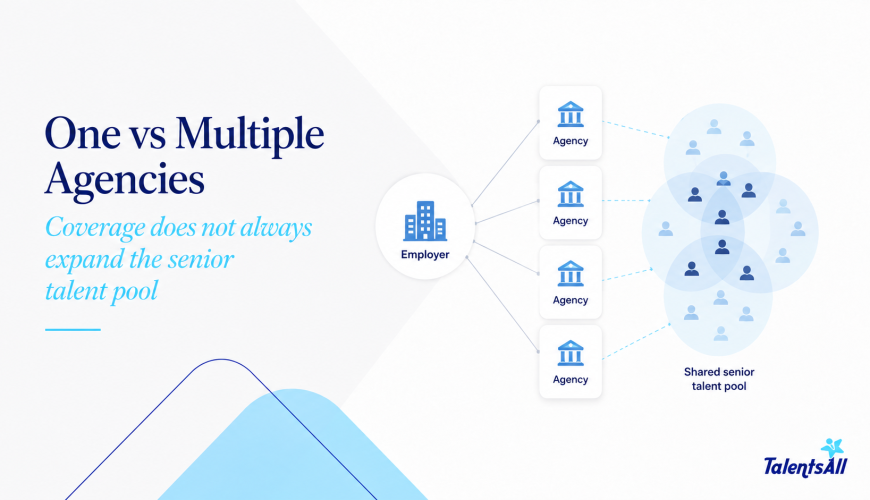
Working with more than one recruitment agency in Vietnam does not automatically lead to faster or better senior hiring. The right model depends on talent scarcity, role seniority, confidentiality and how much search depth the position requires.
For highly specific roles, several agencies may approach the same limited talent pool, creating more CVs and duplicate outreach without increasing candidate quality.
The key question is not “Should we use one or multiple agencies?” but “Which recruitment model best fits this role?”
1. What Is the Difference Between One Recruitment Agency in Vietnam and Multiple Agencies?
The main difference lies in how the hiring mandate is distributed, how suppliers compete for the role and how much time each recruitment agency can invest in understanding the market and approaching candidates. Neither model is automatically better for every hiring situation.
1.1. What Does Working With One Recruitment Agency Mean?
Working with one recruitment agency means appointing a primary external partner to manage a specific search, allowing the agency to develop a deeper understanding of the role, business context and relevant candidate market.
The arrangement can take different forms. A company may give one recruitment agency in Vietnam an exclusive mandate or allow one partner to work on the vacancy for a defined period before involving other suppliers.
The main advantage is not simply having fewer recruiters involved.
A dedicated recruitment partner can spend more time understanding why the position exists, which business outcome the new hire must deliver and which requirements are genuinely essential.
This becomes increasingly important for senior positions because the same title can represent very different levels of responsibility.
A Plant Manager may lead a stable production facility or be expected to transform an underperforming operation. A Sales Director may inherit an established team or be responsible for building a new commercial function.
The search strategy should reflect those differences.
Working with one recruitment agency does not automatically mean using retained Executive Search. The commercial structure and scope of the engagement can still vary.
For a broader comparison of recruitment models, employers can also refer to TalentsAll’s guide on In-house Recruitment vs RPO vs Executive Search.
1.2. How Does a Multiple-Agency Model Work?
A multiple-agency model means several recruitment agencies work on the same vacancy at the same time, usually competing to introduce a successful candidate first.
This model can increase sourcing activity quickly.
Different agencies may have access to different active candidates, professional networks or industry communities. When the talent pool is broad, this additional sourcing capacity can improve coverage.
However, the model also changes the economics of the search.
If several suppliers are competing for the same placement, each agency has a lower probability of completing the assignment successfully. This can affect how much time is spent on deeper market mapping, passive candidate engagement or detailed role consultation.
For this reason, multiple recruitment agencies may work well for some hiring situations but become less effective as the position becomes more senior or specialized.
2. Why Do More Recruitment Agencies Not Always Mean More Qualified Candidates?
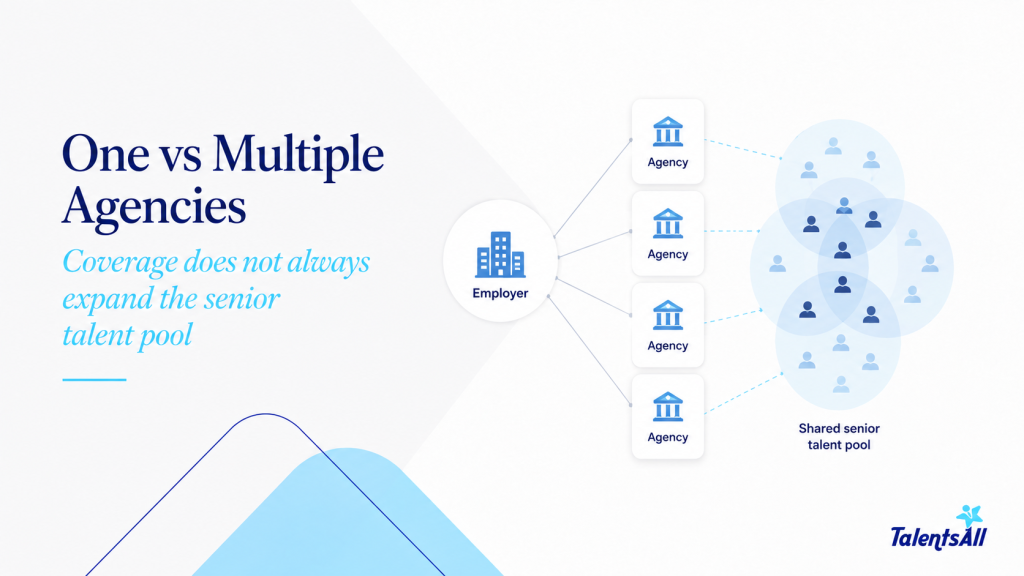
For senior hiring, several recruitment agencies may ultimately search within the same limited talent market. Increasing the number of suppliers can create more sourcing activity, but it does not necessarily increase the number of professionals who genuinely match the role.
2.1. Recruitment Agencies May Be Searching the Same Talent Pool
When a role has highly specific requirements, different recruitment agencies can end up identifying the same relatively small group of candidates.
Consider a manufacturer looking for a Plant Manager with:
- experience in a specific manufacturing segment;
- responsibility for a large workforce;
- strong English communication;
- automation or transformation experience;
- exposure to multinational management structures.
Each requirement narrows the available talent pool.
Adding three or four agencies does not create additional qualified Plant Managers in the market. Instead, several recruiters may identify the same professionals.
For hard-to-fill senior roles, the more useful question becomes:
Has the relevant talent market been mapped correctly?
TalentsAll explores this issue further in Executive Talent Mapping in Vietnam: Why It Matters Before Senior Hiring Begins.
2.2. Duplicate Outreach Can Affect Candidate Experience
When several recruiters approach the same senior candidate for the same role, the employer message can become fragmented and the opportunity may appear less controlled.
Experienced professionals are often selective about which opportunities they explore.
If the same candidate receives several calls describing slightly different versions of one vacancy, immediate questions may arise:
- Which recruiter officially represents the employer?
- Why are several agencies working on the same role?
- Is the position particularly difficult to fill?
- Which information about scope, reporting line or compensation is accurate?
Different recruiters may also position the opportunity differently depending on how much information they have received.
For senior recruitment, where a passive candidate may need significant context before deciding whether to engage, consistency matters.
2.3. More Suppliers Can Create More Internal Coordination
Using multiple recruitment agencies also increases the amount of supplier management required from the employer.
HR and Talent Acquisition teams may need to manage:
- duplicate candidate submissions;
- candidate ownership;
- interview coordination;
- supplier updates;
- changes to the hiring brief;
- feedback across multiple consultants.
If agencies receive different information at different times, candidate quality can become inconsistent even when the original search brief was the same.
More recruitment suppliers therefore do not automatically reduce the employer’s workload. In some cases, they simply move the workload from sourcing candidates to coordinating suppliers.
3. Four Factors Employers Should Evaluate Before Choosing a Recruitment Agency Model
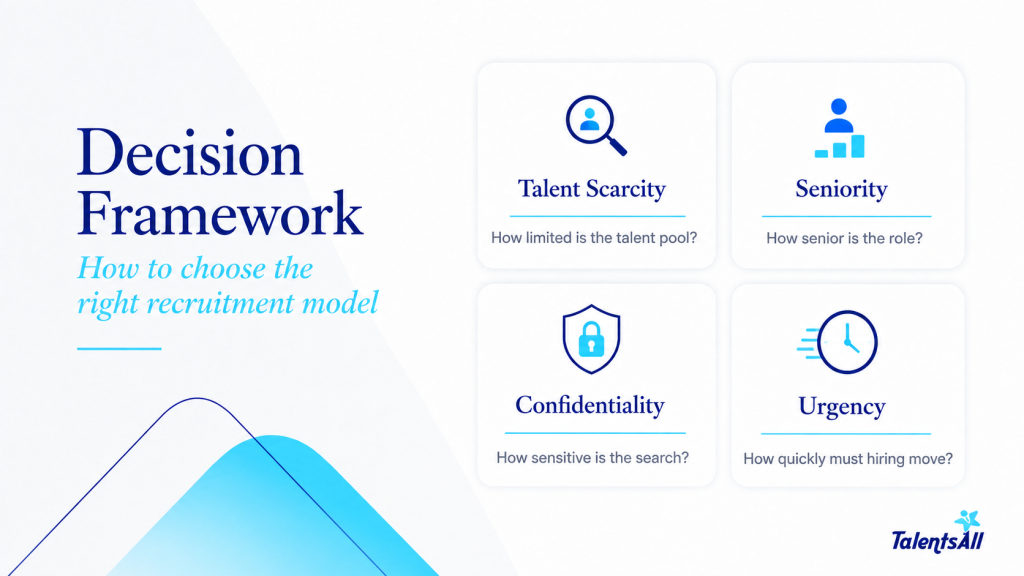
Employers should decide between one and multiple recruitment agencies based on four factors: talent scarcity, seniority, confidentiality and urgency. These provide a stronger decision framework than comparing suppliers only by the number of CVs they can deliver.
3.1. Talent Scarcity: How Large Is the Relevant Candidate Pool?
The smaller and more specialized the talent pool, the more important search depth becomes compared with the number of recruitment agencies involved.
For relatively common positions, different suppliers may genuinely reach different candidate segments.
For example, a company may require a commercial leader who combines:
- industrial B2B experience;
- team leadership;
- P&L responsibility;
- regional customer exposure;
- strong English;
- experience in a specific product category.
The challenge is no longer generating applicants.
It is identifying which professionals genuinely combine the required capabilities and which adjacent profiles may still succeed in the role.
In this situation, a recruitment agency in Vietnam with relevant market knowledge may create more value through focused search than several suppliers sourcing independently from the same job description.
3.2. Seniority: How Complex Is the Hiring Decision?
The more senior the position, the more important it becomes to assess business scope, leadership impact, motivation and organizational fit rather than relying mainly on title and technical experience.
Senior candidates also tend to require more context before entering a recruitment process.
They may want to understand:
- why the position is open;
- who the role reports to;
- what authority the position really holds;
- what needs to be achieved during the first 6–12 months;
- whether the opportunity represents a meaningful career move.
Recruitment therefore becomes more than sourcing.
A recruitment partner needs enough understanding of the mandate to explain why the opportunity may be relevant to someone who is not actively looking for another job.
3.3. Confidentiality: How Sensitive Is the Search?
Confidential searches require tighter control over information, candidate communication and market approach, which can make a smaller supplier structure more appropriate.
Examples include:
- confidential executive replacement;
- succession planning;
- organizational restructuring;
- a leadership position that has not yet been announced;
- a new business unit still under development.
When the same confidential mandate is distributed to many suppliers, controlling who has been approached and what information has been shared becomes more difficult.
For sensitive senior positions, discretion can therefore be more valuable than sourcing volume.
3.4. Urgency: Does Faster Hiring Require More Recruitment Agencies?
An urgent vacancy does not automatically require more recruitment agencies because hiring speed depends on both sourcing capacity and the actual size of the talent pool.
There is an important difference between:
Urgent role + broad talent pool
and
Urgent role + scarce talent pool.
When many qualified candidates exist, several agencies may increase reach and speed.
When only a small number of suitable professionals exist, additional suppliers can simply create more overlap.
In that situation, the real question is whether the search is targeting the right industries, competitor companies, locations and adjacent talent pools.
Urgency should influence the recruitment model, but it should not determine the model by itself.
4. When Does Working With Multiple Recruitment Agencies Make Sense?
Multiple recruitment agencies can be effective when the candidate pool is broad, several similar positions need to be filled, confidentiality is limited and the internal HR team has enough capacity to manage several suppliers consistently.
4.1. When the Talent Pool Is Broad
Using several recruitment agencies can provide additional sourcing coverage when many candidates in the market can realistically meet the requirements.
Different recruitment companies may have access to different active candidate databases, professional communities or networks.
For these roles, broader sourcing can improve speed.
The employer should still maintain a consistent hiring brief so that every recruitment agency works from the same understanding of the position.
4.2. When the Company Is Hiring Several Similar Positions
A multiple-agency model may be useful when a company needs to fill several comparable positions and sourcing capacity is more important than deep market mapping for each vacancy.
For example, a business expansion may require several sales, technical or operational positions with similar requirements across different locations.
In this situation, distributing sourcing activity among suppliers can help increase coverage.
The company should establish clear rules for candidate ownership and duplicate profiles before opening the roles to several agencies.
4.3. When Internal Talent Acquisition Can Manage Multiple Suppliers
Multiple recruitment agencies work best when the internal team has sufficient capacity and governance to coordinate them.
Supplier management still requires:
- regular updates;
- consistent feedback;
- candidate ownership rules;
- interview coordination;
- clear communication when the brief changes.
Without this structure, using more agencies can create fragmentation instead of speed.
5. When Can One Recruitment Agency Be More Effective?
A dedicated recruitment partner can be more effective when the position is senior, the talent pool is narrow, the hiring brief requires calibration or the employer needs market feedback in addition to candidate introductions.
5.1. When the Challenge Is Finding Talent, Not Generating Applications
For hard-to-fill positions, the central recruitment problem is often identifying the right professionals rather than generating a larger number of applicants.
Senior executives and experienced managers may not actively apply through job boards.
They need to be identified, approached and given enough information to decide whether a conversation is worthwhile.
This requires a different process from simply distributing the vacancy through more sourcing channels.
5.2. When Passive Candidate Outreach Matters
A dedicated recruitment agency can invest more consistently in professionals who need targeted engagement before entering the hiring process.
Passive candidates may want to understand the business situation, leadership expectations, reporting line, compensation and reason behind the search before sharing a CV.
The recruiter therefore needs to represent the opportunity accurately and credibly.
For critical positions, candidate engagement becomes part of the search capability itself.
5.3. When the Hiring Brief Needs Calibration
Sometimes the recruitment problem begins before candidate sourcing because the hiring brief does not match the talent market.
Common issues include:
- an overly narrow industry requirement;
- a title that does not reflect the actual responsibilities;
- too many must-have criteria;
- compensation below the expected market level;
- unclear reporting lines;
- a mismatch between scope and seniority.
If the same misaligned job description is sent to five agencies, the company may simply receive the same weak market response five times.
This is why senior hiring often requires clarifying the business mandate before search activity increases.
TalentsAll discusses this issue in more detail in Why Job Descriptions Fall Short in Executive Search.
5.4. When Employers Need Market Feedback During the Search
A recruitment agency supporting a difficult senior search should help the employer understand what the market is saying, not only report whether new CVs are available.
Useful feedback may include:
- why target candidates are declining;
- which requirements are restricting the candidate pool;
- whether the compensation range is competitive;
- which adjacent industries contain relevant talent;
- whether location affects candidate mobility;
- what candidates need to know before entering the process.
For example, if strong candidates repeatedly disengage after learning the compensation package, increasing sourcing volume is unlikely to solve the problem.
The company may need to review the offer itself. TalentsAll’s article on Executive Compensation in Vietnam explains how compensation should be aligned with role scope, talent scarcity and business impact.
6. How Should Employers Choose Between One and Multiple Recruitment Agencies?
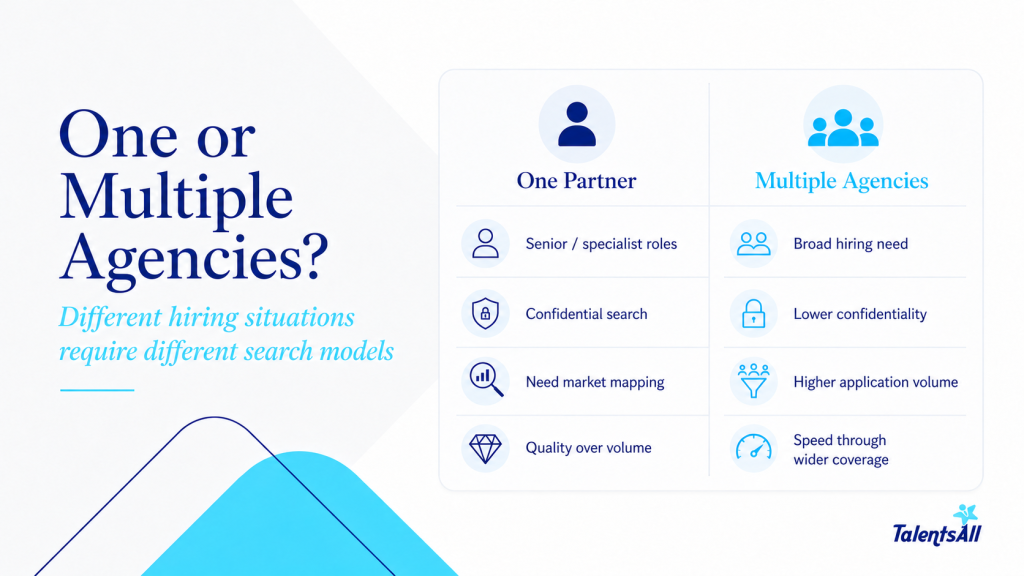
Employers should compare both models using the same criteria: talent scarcity, role seniority, confidentiality, urgency and internal supplier-management capacity. The right recruitment agency model depends on the hiring situation rather than a fixed company-wide rule.
| Hiring situation | One recruitment partner | Multiple recruitment agencies |
|---|---|---|
| Senior leadership role | More suitable | Less suitable |
| Scarce talent pool | More suitable | Higher risk of overlap |
| Confidential replacement | More suitable | Harder to control |
| Market mapping required | More suitable | Insights may become fragmented |
| Several common positions | Possible | Often suitable |
| Broad active candidate pool | Possible | Often suitable |
| High-volume recruitment | Less suitable in some cases | Often suitable |
| Limited internal TA capacity | Easier to coordinate | Higher management workload |
This framework should not be treated as an absolute rule.
A mature organization can use different recruitment models for different hiring needs.
For example:
- operational or high-volume roles may involve several suppliers;
- specialized management positions may be assigned to one recruitment partner;
- confidential or business-critical leadership roles may require Executive Search;
- large-scale recruitment transformation may require a different solution such as RPO.
The objective is not to identify one recruitment model that works for every vacancy.
It is to match the recruitment model to the difficulty, risk and business importance of the role.
7. Four Questions to Answer Before Appointing Recruitment Agencies
Before deciding how many recruitment agencies to appoint, employers should clarify how difficult the profile is to find, what support they expect from suppliers, how much internal coordination capacity they have and how success will be measured.
7.1. How Difficult Is This Candidate Profile to Find?
Employers should distinguish between a vacancy receiving too few applications and a talent profile that is genuinely scarce in the market.
If many suitable candidates exist, broader sourcing may help.
If only a small number of professionals have the required experience, deeper market mapping becomes more important.
This distinction prevents companies from responding to every difficult vacancy simply by adding more suppliers.
7.2. Do We Need CVs or Market Intelligence as Well?
The right recruitment agency model depends partly on whether the employer needs candidate introductions only or expects market insight during the search.
For straightforward hiring, CV delivery may be sufficient.
For a critical management position, the company may also need information about:
- candidate availability;
- competitor talent pools;
- compensation expectations;
- candidate motivation;
- location constraints;
- alternative industries.
The wider the expected support, the more important the capability of the recruitment partner becomes.
7.3. How Much Internal Capacity Do We Have to Manage Suppliers?
Working with multiple recruitment agencies requires consistent coordination, feedback and candidate ownership processes from the employer.
If the internal Talent Acquisition team is already managing a large number of vacancies, adding more external suppliers may increase administrative pressure.
A recruitment model should reduce hiring friction rather than move the problem from sourcing to supplier management.
7.4. What Would Make This Search Successful Beyond Speed?
Time-to-hire matters, but senior recruitment should also be evaluated through candidate quality, fit, transparency and the sustainability of the final hire.
A company should therefore define what a successful search means before appointing a recruitment agency in Vietnam.
For a high-impact senior role, a fast shortlist is valuable only if the candidates genuinely meet the business mandate.
8. Working With TalentsAll on Senior and Hard-to-Fill Roles
TalentsAll supports employers hiring senior and hard-to-fill talent by helping clarify the hiring mandate, understand the relevant candidate market and approach professionals whose experience matches the real requirements of the role.
For critical positions, recruitment should begin with more than distributing a job description.
Understanding the business context, required leadership capability, talent availability and candidate expectations can help employers choose a more effective search strategy before sourcing begins.
TalentsAll works with companies on senior recruitment and Executive Search assignments where candidate quality, market understanding and fit are more important than simply increasing the number of profiles submitted.
Companies that want to understand the full process can also explore Executive Search Process in Vietnam 2026: A Strategic Approach.
Hiring for a senior or hard-to-fill position in Vietnam? Discuss your hiring brief with TalentsAll to identify the recruitment approach that best fits the mandate.
9. Frequently Asked Questions About Using One or Multiple Recruitment Agencies
The questions below address common employer concerns when deciding whether to appoint one recruitment agency in Vietnam or work with several suppliers on the same vacancy.
9.1. Should Employers Send the Same Job Description to Multiple Recruitment Agencies?
Yes, this can be appropriate for some positions, but employers should first consider the size of the talent pool, role seniority and level of supplier coordination required.
For broad candidate markets, several agencies may increase sourcing coverage.
For highly specialized or senior positions, multiple suppliers may repeatedly approach the same candidates without materially expanding the relevant talent pool.
9.2. Does Working With One Recruitment Agency Reduce the Candidate Pool?
Not necessarily. Candidate coverage depends on the recruitment agency’s search methodology, network and ability to approach passive talent rather than the number of suppliers alone.
A single partner conducting structured market mapping may identify a broader relevant pool than several agencies relying mainly on active candidates already available in their databases.
Employers should therefore evaluate search capability rather than assume that more suppliers automatically mean more talent.
9.3. How Many Recruitment Agencies Are Too Many?
There is no universal number because the appropriate level depends on the vacancy, talent market and the employer’s ability to manage suppliers.
One useful warning sign is when increasing the number of agencies creates more duplicate candidates than new qualified profiles.
At that point, additional suppliers may no longer improve meaningful market coverage.
9.4. Is Exclusive Recruitment Suitable for Every Role?
No. Exclusive recruitment is generally more relevant when the assignment requires deep market mapping, passive candidate outreach, confidentiality or substantial consultation.
For high-volume or relatively common positions, employers may prefer broader multi-agency sourcing.
The recruitment model should reflect the complexity of the role rather than become a standard rule for every vacancy.
9.5. When Should Employers Move From Multiple Agencies to One Recruitment Partner?
Employers may consider consolidating the search when several agencies repeatedly present the same candidates, candidate quality does not improve or the vacancy remains open without clear market feedback.
At that stage, the issue may no longer be sourcing volume.
The company may need to review the talent market, compensation, role scope, candidate criteria or overall search strategy.
TalentsAll | Talents for All, All for Talents
Khám phá cơ hội nghề nghiệp tại TalentsAll Careers
Theo dõi các cập nhật về tuyển dụng và thị trường tại TalentsAll trên LinkedIn