
Executive talent mapping helps FDI companies assess whether a leadership hiring plan is realistic before a vacancy becomes urgent. Instead of waiting until a senior leader resigns or a business project enters execution, companies can examine talent availability, candidate mobility, compensation expectations and potential search constraints in advance.
The purpose is not to build the longest possible list of profiles. A disciplined mapping process should help the organization decide whether to launch a search, recalibrate the role, develop a leadership pipeline or reconsider the proposed workforce solution.
1. Why Executive Talent Mapping Should Begin Before the Vacancy
Many executive searches begin only after the business is already under pressure.
A senior leader resigns, a new plant approaches operation, an expansion project is approved or a critical function begins to underperform. The company then expects to identify and appoint the right executive within a limited timeframe.
However, several important questions may still be unresolved:
- Does the required leadership profile exist in Vietnam?
- Are suitable candidates concentrated in direct competitors or adjacent industries?
- Will qualified executives relocate?
- Is the compensation aligned with the mandate?
- Does the role offer enough authority to attract the expected level of talent?
When these questions are addressed only after recruitment begins, the company may need to revise the job description, expand the target market, change the reporting structure or request additional compensation approval.
Each adjustment extends the recruitment timeline while the organization continues operating without the intended leadership capacity.
Executive talent mapping reduces this uncertainty by testing the assumptions behind the hiring plan before the vacancy becomes a business risk.

2. Build Executive Talent Mapping Around Business Outcomes
A talent map should not begin with the question:
“Who matches this job description?”
It should begin with:
“What must this leader change, build, protect or deliver?”
This distinction matters because the same title can represent very different mandates.
A Plant Manager may lead one stable production site or several facilities undergoing transformation. A Country Manager may own full profit-and-loss accountability or primarily coordinate functions controlled by regional headquarters.
Mapping titles without understanding the role can produce a large but misleading talent pool.
Before analysing the market, the company should clarify:
- The expected business outcomes.
- The decisions the leader will own.
- The scale of the team and operation.
- The relationship between local and regional authority.
- The capabilities required from the first day.
- The capabilities that can be developed after appointment.
This creates a stronger foundation for executive talent mapping and prevents the organization from searching for a direct copy of the previous role-holder when the business may now require a different type of leadership.
Further reading: Why Job Descriptions Fall Short in Executive Search

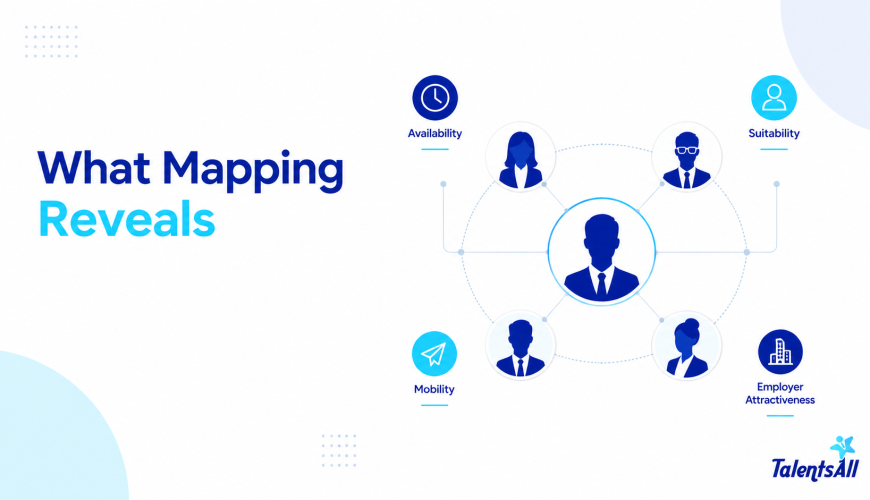
3. What Executive Talent Mapping Should Reveal
A useful executive talent mapping exercise should provide leadership teams with a clear view of four dimensions.
3.1 Talent Availability
The company needs to understand how many plausible executives exist and where they are currently located.
The relevant market may include:
- Direct competitors.
- Adjacent industries.
- Vietnamese executives in regional positions.
- Returning Vietnamese professionals.
- International leaders with relevant Vietnam experience.
The purpose is not to collect as many names as possible. It is to understand how the market is structured and where the most credible options are likely to come from.
3.2 Candidate Suitability
A relevant job title does not automatically mean the candidate has managed the required scope.
The mapping process should examine:
- Business scale.
- Decision authority.
- Transformation experience.
- Team and budget responsibility.
- Regional stakeholder exposure.
- Results achieved in comparable situations.
This helps distinguish profiles that appear suitable on paper from executives whose experience genuinely reflects the mandate.
3.3 Candidate Mobility
A qualified executive is not necessarily an available executive.
Location, family considerations, notice periods, career timing and willingness to change sectors can all affect mobility.
This is particularly important for manufacturing and operational roles outside Hanoi and Ho Chi Minh City. A candidate based in a major city should not automatically be considered available for a permanent role in an industrial province.
Candidate mobility must be tested as a market condition rather than assumed from professional seniority.

3.4 Employer Attractiveness
The company must also determine whether its opportunity is strong enough to engage the target market.
Relevant factors include:
- Scope of responsibility.
- Local decision authority.
- Reporting line.
- Regional exposure.
- Transformation mandate.
- Compensation.
- Employer reputation.
- Long-term career potential.
If the role does not provide sufficient authority or professional value, searching more aggressively may not solve the problem. The position itself may need to be recalibrated.
4. Test Executive Talent Mapping Against Vietnam’s Market
A limited shortlist does not always mean Vietnam lacks qualified senior leaders.
The difficulty may come from an overly restrictive search design.
For example, an FDI company may require a local executive with deep industry knowledge, regional exposure, transformation experience, strong English communication, commercial capability and an established local network.
Each requirement may be reasonable individually. Combined, however, they may create a profile that very few candidates have had the opportunity to develop.
A practical market review should compare four potential talent pools:
- Local candidates with direct-sector experience.
- Leaders from adjacent industries with transferable capabilities.
- Vietnamese executives currently working in regional roles.
- Regional candidates who may consider relocating to Vietnam.
The purpose is not to lower standards. It is to identify which requirements protect business performance and which preferences unnecessarily reduce the talent pool.
Before expanding the search internationally, the company should also test whether the real constraint comes from compensation, location, title, authority or reporting structure.
This allows executive talent mapping to reflect the market that actually exists rather than the market the company expects to find.

5. Four Decisions After Executive Talent Mapping
A talent map should lead to a business decision, not remain a static presentation.
| Business condition | Recommended decision |
|---|---|
| The role is critical, clearly defined and supported by the market | Launch the search |
| The capability exists, but the role limits access to it | Recalibrate the role |
| The capability is important, but recruitment is not urgent | Build a leadership pipeline |
| The business case or operating model remains unclear | Defer or rethink the solution |
5.1 Launch the Search
The company can proceed when the business need is confirmed, the mandate is clear and the market contains credible candidates.
Compensation, assessment criteria and decision ownership should also be aligned before candidates are formally approached.
5.2 Recalibrate the Role
Recalibration is required when the capability exists but the current position restricts access to it.
The organization may need to revise:
- Title.
- Scope.
- Reporting line.
- Decision authority.
- Target sectors.
- Location.
- Compensation.
Market feedback should improve the role before recruitment begins.
5.3 Build a Leadership Pipeline
Some capabilities should be mapped before a formal vacancy exists.
This approach is useful when the company anticipates expansion, identifies succession exposure or expects a new capability to become strategically important.
The organization can maintain visibility of relevant executives without initiating an immediate search.
5.4 Defer or Rethink the Workforce Solution
The market may not support the proposed role in its current form.
The company may need to:
- Develop an internal successor.
- Divide the mandate between two positions.
- Use an interim executive.
- Retain selected responsibilities at regional level.
- Build the capability gradually.
Deciding not to recruit immediately is not a failure. Launching an unclear search creates a greater risk.

6. Align Compensation with the Leadership Mandate
Compensation should be tested during executive talent mapping, not after the final shortlist has been created.
Two roles with the same title may differ significantly in revenue responsibility, team size, operational risk, regional exposure and decision authority.
A benchmark based only on title can therefore create a false sense of market alignment.
The company should assess whether the package reflects:
- The complexity of the mandate.
- The scarcity of the capability.
- The location requirement.
- Regional reporting expectations.
- Business-performance responsibility.
- The candidate’s current career opportunity.
If the approved package cannot support the intended scope, the organization must either increase compensation, reduce responsibilities or reconsider the candidate profile.
Further reading: Compensation in Vietnam: How FDI Companies Can Avoid Costly Offer Mistakes
7. Executive Talent Mapping as Decision Support
For FDI companies in Vietnam, leadership roles often sit between local operating realities and regional governance expectations.
Headquarters may define the desired profile through a global competency model. However, titles, career paths, compensation structures and decision authority may be organized differently in Vietnam.
A candidate who appears less suitable on paper may possess stronger local execution capability. Another candidate may hold the expected title but lack ownership of the decisions required by the role.
Executive talent mapping gives local and regional stakeholders a common basis for discussing:
- Talent availability.
- Role scope.
- Local authority.
- Compensation.
- Location constraints.
- Succession exposure.
- Recruitment timing.
Its value lies before sourcing begins.
A strong mapping process may confirm that the company should launch an executive search. It may also show that the role needs to be redesigned, the market should be expanded or an external leadership pipeline should be developed first.
Further reading: Executive Search in Vietnam: How Enterprise Leaders Reduce Hiring Risk
Conclusion: Map Before You Recruit
Executive hiring should not begin with an urgent request for candidate profiles.
It should begin with a clear understanding of the business outcome, the leadership capability required and the market’s ability to supply that capability.
A disciplined executive talent mapping process helps FDI companies determine whether the right executives exist, where they are located, what may motivate them to move and whether the role is competitive enough to attract them.
The objective is not to predict exactly who the company will hire. It is to reduce uncertainty before a leadership vacancy becomes a business risk.
At TalentsAll, executive talent mapping is approached as decision support—not simply as a list-building exercise.
Map the market before the vacancy becomes a business risk.
TalentsAll – Connecting global talent with visionary companies to drive mutual success
Email: trang@talentsall.com.vn
Website: https://talentsall.com.vn
LinkedIn: https://www.linkedin.com/company/talentsall