
AI in recruitment is helping companies draft job descriptions, screen applications, identify candidates and reduce administrative work. However, faster processing does not automatically produce more accurate hiring decisions particularly when the role involves leadership, business judgment and organizational influence.
The central question is therefore not whether companies should use AI. It is where technology can improve efficiency, where human review remains essential and how employers can prevent polished AI-generated information from being mistaken for evidence of real capability.
1. How AI in Recruitment Is Changing Hiring
AI is becoming embedded in both sides of the recruitment process.
Employers can use AI to prepare job descriptions, search talent pools, summarize applications, generate interview questions and organize candidate information. Candidates can use the same technology to improve CVs, prepare interview answers and present their experience more clearly.
These tools can make recruitment more accessible and efficient. They also create a new challenge: the quality of presentation is becoming increasingly separated from the quality of the underlying evidence.
A well-written CV may have been heavily refined by AI. A professional job description may have been generated without a detailed understanding of the actual working environment. An automated candidate ranking may appear objective while relying on incomplete criteria or historical assumptions.
Microsoft’s 2026 Work Trend Index frames the wider workplace shift around human agency: as AI takes on more execution, people have more responsibility to direct the work, make judgments and own outcomes. That principle is particularly relevant in recruitment, where decisions directly affect both individuals and organizations.

2. Where AI in Recruitment Creates Value
The strongest use of AI in recruitment is not replacing the recruiter. It is reducing the time spent on repetitive activities so recruiters can focus on work that requires context and judgment.
AI can support recruitment teams by:
- Organizing large volumes of candidate information.
- Identifying keywords, experience patterns and possible matches.
- Drafting candidate communications and interview frameworks.
- Summarizing notes from different interview stages.
- Highlighting missing information for further verification.
SHRM notes that AI-enabled resume parsing and screening can reduce the time HR teams spend reviewing large application volumes. LinkedIn has similarly described AI as a tool that can support sourcing, communication and recruitment administration while recruiters focus on more strategic advisory work.
The value is therefore operational acceleration.
AI may help a recruiter reach the relevant evidence faster. It cannot independently determine whether that evidence is credible, whether the candidate understands the business context or whether the appointment will succeed.
3. Three AI Recruitment Risks Companies Should Not Ignore
The wider adoption of AI creates risks on both sides of the hiring process.
3.1 AI-Generated CVs May Hide Capability Gaps
AI can help candidates describe their experience more clearly. Used appropriately, this improves communication without changing the substance of the profile.
The risk appears when AI-generated language creates a stronger impression than the candidate’s actual contribution.
A CV may contain convincing descriptions of transformation, strategy, stakeholder management or team leadership. During a detailed interview, however, the candidate may struggle to explain:
- The decisions they personally owned.
- The scale and complexity of the work.
- The obstacles they encountered.
- The trade-offs they considered.
- The measurable results they produced.
- What they would do differently.
LinkedIn has highlighted growing concerns about AI-assisted candidate misrepresentation and the need for hiring teams to strengthen verification rather than relying on polished applications alone.
The solution is not to reject every AI-assisted CV. It is to assess the evidence behind it.
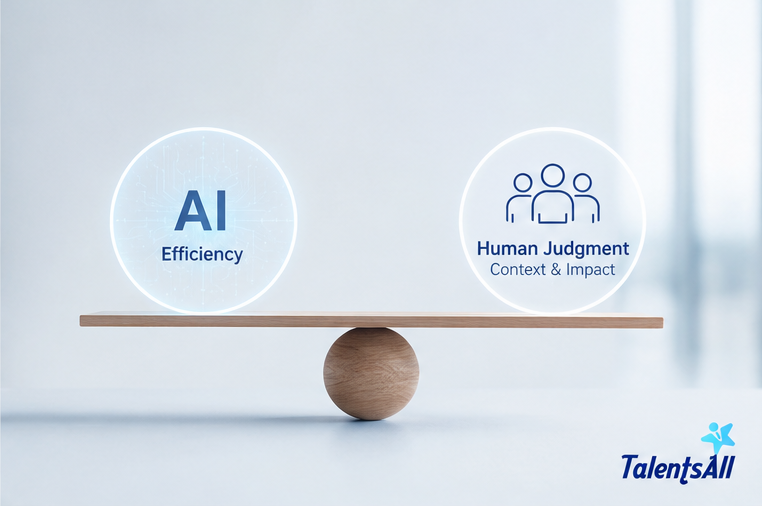
3.2 AI-Generated Job Descriptions May Misrepresent the Role
The same issue applies to employers.
AI can generate a complete job description within minutes. The output may be structured, professional and consistent with market terminology.
However, the system does not automatically understand:
- Why the position is being recruited.
- What business problem the new leader must solve.
- Which decisions remain under regional control.
- Whether stakeholders agree on the mandate.
- What the working environment is actually like.
- Which expectations are realistic within the approved package.
A polished job description can therefore describe an idealized role rather than the real opportunity.
This may attract candidates under inaccurate assumptions and create withdrawal, offer rejection or early turnover when the actual scope becomes clear.
Further reading: Why Job Descriptions Fall Short in Executive Search
3.3 Automated Screening Can Create False Confidence
Automated screening can identify patterns quickly, but candidate matching is not the same as candidate assessment.
A system may prioritize profiles based on job titles, keywords, education, career history or previous hiring data. These indicators can help organize a talent pool, but they do not fully reveal motivation, leadership judgment, cultural adaptability or the ability to operate in a specific organizational context.
AI can also reproduce weaknesses in the criteria or data used to configure the system. A fast process may therefore apply an incomplete assumption at greater scale.
The International Labour Organization emphasizes transparency, accountability and meaningful human oversight when AI is used in recruitment and other workplace decisions.

4. What Human Judgment Must Still Validate
Human involvement should not be limited to approving a final recommendation generated by a system.
Recruiters and hiring leaders must actively examine the areas that technology cannot reliably interpret without organizational context.
These include:
- Capability: What has the candidate personally delivered?
- Scope: What decisions, budgets, teams and risks did they own?
- Motivation: Why does the opportunity make sense at this stage?
- Judgment: How does the candidate respond to ambiguity and trade-offs?
- Leadership fit: Can the individual influence the specific stakeholders involved?
- Role credibility: Does the opportunity presented to candidates reflect reality?
For executive hiring, these questions are critical because leadership performance depends on more than matching technical qualifications.
A candidate may satisfy every visible requirement but still be unsuitable for the authority structure, transformation stage or stakeholder environment of the business.
5. How Companies Should Use AI in Recruitment Responsibly
Responsible use of AI in recruitment requires a clear division between technology support and human accountability.
| Recruitment activity | Role of AI | Role of people |
|---|---|---|
| Market research | Process and organize information | Define the relevant market |
| CV review | Highlight experience and possible matches | Verify scope and evidence |
| Job descriptions | Support drafting and structure | Confirm the real mandate |
| Interview preparation | Generate question frameworks | Probe context, judgment and motivation |
| Candidate comparison | Organize assessment information | Own the final decision |
A practical principle is:
AI may inform the decision, but a person must understand, challenge and own it.
SHRM describes human-centred AI in similar terms: algorithms can support analysis, but people must apply context and remain accountable for the outcome.
Companies should also tell recruiters and hiring managers where AI is being used, what information it evaluates and which decisions require mandatory human review.

6. Why Human Judgment Matters More in Executive Hiring
The higher the level of the appointment, the less reliable simple keyword or title matching becomes.
Two candidates with similar titles may have operated with very different authority. One Country Manager may own full profit-and-loss responsibility, while another mainly coordinates activities controlled by regional headquarters. One Plant Director may lead a stable site, while another has managed restructuring, automation and significant operational risk.
Executive assessment must therefore examine the mandate behind the title.
Human judgment is also required to evaluate factors that may not appear in structured data:
- Their ability to build trust with local and regional stakeholders.
- The alignment between their leadership style and the organization’s current stage.
- Their understanding of the consequences of difficult decisions.
This is why AI in recruitment should strengthen executive-search research and administration without replacing role calibration, candidate engagement or evidence-based assessment.
Further reading: Executive Search in Vietnam: How Enterprise Leaders Reduce Hiring Risk
7. TalentsAll’s Perspective on AI in Recruitment
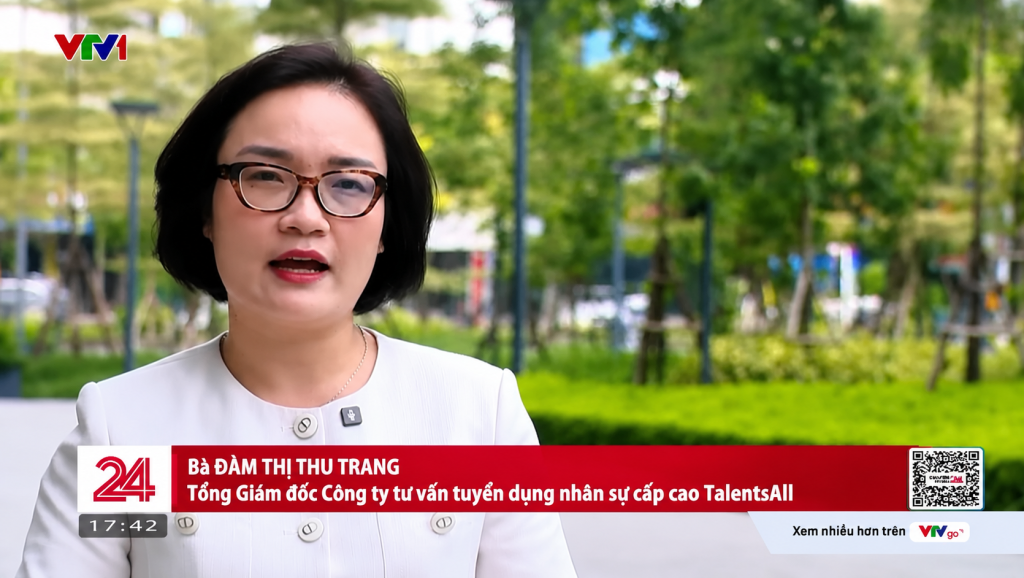
In a recent VTV discussion about AI and the labour market, Trang Dam, CEO of TalentsAll, highlighted a risk affecting both candidates and employers.
Candidates can use AI to create highly polished application documents that may not fully reflect their real capability. Employers can also use AI to produce job descriptions that do not accurately represent the role, working environment or long-term needs of the organization.
The issue is therefore not technology alone. It is the loss of verification when users begin treating AI output as established fact.
From an executive-search perspective:
- A stronger CV does not replace evidence of performance.
- A higher matching score does not replace candidate assessment.
- A polished job description does not replace role calibration.
- More data does not replace understanding candidate motivation.
- Faster processing does not automatically reduce hiring risk.
The quality of recruitment still depends on the questions people ask, the evidence they verify and the decisions they are prepared to own.
(Source: VTV1)
Conclusion: Use AI to Support Judgment, Not Replace It
AI in recruitment can improve speed, consistency and access to information. Used responsibly, it gives recruiters more time for candidate engagement, market analysis and deeper assessment.
However, recruitment becomes less reliable when AI-generated CVs, job descriptions or rankings are accepted without verification.
This is particularly important in executive hiring, where a successful appointment depends on business context, leadership judgment, motivation and organizational fit—not only information that can be extracted from a document.
At TalentsAll, AI is viewed as a tool to support recruitment expertise, not a substitute for it.
AI can make recruitment faster. Human judgment is what makes the decision credible.
TalentsAll – Connecting global talent with visionary companies to drive mutual success
Email: trang@talentsall.com.vn
Website: https://talentsall.com.vn
LinkedIn: https://www.linkedin.com/company/talentsall