
When recruitment begins to impact operational timelines, workforce quality, and business growth, many organizations turn to RPO services to regain control. However, RPO services are often misunderstood as simple recruitment outsourcing.
Drawing on hands-on experience supporting enterprise and FDI companies, TalentsAll explains how RPO services function as a structured recruitment management model rather than a transactional HR solution.
1. What Are RPO Services and Why They Matter for Businesses
RPO services are commonly described as outsourced recruitment. While this definition is technically correct, it fails to capture the strategic role RPO services play in modern organizations. Companies that adopt RPO services without a clear understanding of their purpose often experience shallow implementation and limited results.

In practice, RPO services are most effective when viewed as a way to redesign how recruitment decisions are made, governed, and executed—especially in complex or fast-changing business environments.
1.1 RPO as a Recruitment Management Capability
At a management level, Recruitment Process Outsourcing services go beyond providing hiring support. They allow organizations to extend recruitment capability in a controlled and structured way when internal capacity is limited or strategically constrained.
Rather than investing in short-term output, organizations leverage Recruitment Process Outsourcing services to establish a repeatable operating model that includes:
- Recruitment process design and governance
- Operational discipline and performance measurement
- Consistent screening and evaluation logic
- Structured collaboration between HR, line managers, and leadership
From this perspective, Recruitment Process Outsourcing services are closer to outsourcing recruitment management capability than outsourcing headcount.
1.2 Why RPO Services Are Not the Same as CV Forwarding or Temporary Recruiters
RPO services differ fundamentally from CV forwarding or temporary recruitment staffing. CV forwarding is a transaction, and temporary recruiters address short-term capacity gaps. RPO services, by contrast, are built around consistent decision logic, process governance, and operational accountability.
Without clear evaluation criteria, structured workflows, transparent reporting, and end-to-end ownership, an engagement labeled as RPO services will struggle to deliver sustainable value.
2. When Recruitment Becomes a Strategic Risk
Many organizations only begin exploring RPO services when hiring slows down or vacancies remain open for extended periods. In reality, these symptoms often indicate a deeper issue: recruitment has begun to introduce operational risk.
2.1 How RPO Services Reduce Recruitment-Driven Operational Risk
In enterprise and FDI environments, delayed hiring or mis-hires can disrupt project timelines, overload middle management, and weaken leadership continuity. Over time, these pressures reduce productivity and increase attrition.
RPO services help stabilize hiring outcomes by restoring structure, predictability, and governance to recruitment processes that directly affect business performance.

3. What Business Problems RPO Services Actually Solve
Before evaluating whether RPO services can accelerate hiring, organizations should first understand the core problems RPO services are designed to address.
3.1 Why RPO Prioritize Stability Over Hiring Speed
One of the most important values of RPO services is stability. Rather than focusing on filling individual roles as quickly as possible, RPO services aim to:
- Maintain consistent hiring quality
- Reduce reliance on individual recruiters
- Sustain predictable recruitment rhythms aligned with business plans
For growing organizations, this stability is often more critical than short-term gains in speed.
3.2 How Recruitment Process Outsourcing Services Reveal True Recruitment Capability
Through structured reporting and performance tracking, RPO services provide organizations with visibility into where recruitment actually breaks down. This includes identifying bottlenecks in sourcing, interview cycles, and decision-making, as well as uncovering where time and effort are lost.
In this way, Recruitment Process Outsourcing services not only deliver hires but also reveal how recruitment functions as part of the broader organization.
4. How RPO Services Operate in Practice
Once the value of RPO services is clear, the next question is how they function day to day and what level of involvement is required from the business.
4.1 RPO Services as a Co-Operating Model
RPO services operate as a co-operating recruitment model. Businesses retain decision authority over candidate selection and cultural fit, while the RPO partner manages execution, process discipline, quality control, and reporting.
Successful Recruitment Process Outsourcing services depend on collaboration rather than full delegation, ensuring alignment between business priorities and recruitment execution.
4.2 Common Reasons RPO Services Fail
RPO services often underperform when expectations are misaligned. Common failure points include unclear decision ownership, limited data sharing, or treating RPO services as a fully outsourced function rather than a partnership.
These risks should be identified and addressed before implementation to ensure long-term effectiveness.

5. When Businesses Should — and Should Not Use
RPO services are not a universal solution and should be applied selectively.
5.1 Scenarios Where RPO Services Deliver the Most Value
Recruitment Process Outsourcing services are most effective for organizations experiencing growth, facing multi-role hiring pressure, or needing to scale recruitment without expanding permanent HR headcount. In these contexts, RPO services function as a capability multiplier rather than a cost-saving measure.
5.2 When The Services May Not Be the Right Fit
In cases of fragmented hiring demand, slow decision-making, or low internal readiness, RPO services may add cost without delivering proportional value. Understanding organizational readiness is essential before committing to RPO services.
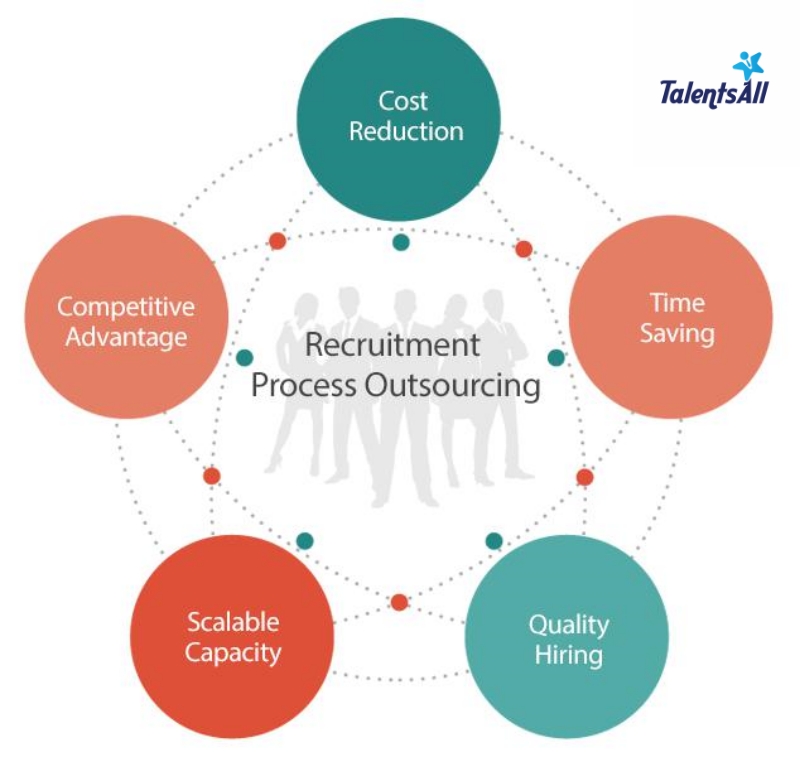
6. RPO Services in the Broader Recruitment Strategy
RPO services are designed to complement, not replace, existing recruitment models.
Headhunting focuses on deep selection for critical leadership roles, in-house recruitment maintains baseline hiring capability, and RPO services scale recruitment capacity across defined business cycles. Mature organizations combine these approaches strategically to match different hiring needs.
7. TalentsAll’s Approach
At TalentsAll, RPO services are delivered as a recruitment management discipline rather than a standardized package. Each Recruitment Process Outsourcing services engagement is tailored to industry context, organizational scale, and growth stage, with a strong emphasis on operational discipline, transparency, and long-term capability building.
8. Conclusion
RPO is neither a fast nor inexpensive solution, and it is not appropriate for every organization. However, when implemented in the right context, RPO reduces recruitment risk, protects growth, and stabilizes organizational operations. Before asking about RPO costs, organizations should assess whether the real challenge lies in a lack of candidates or in the absence of a structured, well-managed recruitment capability.
TalentsAll – Connecting global talent with visionary companies to drive mutual success
Email: trang@talentsall.com.vn
Website: https://talentsall.com.vn
LinkedIn: https://www.linkedin.com/company/talentsall