
1. Introduction: Growth Is Strong, but Hiring Decisions Are Harder
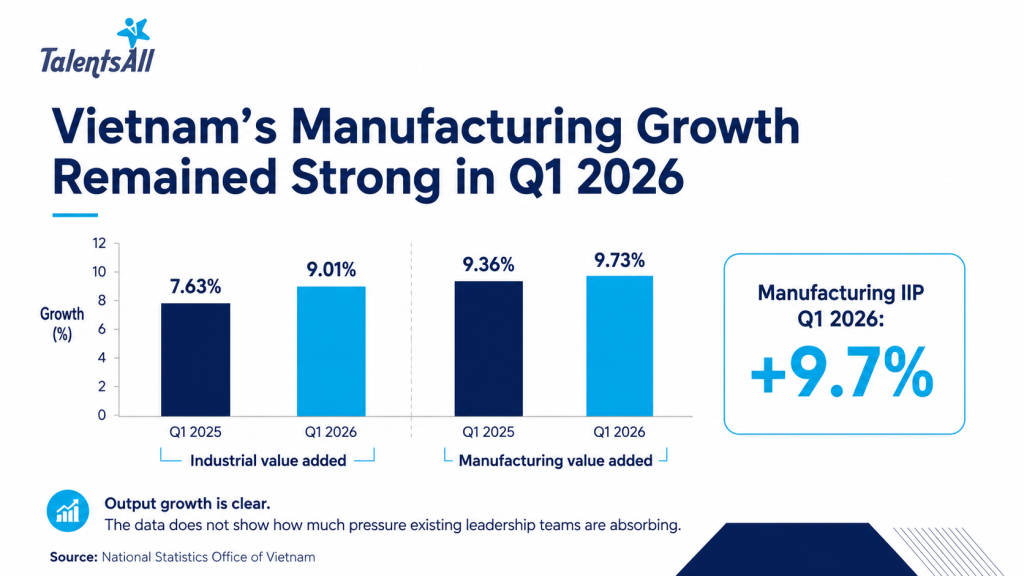
Vietnam’s manufacturing sector entered 2026 with strong momentum. Production increased, foreign investment remained active, and business conditions stayed in growth territory. In Q1 2026, industrial value added rose by 9.01 percent year on year, compared with 7.63 percent in Q1 2025. Manufacturing remained the main driver, growing by 9.73 percent.
The momentum continued after Q1. Vietnam’s Industrial Production Index rose by 10.8 percent in the first half of 2026. In June alone, industrial production increased by 12.7 percent year on year, while manufacturing and processing grew by 12.6 percent.
These figures support a positive outlook. However, growth does not make manufacturing hiring easier. Higher output often creates pressure before companies expand their formal structures. Existing leaders must manage more production, tighter deadlines, rising costs, supply risks, quality standards, and workforce issues. For the rest of 2026, manufacturers should ask not only whether they need more people, but whether their current leadership structure can support the next stage of growth.
2. Vietnam Manufacturing After Q1 2026: What the Data Shows
2.1 Industrial Production Confirms Real Growth
Vietnam’s industrial data shows that manufacturing growth is real. Manufacturing value added increased by 9.73 percent in Q1 2026, slightly above the 9.36 percent recorded a year earlier. The sector also contributed 32.52 percent to the increase in the economy’s total value added.
However, output data does not explain how companies create that growth. Some manufacturers expand by opening factories and adding production lines. Others increase output through existing facilities by improving efficiency, extending shifts, reducing downtime, or using more automation.
These two growth models create different hiring needs. A new factory may need a full leadership team. A mature plant may need only a few critical leaders who can remove bottlenecks and improve performance. In this case, higher output should lead to a review of leadership capacity rather than an automatic rise in headcount.
2.2 PMI Shows Growth, but Conditions Can Change Quickly
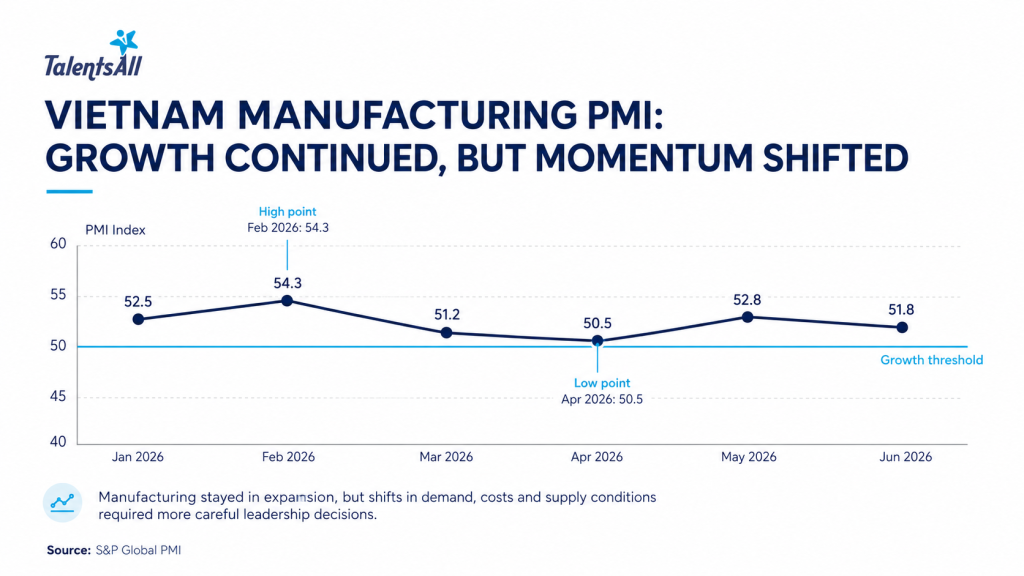
The Vietnam Manufacturing PMI stayed above the 50-point growth threshold during Q1 2026. It rose from 52.5 in January to 54.3 in February, showing stronger production, new orders, employment, and business confidence.
Conditions became less stable in March. The PMI fell to 51.2, its lowest level in six months. Output and new-order growth slowed, export orders declined, and manufacturers faced higher input costs and longer supplier delivery times.
This pattern matters for hiring. A company can see higher production while also facing weaker export demand, rising costs, and supply disruption. Leaders must make careful trade-offs across output, cost, quality, inventory, and workforce planning. Manufacturers therefore need more than additional management capacity. They need leaders who can connect decisions across several functions.
3. Why Growth Does Not Make Manufacturing Hiring Easier
3.1 Existing Teams Often Absorb Growth First
Manufacturers rarely add permanent headcount as soon as demand begins to rise. They usually try to use current resources first by improving productivity, changing shifts, combining responsibilities, or making greater use of existing equipment.
This can support growth for a time, but it also puts more pressure on current leaders. A Plant Manager may become the escalation point for too many decisions. Engineering teams may delay improvement projects because daily production issues take priority. Quality managers may spend more time fixing incidents than preventing them.
The company may still meet its targets, but its performance can become too dependent on a few people. By the time the business approves a new role, the need may already be urgent. Stronger companies identify these warning signs earlier and decide whether they need a new leader, better delegation, stronger succession, or a change in team structure.
3.2 Leadership Roles Now Cover More Business Areas
Plant Managers and Factory Directors no longer focus only on production. They must also manage cost, quality, customer needs, workforce stability, compliance, and communication with regional teams. Many also lead improvement programmes, support automation, and build future leadership pipelines.
Operations Director roles also vary widely. In one company, the position may cover production only. In another, it may include engineering, maintenance, quality, supply chain, or several sites. The same title can therefore describe very different jobs.
Engineering, quality, and supply-chain leaders also have broader business impact. Engineering leaders influence investment and automation. Quality leaders affect customer trust, audit results, and supplier status. Supply-chain leaders must balance cost, stock, and continuity. An outdated job description may match a candidate on paper but fail to reflect the real business need.
4. The Real Hiring Bottleneck Is Leadership Readiness
4.1 Experienced Candidates Are Not Always Ready for the Role
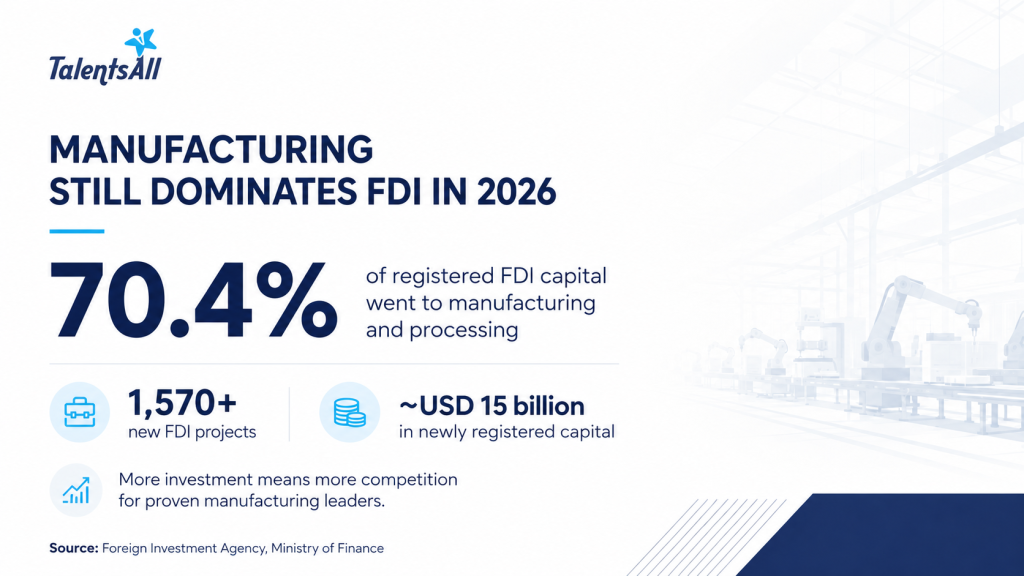
Foreign investment continues to expand Vietnam’s manufacturing base. In the first months of 2026, Vietnam recorded more than 1,570 new FDI projects, with close to USD 15 billion in newly registered capital. Manufacturing and processing received 70.4 percent of total registered capital.
This investment creates new factories, jobs, and supplier opportunities. It also increases competition for experienced leaders who understand Vietnam’s workforce, international quality systems, customer audits, and regional reporting.
Vietnam has many experienced manufacturing professionals. However, fewer candidates can enter a specific company and deliver results quickly. A candidate may have managed a large plant but lack regional exposure. Another may have strong technical skills but limited experience with budgets, people, or commercial risk. This is the difference between experienced candidates and leaders who are truly ready for the role.
4.2 Fit With the Current Business Stage Matters
Manufacturers in the same sector can face very different business challenges. A new plant may need to build teams and systems. A growing plant may need to stabilize output. A mature site may focus on cost, yield, automation, or local sourcing. Another company may need a turnaround.
Each stage requires a different type of leader. A greenfield leader must build quickly. A stabilization leader must improve discipline and reduce variation. An optimization leader must improve results without disrupting production. A transformation leader must change systems while keeping employees, customers, and regional teams aligned.
Hiring teams should therefore assess candidates based on the problems they have solved, not only the titles they have held. They should examine the candidate’s past environment, level of authority, key decisions, and measurable results.
5. Three Leadership Gaps to Review Before Hiring
5.1 Leadership Capacity Gap
A leadership capacity gap appears when the current team cannot manage the level of work and complexity. Decisions take longer, problems move upward too often, and senior leaders spend most of their time handling urgent issues.
Improvement projects may also lose momentum because daily operations take priority. The business can become too dependent on a few people who hold most of the knowledge and authority.
This does not always mean the company needs to replace a leader. It may need a stronger deputy, another functional head, or clearer ownership across the team. Adding another management layer without a clear diagnosis may not improve performance.
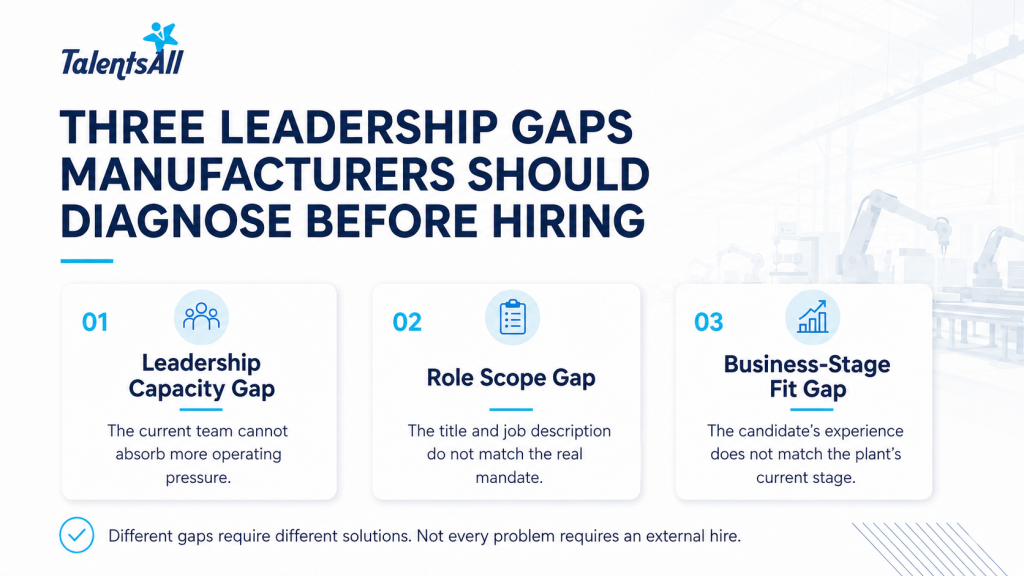
5.2 Role Scope Gap
A role scope gap appears when the job title no longer matches the company’s real need. A manufacturer may search for a Production Manager while expecting that person to lead plant-wide improvement, manage customer issues, coordinate engineering, and report to regional teams.
The market sees one role, while the business expects another. Senior candidates may view the title as too narrow, while other candidates may enter the process without the skills needed for the real mandate.
Before hiring, the company should define the business problem and the first-year goals. It should also clarify reporting lines, ownership, and decision rights.
5.3 Business-Stage Fit Gap
A business-stage fit gap appears when the candidate’s experience does not match the plant’s current needs. Two candidates may have the same title and years of experience but very different strengths.
One may know how to build a new operation. Another may know how to improve a mature factory. A third may have led a difficult turnaround. Each profile can create value, but they cannot solve the same problem.
The company should define its current stage before it defines the ideal candidate. This approach helps hiring teams judge experience more accurately and reduces their dependence on company names, factory size, or job titles.
6. Why Role Clarity Matters More Than Hiring Speed
6.1 Leaders Need Enough Authority to Deliver
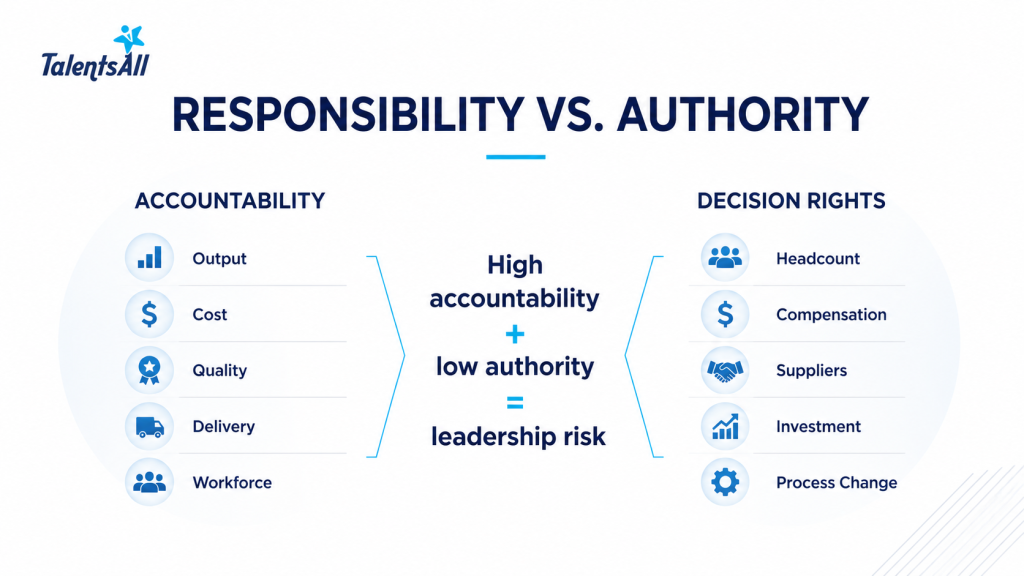
Hiring becomes risky when a leader has high accountability but limited authority. A local Plant Manager may own output, cost, quality, delivery, and employee turnover, while regional teams control headcount, pay, suppliers, investment, and major process changes.
Even a strong leader may struggle in this structure. The company may later blame the individual, although the real problem comes from the design of the role. Replacing the person without changing the structure can create the same result again.
Before starting a search, companies should define what the leader can decide, which decisions need approval, and who shares responsibility for each result. Hiring cannot fix an unclear operating model.
6.2 Local and Regional Teams Must Agree on the Role
Manufacturing searches often become difficult when local and regional leaders expect different things. Local teams may want faster decisions, stable staffing, and quick supplier action. Regional teams may focus on control, standards, reporting, and cost.
Both views can be reasonable. The problem starts when the company does not align them before interviews begin. Interviewers may then use different criteria, the role may change during the process, and the final candidate may enter a job with conflicting goals.
Local and regional teams should agree on the main business need, the role’s authority, and the first-year goals before they approach candidates. Faster hiring will not solve unclear expectations.
7. How Manufacturers Should Plan Leadership Hiring in 2026
7.1 Start With the Business Problem
Leadership hiring should start with the problem, not the title. The company should identify what is limiting performance, whether it involves production capacity, slow decisions, quality, engineering, supply risk, or workforce stability.
Each problem may require a different solution. The company may need an external hire, an internal promotion, better delegation, interim support, or a new team structure.
Recruitment should follow a clear diagnosis. Once the problem is clear, the business can define its current stage and identify the leadership experience that matters most.
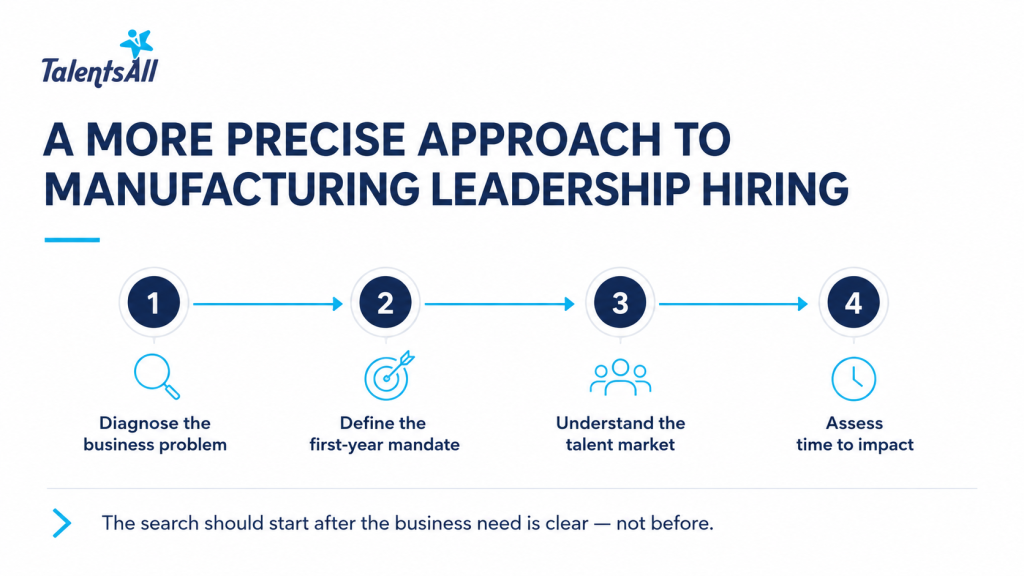
7.2 Define the First-Year Mandate
The company should state what the new leader must achieve in the first 12 months. It should define the role’s responsibilities, reporting lines, resources, and decision rights.
The goals must also match the business stage. A stabilization leader should not receive an aggressive expansion target. A transformation leader cannot change the business without enough resources and authority.
A clear mandate helps the company attract the right candidates. It also gives interviewers a common way to assess them and helps the new leader start with clearer expectations.
7.3 Understand the Market Before the Role Becomes Urgent
Market mapping helps companies understand who is available before they start a formal search. It can show which leaders have solved similar problems and where useful experience may exist in related sectors.
Companies can also see the trade-offs between technical skills, regional exposure, salary, location, and availability. This becomes more important as foreign investment increases competition for manufacturing leaders.
Strong candidates may have long notice periods, retention offers, or limited mobility. Early market insight helps companies set a more realistic profile and timeline before urgency shapes the process.
7.4 Focus on Time to Impact
Hiring teams should not assess candidates only on past roles. They should also ask how the candidate will create value in the new environment.
A strong candidate should explain how they would understand the operation, set priorities, align stakeholders, and balance output, cost, quality, and workforce needs.
The key question is not only whether the candidate has held the title before. It is whether that person can create relevant results within the first six to twelve months.
8. Conclusion: Growth Builds Confidence, Precision Builds Resilience
Vietnam’s manufacturing sector continued to grow after Q1 2026. Industrial production remained strong, manufacturing attracted most registered FDI, and business conditions stayed in growth territory.
The wider outlook remains positive, but risks remain. Manufacturing and exports will continue to support growth, while companies must also improve productivity, strengthen local supply links, and manage external pressure.
The main hiring challenge is not simply a lack of experienced people. It is the need to find leaders who fit the company’s current stage and can solve its real operating problems.
Stronger companies will act earlier. They will review leadership capacity, define the role, align local and regional expectations, and understand the external talent market before the need becomes urgent.
In a market shaped by both growth and change, hiring speed can support execution.
Precision protects performance.
TalentsAll – Connecting global talent with visionary companies to drive mutual success
For manufacturers reviewing critical plant, operations, engineering, quality or supply-chain leadership requirements, TalentsAll supports market mapping, role calibration and executive search aligned with the organization’s actual operating phase.
Email: trang@talentsall.com.vn
Website: TalentsAll
LinkedIn: TalentsAll