
Knowing when to use executive search is a critical decision for FDI companies hiring senior leaders in Vietnam. Consider a manufacturing company that has spent months recruiting a Plant Manager. Despite multiple interviews and candidate shortlists, its internal recruitment team has struggled to identify someone with the right combination of operational leadership, industry expertise and international experience.
Should the company continue recruiting internally or engage an Executive Search partner? The answer depends on talent availability, recruitment complexity and the business impact of a prolonged vacancy. For HR Directors and Country Managers, understanding these factors is essential to choosing the most effective hiring approach.
1. Why Choosing Between Internal Recruitment and Executive Search Matters
Internal recruitment teams play an essential role in workforce planning and talent acquisition. They understand the company’s organizational structure, hiring priorities and internal stakeholders, making them well positioned to manage many recruitment needs.
However, some leadership positions require capabilities beyond standard sourcing and recruitment processes. Companies may need to access passive candidates, conduct confidential outreach or evaluate leadership experience across unfamiliar industries.
The challenge is determining whether the existing recruitment approach can deliver the necessary market access, assessment depth and execution capacity.
1.1. The Business Impact of an Unfilled Leadership Position
Consider an FDI manufacturer preparing to expand production capacity. Without a suitable Plant Manager, responsibilities may be distributed among existing department heads, creating gaps in operational coordination and management accountability. Decisions involving productivity, quality, maintenance and workforce planning may become slower or more fragmented.
The financial impact of a leadership vacancy extends beyond recruitment expenses. Companies should consider whether prolonged vacancies could affect operational stability, expansion timelines or strategic execution. The greater the business impact, the more important it becomes to evaluate whether the current recruitment model is adequate.
1.2. Why Seniority Alone Should Not Determine the Recruitment Model
Not every Director-level position requires external Executive Search. A company with a strong succession pipeline or an experienced internal Talent Acquisition team may already have the resources needed to identify and assess suitable candidates. In such cases, external recruitment could duplicate existing capabilities without creating sufficient additional value.
Conversely, a specialized Engineering Manager or Plant Controller position may require targeted market research if the available talent pool is particularly narrow. The deciding factor should be the complexity and criticality of the hiring mandate, rather than the seniority of the job title alone.
For a broader comparison of recruitment operating models, see TalentsAll’s guide to In-house Recruitment vs RPO vs Executive Search.
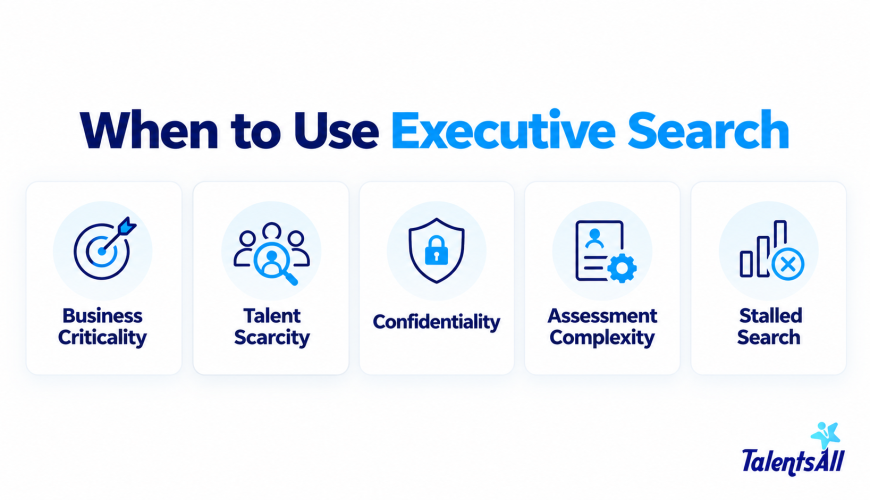
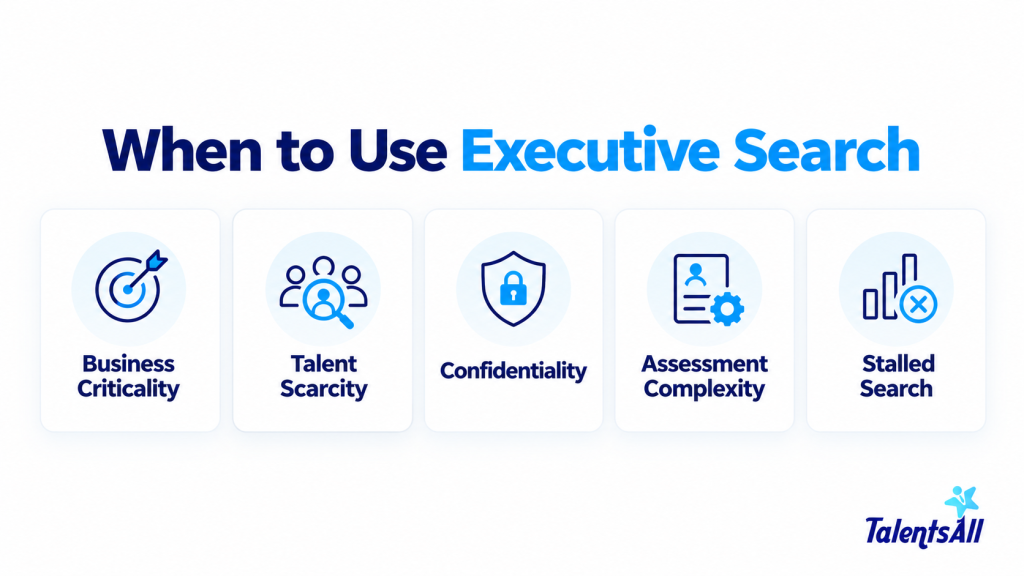
2. Five Signals That an FDI Company Should Consider Executive Search
The decision to engage an Executive Search partner should begin with a clear understanding of the challenges facing the internal recruitment team. Certain hiring situations require broader market access, greater confidentiality or specialized leadership assessment.
The following five signals can help HR leaders and business executives determine when external search expertise may provide meaningful value.
2.1. The Position Has a Direct Impact on Business Continuity
Some leadership appointments influence business performance far beyond the recruitment function. A Finance Director may be responsible for financial governance during expansion, while a Plant Manager may oversee production stability and cross-functional operations. When these positions remain vacant, important decisions may be delayed or transferred to managers whose responsibilities are already extensive.
Executive Search deserves consideration when a vacancy creates significant operational exposure or when an unsuccessful appointment could affect business continuity. However, criticality alone does not establish the need for external support. Companies should also evaluate whether their internal recruitment team can access and assess the required leadership talent.
2.2. The Relevant Candidate Pool Is Narrow or Difficult to Reach
An FDI manufacturer may require a Plant Manager with experience in automated production, cost control, multinational reporting and cross-functional leadership. Candidates with this combination of capabilities may already occupy stable senior positions and have limited interest in actively searching for new opportunities.
Traditional job advertising may therefore produce applications without reaching the most relevant professionals. A targeted Executive Search process can help identify potential candidates across competing or adjacent industries, engage passive talent and evaluate how closely their experience matches the business requirements. As outlined by the Association of Executive Search and Leadership Consultants (AESC), specialized search firms contribute through market access, research and leadership assessment.
2.3. The Recruitment Process Requires Confidentiality
Confidentiality becomes especially important during leadership replacement, organizational restructuring or sensitive expansion plans. Publicly advertising a senior vacancy may create uncertainty among employees, customers or business partners before the organization is ready to communicate its decision.
An external Executive Search partner can support discreet market engagement through controlled outreach and structured candidate communication. Nevertheless, confidentiality requires clear governance from both parties. Employers should define who can access sensitive information, when the company’s identity may be disclosed and how candidate information will be protected throughout the process.
2.4. The Role Requires Complex Leadership Assessment
A strong professional track record does not always demonstrate readiness for a different leadership mandate. For instance, a Production Manager who consistently achieves operational targets may have limited experience managing factory-wide financial performance, long-term investment decisions or relationships with regional headquarters.
Leadership assessment should therefore examine the scope of responsibility behind each achievement. Executive Search can support this evaluation by investigating decision-making authority, organizational complexity and business outcomes. For FDI companies, this may also involve assessing a candidate’s ability to balance local operational requirements with multinational governance standards.
2.5. Internal Recruitment Efforts Have Stalled Without Clear Market Evidence
A recruitment process may continue for months without producing a suitable shortlist. Reposting vacancies or increasing sourcing activities can generate more applications, but these measures may have limited impact if the underlying problem remains unclear.
Before changing recruitment providers, HR leaders should investigate whether the difficulties arise from talent scarcity, compensation expectations, restrictive job requirements or misalignment among decision-makers. Executive Search may provide value through talent mapping and structured market feedback. However, if the primary obstacle is an unrealistic hiring mandate or slow internal approvals, engaging an external partner alone is unlikely to resolve the issue.
3. When Should Internal Recruitment Remain the Preferred Approach?
Executive Search represents an additional investment and should address a clearly defined recruitment challenge. For many organizations, internal recruitment remains the most effective approach when the talent market is accessible and the company has sufficient recruitment capabilities.
Before engaging an external partner, employers should examine whether their existing processes can reasonably deliver the desired outcome.
3.1. The Company Has Access to a Strong Candidate Pipeline
When a company has identified qualified internal successors or maintains relationships with relevant external candidates, its recruitment team may be able to manage the process independently. Existing market knowledge and candidate relationships can reduce the need for additional search resources.
This approach is particularly appropriate when recruiters understand the position, have access to suitable talent and can conduct the necessary assessments. External search should contribute capabilities that the organization genuinely lacks.
3.2. The Role and Recruitment Requirements Are Well Defined
Internal recruitment generally works well for positions with established responsibilities, realistic compensation ranges and identifiable talent pools. When hiring managers agree on the required capabilities and the recruitment team has relevant industry experience, the organization may already possess the conditions for an effective search.
In these circumstances, engaging an external provider should be based on a specific requirement, such as additional market coverage or specialist assessment. A clearly defined role does not automatically justify outsourcing the search.
3.3. The Main Constraint Is Internal Decision-Making
Recruitment delays are sometimes attributed to candidate shortages when the actual problem lies within the organization. A Regional HR team may prioritize international reporting experience, while the local Managing Director places greater emphasis on operational execution. If these expectations remain unresolved, recruiters may repeatedly present candidates who satisfy one stakeholder but fail to convince another.
Changing recruitment providers will have limited impact until the organization agrees on its hiring criteria and decision-making responsibilities. Companies should first establish alignment on the role’s objectives, compensation, reporting structure and approval process.
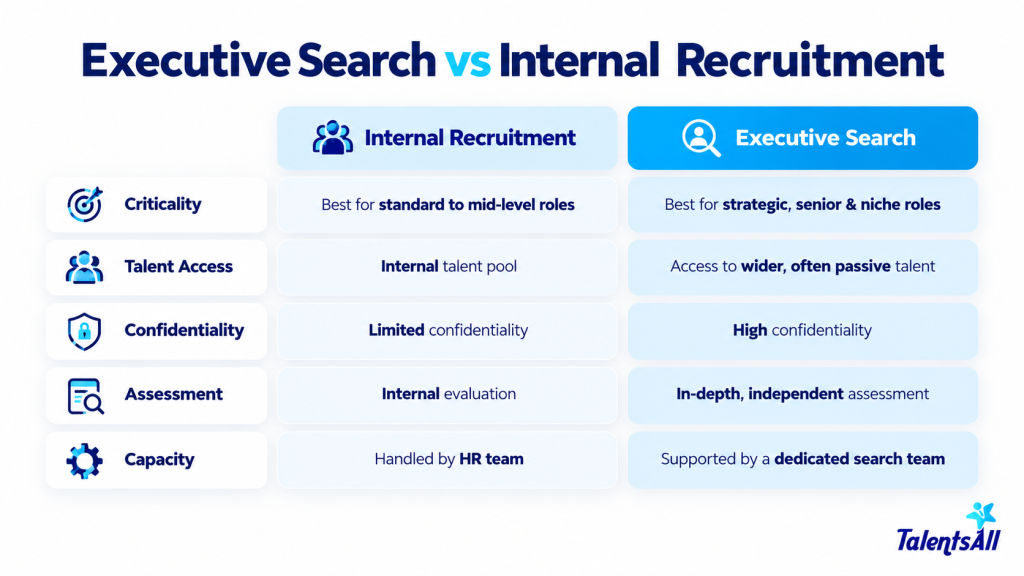
4. Executive Search or Internal Recruitment? A Practical Decision Framework
For HR Directors and Country Managers, the choice becomes clearer when recruitment options are evaluated against the requirements of a specific leadership vacancy.
The following framework provides a practical starting point for discussions between internal HR, hiring managers and regional stakeholders.
| Decision Factor | Internal Recruitment May Be Sufficient When… | Executive Search Deserves Consideration When… |
|---|---|---|
| Business Criticality | Responsibilities can be managed during the vacancy. | The vacancy or an unsuitable appointment could materially disrupt operations. |
| Talent Availability | Qualified candidates are accessible through existing recruitment channels. | The talent pool is narrow, passive or difficult to reach. |
| Confidentiality | The vacancy can be publicly communicated. | The search requires discreet outreach and restricted disclosure. |
| Assessment Complexity | Internal teams have sufficient expertise to assess candidates. | Specialized leadership or cross-functional assessment is required. |
| Recruitment Capacity | Internal recruiters can dedicate adequate time and resources. | The assignment requires dedicated research and extensive market engagement. |
| Stakeholder Alignment | Decision-makers share clear evaluation criteria. | The mandate requires clarification before either recruitment model can succeed. |
This framework is intended to support business judgment rather than generate a numerical score. An organization does not need to meet every condition before considering Executive Search. One significant confidentiality requirement or operational risk may justify additional support.
However, the decision should always be connected to a specific recruitment challenge and the additional value an external partner can provide.
4.1. Example: Hiring a Plant Manager for an Expanding FDI Factory
Consider a hypothetical electronics manufacturer expanding its operations in Vietnam. The company requires a Plant Manager with responsibility for production, engineering, quality and operational improvement, alongside regular reporting to regional leadership. Its internal recruiters have identified several experienced Production Managers, but few candidates have managed complete factory operations.
The first decision is whether the role genuinely requires an established Plant Manager or whether a strong Production Manager could develop into the position. If full-site leadership experience is essential, external market mapping may help identify qualified candidates beyond the current pipeline. If the company can accommodate a development pathway, revising the mandate may create additional options. Executive Search can support both approaches, provided the business has defined which capabilities are essential and which trade-offs are acceptable.
5. What Should an FDI Company Prepare Before Engaging Executive Search?
Once external search appears appropriate, preparation becomes essential. A well-defined hiring mandate allows both the employer and the search partner to assess the same requirements, communicate consistently with candidates and make informed decisions.
Before launching the assignment, organizations should establish agreement on five elements.
5.1. Business Outcomes and Success Criteria
Start by defining what the new leader must achieve during the first 12–18 months. For a Plant Manager, this might involve improving operational stability, strengthening quality performance or building a more capable management team. These outcomes provide a stronger basis for candidate assessment than an extensive list of generic competencies.
The organization should also determine how success will be evaluated and which responsibilities the new leader will have authority to influence. Clear expectations allow the search partner to distinguish relevant achievements from experience that appears impressive but may not translate into the new environment.
5.2. Essential Requirements and Acceptable Trade-offs
Hiring teams should separate essential qualifications from preferred experience. A company may seek candidates with the same industry background, multinational experience, strong technical knowledge and exposure to regional reporting. Requiring every characteristic simultaneously may significantly restrict the available talent pool.
A more effective approach is to identify which capabilities are necessary from the first day and which can be developed or transferred from adjacent industries. These distinctions help search consultants evaluate candidates beyond rigid job descriptions while maintaining the employer’s core requirements.
5.3. Compensation and Decision Authority
Before approaching senior candidates, employers should confirm the approved compensation framework, reporting relationships and scope of authority. For multinational organizations, the process may require coordination between local management and regional headquarters, particularly when compensation packages or hiring decisions exceed local approval limits.
Uncertainty at this stage can weaken candidate engagement and delay negotiations. If market feedback suggests that the approved compensation does not match the required capabilities, the organization should review the trade-offs early rather than wait until the final offer.
5.4. Stakeholder Alignment and Interview Governance
Senior recruitment processes often involve multiple decision-makers, including HR, functional leaders, Country Managers and regional executives. Each stakeholder may evaluate candidates against different expectations, creating the risk of inconsistent feedback or prolonged decision cycles.
Before launching the search, the company should establish who owns the hiring decision, how candidates will be assessed and when feedback is required. Clear governance helps the search partner manage candidate expectations and prevents avoidable delays during critical stages.
5.5. Search Scope and Confidentiality Requirements
The search mandate should identify the target industries, geographic coverage, relevant competitor organizations and any restrictions on candidate outreach. Confidential assignments also require explicit guidance on information disclosure, candidate data handling and communication with internal stakeholders.
Employers should agree on expected deliverables, reporting frequency and responsibilities throughout the process. These arrangements create accountability and establish a shared understanding of how the search will be managed.
6. How Should Internal HR and an Executive Search Partner Work Together?
For many FDI companies, an effective approach combines internal organizational knowledge with external market expertise.
Internal HR should remain responsible for stakeholder alignment, business requirements and final hiring decisions. The Executive Search partner can contribute targeted market research, access to passive candidates, structured outreach and independent assessment support.
A clear division of responsibilities helps both parties operate efficiently.
| Responsibility | Internal HR / Business | Executive Search Partner |
|---|---|---|
| Define business outcomes | Own and approve | Challenge and refine |
| Identify target talent markets | Provide business context | Research and recommend |
| Candidate outreach | Coordinate employer requirements | Lead agreed external outreach |
| Candidate assessment | Evaluate organizational fit | Provide evidence-based assessment |
| Search progress | Review findings and make decisions | Report market signals and recommend adjustments |
| Final hiring decision | Retain decision authority | Advise and support |
6.1. Why Market Feedback Matters as Much as Candidate Shortlists
A useful Executive Search engagement should provide insight into the market throughout the assignment. This may include how qualified candidates perceive the opportunity, which requirements restrict the talent pool and whether compensation or location creates barriers to engagement.
Such information allows employers to make evidence-informed adjustments before the search becomes prolonged. For example, repeated candidate concerns about decision-making authority may suggest that the position’s responsibilities need clarification, while consistent compensation objections may indicate a mismatch between the mandate and market expectations.
6.2. What Employers Should Expect From Search Progress Reports
Progress reports should explain what the search team has learned and what decisions are needed from the employer. Beyond the number of candidates contacted or CVs submitted, useful reporting may include target companies approached, candidate response patterns, rejection reasons and recommendations for refining the search strategy.
The value of these updates depends on whether they help decision-makers act. A report showing substantial outreach but limited candidate interest should prompt a discussion about possible barriers rather than simply extending the search without changing the approach.
7. Making the Right Executive Search Decision
The choice between internal recruitment and Executive Search should begin with a clear review of the hiring mandate.
For HR Directors and business leaders, three questions are particularly useful:
- Can our internal recruitment team access and assess the talent required for this position?
- What business risks could arise from a prolonged vacancy or an unsuitable appointment?
- What additional capabilities would an external Executive Search partner contribute?
If the internal team can address these requirements effectively, maintaining an internal process may be the appropriate decision. When the role involves scarce leadership capabilities, confidential market engagement or complex assessment needs, Executive Search deserves consideration.
For FDI and multinational organizations operating in Vietnam, the most suitable recruitment approach is the one aligned with business priorities, available resources and decision-making requirements.
TalentsAll supports organizations through Executive Search and Headhunting services, focusing on senior leadership and specialized positions across multiple industries.
For business-critical or confidential leadership appointments, contact TalentsAll to discuss the hiring mandate and explore an appropriate search strategy.
Frequently Asked Questions
Is Executive Search necessary for every senior management position?
No. Companies should evaluate the importance of the position, candidate accessibility, assessment requirements and available internal recruitment capabilities. A senior title alone does not establish the need for external search.
Should an FDI company engage Executive Search after an unsuccessful internal search?
An unsuccessful internal search should trigger a review of the underlying causes. External search may help when the problem involves limited market access or specialized assessment needs, but it may offer limited value if the hiring requirements or internal approval process remain unclear.
Can internal Talent Acquisition teams work alongside Executive Search firms?
Yes. Internal teams can retain ownership of business requirements, stakeholder alignment and hiring decisions while external partners support talent mapping, candidate engagement and structured assessment. Both parties should agree on responsibilities at the beginning of the assignment.
Does Executive Search guarantee a successful leadership appointment?
No recruitment approach can guarantee a successful appointment. Executive Search can strengthen market coverage, candidate evaluation and hiring intelligence, while the final result also depends on employer expectations, decision-making and offer competitiveness.
Connect With TalentsAll
TalentsAll connects organizations with experienced professionals through Executive Search, Headhunting and specialized recruitment solutions in Vietnam.
For professionals: Explore senior-level career opportunities at TalentsAll Careers.
Stay connected: Follow TalentsAll Global on LinkedIn for hiring insights, market perspectives and career updates.
Talents for All, All for Talents.