
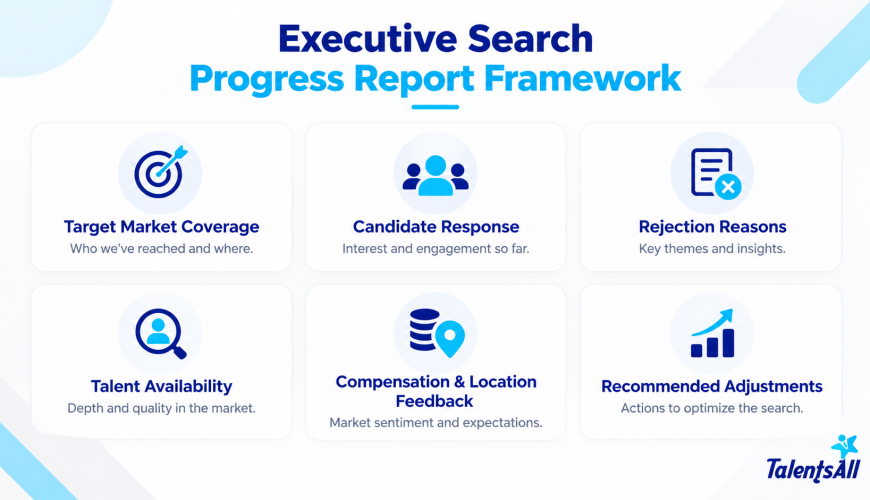
Executive Search Progress should be measured by more than the number of CVs submitted. Employers need visibility into market coverage, candidate response, rejection reasons, talent availability and any signals that may affect the hiring mandate.
A weekly update that only says “No new CVs this week” gives very little information about the actual search.
For senior or hard-to-fill hiring, the better question is:
“What has the Executive Search Progress taught us about the market so far?”
A useful update should therefore connect search activity with market feedback and the decisions the employer may need to make next.
1. What Does Executive Search Progress Really Mean?
Executive Search Progress shows how far the search has moved through the relevant talent market, how candidates are responding and whether the original hiring assumptions remain realistic.
Progress can include sourcing activity, candidate conversations and shortlist development. However, a strong update should also explain what the agency has learned from the market. This gives the employer more context than candidate numbers alone.
For senior hiring, meaningful Executive Search Progress can happen before a final shortlist appears. Candidate conversations may already reveal important information about availability, compensation or role attractiveness.
1.1. Executive Search Progress Is More Than a CV Update
Executive Search Progress should explain what is happening behind the candidate profiles rather than simply counting submitted CVs.
An agency may contact several qualified professionals without presenting any of them. Some may reject the opportunity because of location, while others may see the scope as too broad. Compensation or reporting lines may also reduce interest.
Although no CV has been submitted, the search has still produced useful market evidence. A good report captures those signals and explains what they mean for the mandate.
1.2. Executive Search Progress Should Support Hiring Decisions
The purpose of Executive Search Progress reporting is not only to describe activity. It should help the employer decide whether the current search strategy still makes sense.
If market response remains positive, the search can continue without major changes. However, repeated feedback around compensation, location or candidate profile may justify a deeper review. This makes progress reporting part of the hiring decision process rather than an administrative update.
TalentsAll has also explained how Executive Talent Mapping in Vietnam can help employers understand candidate availability and market constraints.
2. Why Does CV Volume Not Show the Full Executive Search Progress?
CV volume is one visible output, but it does not show the full Executive Search Progress or explain how deeply the agency has explored the relevant talent market.
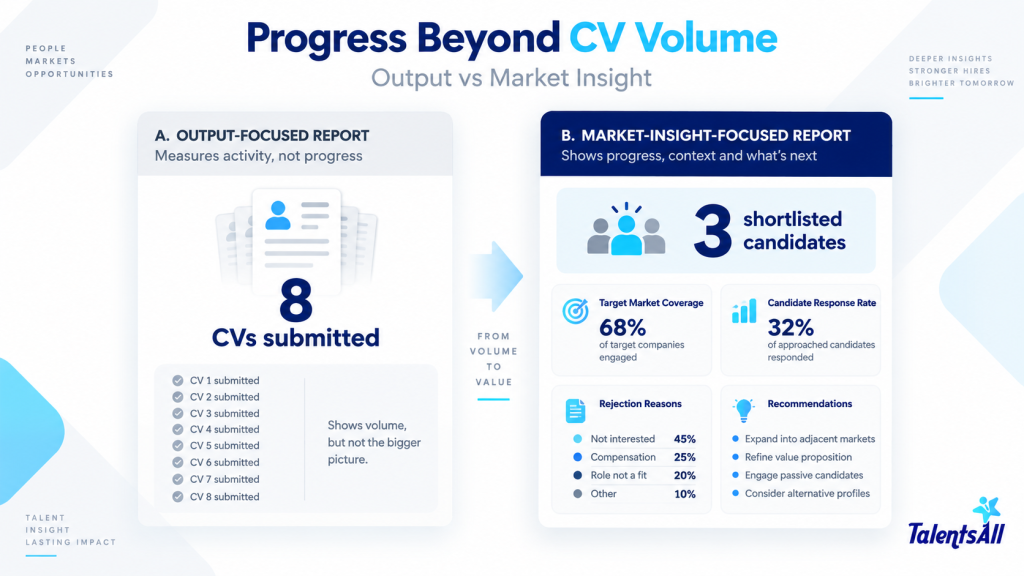
Consider two search assignments after several weeks. Agency A has submitted eight CVs. Agency B has submitted three.
At first glance, Agency A appears to be progressing faster. However, the number does not reveal whether those eight candidates match the actual mandate.
Agency B may have explored a narrower but more relevant market. Its update may also explain why qualified professionals declined and which parts of the brief are limiting candidate interest.
Neither approach is automatically better. The point is that CV count alone cannot measure Executive Search Progress accurately.
2.1. High CV Volume Can Hide Weak Search Quality
A high number of submitted profiles does not necessarily mean the search is reaching the right talent market.
Some candidates may meet basic requirements but lack the leadership scope, business exposure or decision authority required by the role. In other cases, several profiles may come from the same accessible candidate pool while harder-to-reach professionals remain unexplored.
Employers should therefore assess relevance alongside volume.
2.2. A Small Shortlist Can Still Show Strong Executive Search Progress
A smaller shortlist can still represent strong Executive Search Progress when the agency can explain how the market was explored and why other profiles were not recommended.
Senior hiring often involves a limited number of realistic candidates. A targeted search may therefore produce fewer profiles than a high-volume recruitment process.
The important question is whether the agency can show the logic behind that shortlist. Market coverage, candidate response and rejection patterns provide much more useful context.
3. What Should an Executive Search Progress Report Include?
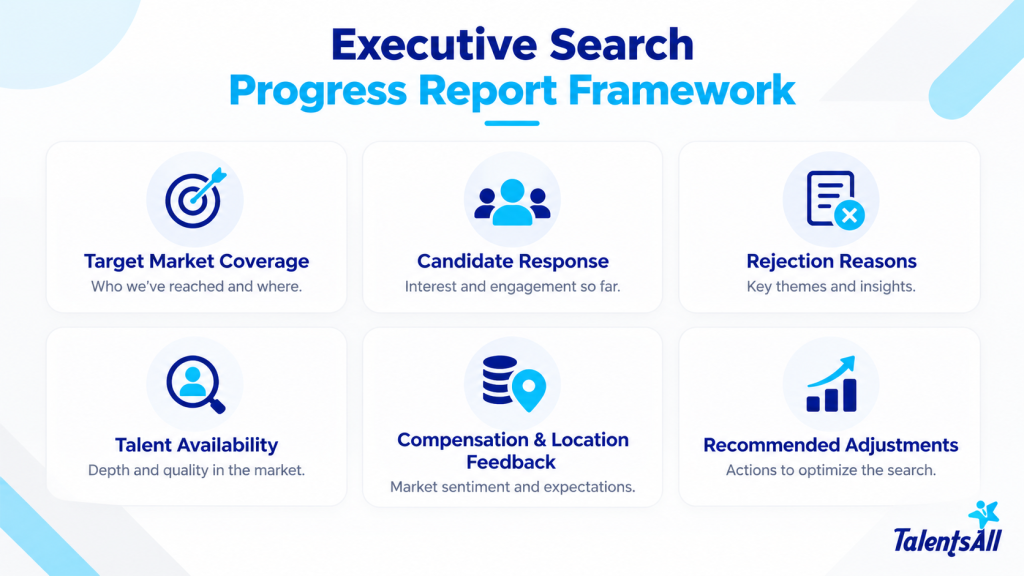
An Executive Search Progress report should cover six areas: target-market coverage, candidate response, rejection reasons, talent availability, compensation or location feedback and recommended adjustments.
Together, these areas explain both what the agency has done and what the talent market is saying.
3.1. Target Companies Approached
Target-company coverage helps employers understand how much of the relevant talent market has already been explored.
For a senior manufacturing role, the search may begin with direct competitors and later expand into adjacent sectors. Another mandate may require companies with similar customers, operating scale or business models.
The objective is not to create the longest company list. The employer needs enough visibility to understand where the search has focused and which parts of the market remain unexplored.
3.2. Candidate Response
Candidate response shows whether the opportunity is generating interest among the intended talent pool.
A progress report may explain how many relevant professionals were approached, how many responded and how many agreed to further conversations. However, the numbers are more useful when the agency also explains the pattern behind them.
Low response can point to timing or employer visibility. Strong response but weak interview conversion may suggest a different issue with the mandate.
3.3. Rejection Reasons
Candidate rejection reasons help explain why Executive Search Progress may slow even when the agency is reaching relevant professionals.
Some candidates may decline because of compensation, while others may be concerned about location or reporting lines. Role scope and timing can also affect passive candidates.
One rejection rarely justifies changing the brief. However, the same concern appearing across several suitable candidates becomes a meaningful market signal.
3.4. Talent Availability
Talent availability shows whether the target candidate profile exists in sufficient numbers within the defined market.
A role may combine several reasonable requirements that become restrictive when applied together. Direct-industry experience, regional exposure, technical knowledge and willingness to relocate can reduce the available pool significantly.
The agency should help distinguish between a difficult search and an unnecessarily narrow profile. This gives the employer a stronger basis for deciding which criteria are essential.
3.5. Compensation and Location Feedback
Compensation and location feedback can explain why Executive Search Progress is slower than expected even when suitable professionals exist.
Repeated compensation concerns may suggest a gap between the approved package and candidate expectations. Likewise, a factory location may reduce the available talent pool even when the role itself is attractive.
These signals should not automatically trigger a salary increase or location change. Instead, they show the trade-offs involved in keeping the original mandate.
3.6. Recommended Adjustments
A strong Executive Search Progress report should turn repeated market feedback into practical recommendations when the search begins to stall.
If the talent pool is too narrow, the agency may recommend adjacent industries. If compensation repeatedly blocks candidate progression, the employer may need to review the package.
The recommendation should always connect back to evidence from the search. This is what separates useful recruitment advice from a simple activity update.
4. How Often Should Employers Review Executive Search Progress?
Employers should review Executive Search Progress often enough to identify meaningful changes, but reporting frequency should not become more important than reporting quality.
A frequent update can still provide little value when it repeats the same information. Conversely, waiting too long can prevent the employer from responding when the market reveals an important constraint.
The appropriate cadence depends on the assignment, urgency and search stage.
4.1. Early Executive Search Progress Should Focus on Market Validation
Early Executive Search Progress should help confirm whether the target market and original hiring assumptions are realistic.
At this stage, the employer needs visibility into target-company coverage, candidate response and early rejection reasons. These signals can quickly show whether the role is positioned effectively.
A small number of submitted profiles is not necessarily a concern during this stage. Market validation can be more valuable than immediate CV volume.
4.2. Later Executive Search Progress Should Focus on Candidate Movement
As suitable profiles emerge, Executive Search Progress should increasingly focus on candidate engagement, interviews and risks that could affect closing.
Candidate motivation may change as the process continues. Concerns about compensation, reporting relationships or decision authority can also become clearer.
The reporting emphasis should therefore move with the search. Early reporting tests the market, while later reporting helps manage candidate progression.
5. What Does Weak Executive Search Progress Reporting Look Like?
Weak Executive Search Progress reporting usually describes activity without helping the employer understand search quality, market response or the next decision.
A short report is not necessarily weak. Concise reporting can still be useful when it explains what changed and why it matters.
The problem begins when the employer repeatedly receives the same vague information without market evidence.
5.1. “We Are Still Searching” Without Market Evidence
A repeated statement that the agency is “still searching” does not demonstrate meaningful Executive Search Progress.
The employer should know which talent pools have been explored and how relevant professionals responded. If no candidates have progressed, there should also be some explanation of why.
Without this context, it becomes difficult to distinguish market scarcity from weak search execution.
5.2. Executive Search Progress Looks the Same Every Week
Repeated reports with no new insight may suggest that the search is not adapting as market information becomes available.
Senior search rarely develops in a perfectly linear way. Candidate conversations should gradually reveal more about talent availability, motivation and expectations.
If every update repeats the same activity, employers may need to ask how the search strategy is evolving.
5.3. Candidate Rejections Are Reported Without Explanation
A rejection becomes more useful when the agency explains whether it reflects an individual preference or a broader pattern affecting Executive Search Progress.
One candidate may decline for personal reasons. Several relevant candidates raising the same compensation concern is different.
A strong recruitment partner should help identify that pattern rather than report only the outcome.
5.4. No Recommendation Appears When Executive Search Progress Stalls
When Executive Search Progress repeatedly encounters the same constraint, the report should help employers evaluate possible adjustments.
This does not mean changing the brief after every rejection. Premature changes can weaken the mandate.
However, once enough evidence appears, the employer should understand the available choices and their trade-offs.
6. When Should Executive Search Progress Trigger Recalibration?
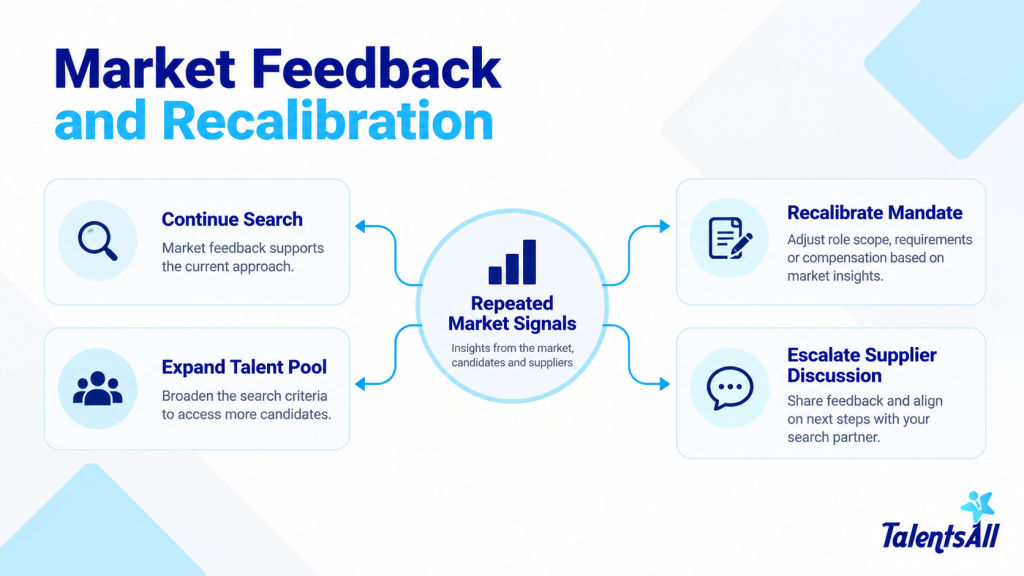
Executive Search Progress should trigger recalibration when consistent market evidence shows that the original hiring assumptions are materially limiting access to suitable candidates.
A difficult search does not automatically mean the brief is wrong. Senior candidates can take longer to identify and engage.
The key signal is repetition. When several relevant professionals respond in similar ways, the employer has stronger evidence that part of the mandate deserves review.
6.1. When the Target Candidate Profile Is Too Narrow
Executive Search Progress may slow when several requirements combine to create an unnecessarily small talent pool.
An employer may require direct competitor experience, a specific technical background and experience at a particular business scale. Each criterion can be reasonable, but together they may exclude capable adjacent profiles.
The agency can help identify which requirements are essential to performance and which can be broadened.
6.2. When Compensation or Location Limits Executive Search Progress
Repeated compensation or mobility concerns may justify a review when they appear across otherwise suitable candidates.
The employer does not always need to change the package. It may choose to maintain the conditions and accept a smaller pool.
However, that decision should be made with clear visibility into the market trade-off.
6.3. When the Market Interprets the Role Differently
Executive Search Progress can expose a gap between how the employer defines a role and how candidates perceive it.
A job title may create one expectation while the responsibilities create another. Reporting lines, decision authority and transformation expectations can also change how senior professionals assess the opportunity.
This feedback can help improve how the mandate is positioned without changing the underlying business need.
6.4. Executive Search Progress Recalibration Should Be Evidence-Based
Recalibration should use evidence from Executive Search Progress rather than simply lowering hiring standards because a role is difficult.
Some requirements remain essential because they directly affect job performance. Others may be broadened when the search shows that comparable capability exists elsewhere.
A useful report helps employers distinguish between those two categories.
7. How TalentsAll Approaches Executive Search Progress
TalentsAll views Executive Search Progress as a combination of candidate movement, market response and practical hiring insight.
For senior and hard-to-fill assignments, the search itself can reveal important information about candidate availability and market expectations. These signals become more valuable when employers can connect them to decisions around the brief.
The objective is therefore not simply to report how many profiles have been presented. Executive Search Progress should help employers understand whether the relevant talent market is responding as expected.
TalentsAll’s Executive Search process in Vietnam provides more context on sourcing, market mapping, candidate assessment and shortlist development.
Hiring a senior or hard-to-fill role? Discuss your mandate with TalentsAll to understand the talent market, search approach and how Executive Search Progress can be evaluated throughout the assignment.
8. Frequently Asked Questions About Executive Search Progress
The questions below address common employer concerns about monitoring Executive Search Progress during a senior hiring assignment.
8.1. How Often Should Employers Review Executive Search Progress?
Employers should review Executive Search Progress often enough to identify meaningful changes in candidate response and market conditions.
The exact cadence depends on the assignment. However, both sides should agree on how important market feedback and candidate movement will be communicated.
8.2. How Many Candidates Indicate Good Executive Search Progress?
There is no fixed number of candidates that automatically indicates strong Executive Search Progress.
For some senior roles, a small number of well-assessed candidates can be more valuable than a long list of loosely matched profiles.
Employers should focus on relevance, assessment quality and the rationale behind each recommendation.
8.3. What If Executive Search Progress Is Slow?
Slow Executive Search Progress does not automatically mean the agency is underperforming.
Employers should first understand how much of the market has been explored, how relevant candidates are responding and what is limiting progression.
A difficult talent market and weak search execution are two different problems.
8.4. Should Employers Change the Brief Based on Executive Search Progress?
The brief should be reconsidered when repeated Executive Search Progress data shows that one part of the mandate is materially restricting the search.
However, the employer should not remove essential requirements simply to increase candidate volume.
The objective is to use market evidence to distinguish essential capabilities from assumptions that can reasonably be adjusted.
8.5. Is High CV Volume a Sign of Strong Executive Search Progress?
Not necessarily. Executive Search Progress cannot be judged only by the number of CVs submitted.
Employers should also examine profile relevance, target-market coverage, candidate response and what the agency has learned through the search.
8.6. When Does Executive Search Progress Become a Supplier Performance Issue?
Executive Search Progress becomes more concerning when the agency cannot explain the market, repeatedly provides the same update or fails to adapt despite consistent evidence.
Before changing suppliers, employers should identify whether the main constraint comes from the mandate, market conditions or search execution.
TalentsAll | Talents for All, All for Talents
Explore TalentsAll Recruitment Services.
Learn more about Executive Talent Mapping in Vietnam.
Read TalentsAll’s Executive Search Process in Vietnam.
Follow recruitment and Vietnam talent-market updates on TalentsAll LinkedIn.