
In the fast-paced environment of Multinational Corporations (MNCs) and Foreign Direct Investment (FDI) companies, your most valuable asset isn’t just your hard work—it’s how you communicate your value. Many high-performing professionals struggle because they bury their best ideas under mountains of context. To get through to C-level executives, you must master the art of effective communication.
The gold standard for this is the Pyramid Principle. Developed by Barbara Minto at McKinsey & Company, this framework ensures your message is heard, understood, and acted upon by the most time-pressed leaders.
1. The Executive Reality: Why Brevity is Mandatory
To practice effective communication, you first need to understand the “C-level perspective.” Senior leaders are “Time Poor.” Their calendars are often triple-booked, and their mental bandwidth is a premium resource.
- Result-Oriented Thinking: Executives care about the “What” and the “So What?” long before they care about the “How.”
- Decision Fatigue: They don’t want to join you on a journey of discovery; they want you to provide the destination so they can decide whether to proceed.
In an MNC setting, being direct is not perceived as being blunt—it is perceived as being efficient and professional.
Read More: Hard Work and Diligence Alone Are Not Enough to Pass into MNCs

2. Deep Dive into the Pyramid Principle Structure
The Pyramid Principle flips traditional storytelling on its head. Instead of building up to a conclusion, you start with it.
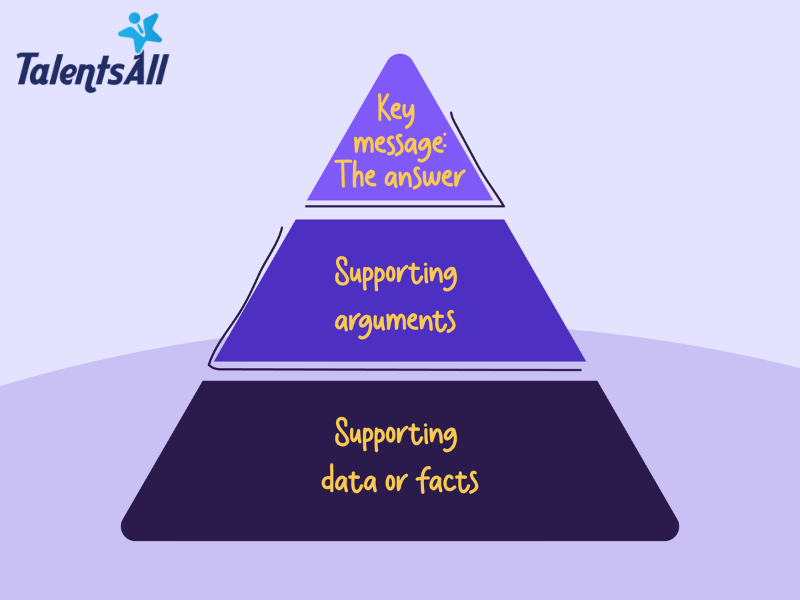
2.1. The Peak: Answer First
The most critical step in effective communication is leading with your conclusion. Within the first 10 seconds, the executive should know exactly what you are proposing or reporting.
- Traditional Approach: “We looked at the market, analyzed the competitors, and realized that our ROI is dipping, so we think we should…” (The executive has already checked their watch).
- Pyramid Approach: “We should shift 20% of our Q3 budget to Semiconductor recruitment content to capture the current market surge.”
2.2. The Body: Key Arguments (The MECE Rule)
Once you provide the answer, the leader will naturally ask “Why?” You should provide 3–4 logical pillars to support your conclusion. These must be MECE (Mutually Exclusive, Collectively Exhaustive):
- Argument 1: Market Demand (External factor)
- Argument 2: Competitive Advantage (Internal factor)
- Argument 3: Resource Readiness (Operational factor)
2.3. The Base: Data & Evidence
This is the foundation of your pyramid. It includes specific figures, industry reports, and case studies. However, in effective communication, this layer is “on-demand.” You only dive into the granular details if the executive asks for deeper validation.
3. Real-World Applications in the Workplace
3.1. High-Stakes Emails
A “Pyramid” email allows a CEO to approve a project from their phone between meetings.
- Subject Line: [Action Required] Proposal for Brand A Expansion.
- Opening: “I recommend expanding Brand A into the Southern region by May.”
- Bullets: Highlight the 3 core reasons (Growth, Cost, Timing).
- Closing: “Full data set attached for your review.”
3.2. The 30-Second “Elevator Pitch”
Imagine bumping into your Country Manager. An effective communication strategy sounds like this:
“Hi, I wanted to share that our latest campaign just hit 120% of its KPI. We achieved this by optimizing our TikTok short-form video strategy. I’ll send a summary report this afternoon with the next steps for scaling.”
4. Common Pitfalls to Avoid
Even with a great framework, effective communication requires nuance:
- Being Brief but Vague: Ensure your “Answer First” is specific. Don’t just say “we need a change”; say “we need a 10% budget increase.”
- Ignoring the Logic Gap: If your arguments don’t logically lead back to the peak of the pyramid, your credibility will crumble under questioning.
- Mechanical Delivery: The Pyramid Principle is a tool for clarity, not an excuse to be robotic. Maintain your professional warmth and cultural intelligence.

5. Conclusion: Your Path to Promotion
In the high-stakes world of MNCs, clarity is power. Mastering the Pyramid Principle demonstrates that you possess a “managerial mindset”—the ability to synthesize complex information into actionable insights. By practicing effective communication, you stop being just an “executor” and start being a “strategic partner” in the eyes of the C-suite.
Ready to accelerate your career? At TalentsAll, we connect top-tier talent with leading FDI and MNC firms. Refine your communication, sharpen your strategy, and find your next leadership role with us.
TalentsAll
Hotline: +84 94 421 18 08
Email: trang@talentsall.com.vn
Talents for All. All for Talents.