
Manufacturing leadership hiring in Vietnam for 2027 should begin well before a new factory reaches its operational milestones. For FDI companies planning new investments or production expansion, securing the right Site Leader, Engineering Manager, Quality Manager and other critical leaders can be just as important as completing construction or installing equipment.
Yet many organizations build their expansion schedules around physical infrastructure while treating management recruitment as a later activity. This creates a potential mismatch between factory readiness and leadership capability. For Country Managers and Regional HR Directors preparing their 2027 plans, the priority is to determine which leaders must be in place, when they need to become effective and how hiring decisions should support operational readiness.
1. Why 2027 Manufacturing Expansion Requires Earlier Leadership Planning
Vietnam enters the 2027 planning period with significant foreign investment activity. According to the National Statistics Office of Vietnam, registered foreign investment reached US$54.85 billion in the first ten months of 2026, up 74% year-on-year. Disbursed FDI increased by 13.1% to US$24.08 billion over the same period.
These figures indicate substantial investment activity, but registered investment should not be confused with factories becoming operational. Each project has its own implementation schedule, technical requirements and workforce needs.
For FDI manufacturers preparing new facilities or capacity expansion in 2027, the recruitment challenge is therefore not simply whether to increase headcount. It is how to build the leadership capabilities required at each stage of investment execution.
1.1. Manufacturing Growth Does Not Automatically Translate Into Leadership Readiness
Vietnam’s manufacturing production index increased by 13% year-on-year in the first ten months of 2026, according to the National Statistics Office. Meanwhile, ManpowerGroup’s Q4 2026 Employment Outlook Survey reported that 52% of surveyed employers expected to increase staffing during the final quarter of the year, with business expansion a leading driver among those planning additional hires.
These indicators provide useful context for 2027 workforce planning, although they do not establish how many manufacturing leadership positions will be needed next year. Each employer must translate its approved investment milestones into specific organizational requirements. Hiring a Plant Manager, for example, is a different business decision from recruiting additional production workers: the appointment affects how the factory will be structured, managed and prepared for operations.
1.2. The Cost of Treating Leadership Recruitment as a Late-stage Activity
Consider an FDI manufacturer targeting trial production in the third quarter of 2027. Its project team may already have scheduled equipment installation, supplier arrangements and construction handover. However, if the permanent Engineering and Quality leaders are appointed shortly before commissioning, they may have limited opportunity to influence important decisions about equipment acceptance, process validation or operational controls.
The resulting risk is not merely a delayed recruitment process. It is the possibility that the new management team inherits decisions it had little opportunity to review. Early leadership planning allows organizations to identify which roles must contribute to factory preparation and which can be introduced closer to production startup.
2. Which Factory Leaders Should FDI Companies Prioritize for 2027?
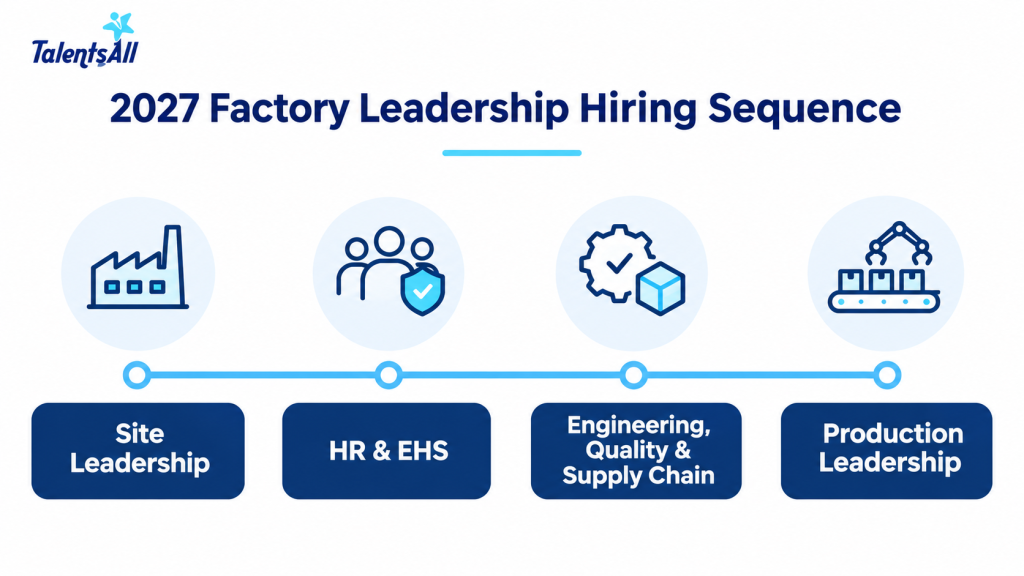
For manufacturing projects scheduled to progress during 2027, the leadership hiring sequence should be determined by operational dependencies rather than organizational hierarchy alone.
The most senior position is not always the first role that must be filled. Some functions require early involvement because their decisions influence equipment design, safety, workforce preparation or customer qualification.
2.1. Site Leadership: Establish Accountability Before Critical Project Decisions
The first priority is defining who will be accountable for the transition from investment planning to factory operations. Depending on the company’s structure, this responsibility may belong to a Project Director, Site Leader, Plant Manager or Country Manager. The organization should clearly distinguish construction project ownership from future plant operating accountability, particularly when the two responsibilities are assigned to different people.
For companies entering Vietnam or establishing a new operating site, appointing site leadership early can support decisions concerning the organization structure, management authority and coordination with regional headquarters. However, employers should avoid assuming that every experienced Plant Manager is automatically suited to greenfield development. Building a new operating system may require different capabilities from optimizing a mature factory.
2.2. HR and EHS: Build the Foundation for a Compliant, Capable Workforce
HR and Environment, Health and Safety (EHS) capabilities should be established according to the activities and risks of the project. Human resource leadership contributes to workforce planning, compensation structures, recruitment procedures and training arrangements. EHS leadership or other competent safety specialists may be required much earlier when construction, equipment installation or hazardous activities create responsibilities that must be managed before production begins.
For 2027 expansion projects, the important question is not whether both departments require permanent managers immediately. It is whether the company has assigned competent owners to critical decisions. Regional support or specialist advisers may cover certain early responsibilities, provided accountability and handover arrangements are clear.
2.3. Engineering, Quality and Supply Chain: Prepare the Factory Before Startup
Engineering leadership becomes important when equipment specifications, installation requirements, commissioning plans and maintenance systems are being defined. Quality leadership should be involved before process qualification and customer requirements become critical, while Supply Chain leadership must coordinate supplier readiness, materials and logistics.
These appointments are closely connected. A production line may be mechanically ready but unable to commence qualified production because quality validation is incomplete or critical materials are unavailable. For FDI manufacturers targeting 2027 production milestones, the hiring plan should ensure that these leaders are effective before the decisions and activities dependent on their expertise.
2.4. Production Leadership: Build Execution Capability Before Ramp-up
Production Managers, Shift Leaders and frontline supervisors become essential as the factory approaches trial production. They translate technical readiness into operating routines, workforce training and daily performance management.
Hiring these leaders too late can leave the organization dependent on temporary technical teams during startup. However, appointing the entire production management structure too early may increase costs without creating equivalent value. The appropriate sequence depends on how quickly production lines and shifts will be introduced, as well as the time needed for recruitment and training.
3. A Practical 2027 Leadership Hiring Roadmap for FDI Manufacturers
A useful leadership hiring roadmap should connect recruitment decisions to factory development milestones. For companies finalizing their 2027 investment plans in late 2026, this means identifying not only which positions need to be filled but also when each leader must begin contributing.
The following timeline illustrates a hypothetical project already preparing for implementation in late 2026 and targeting trial production in Q3 2027. It is an example rather than a standard timetable; a different project may require substantially longer preparation or an alternative sequence.
| Planning Period | Factory Development Priorities | Leadership Hiring Priorities | Key Decision |
|---|---|---|---|
| Q4 2026 | Finalize the 2027 project roadmap, operating model and key responsibilities | Confirm Site Leader accountability; identify critical leadership gaps; establish HR/EHS coverage | Which positions must influence decisions before 2027 begins? |
| Q1 2027 | Advance site preparation, technical planning and organizational setup | Secure required site, engineering and functional leadership; initiate targeted searches for scarce roles | Are decision-makers and technical owners in place? |
| Q2 2027 | Prepare equipment, systems, supplier readiness and commissioning activities | Ensure Engineering, Quality, Maintenance and Supply Chain leadership are effective; prepare Production Managers | Can the organization meet technical and operational readiness requirements? |
| Q3 2027 | Conduct planned trial production and qualification activities | Establish production supervision, workforce training and cross-functional routines | Are the people, processes and systems ready for controlled startup? |
| Q4 2027 | Stabilize or expand commercial operations, subject to project progress | Strengthen management depth, capability development and succession coverage | Can the leadership structure support sustainable performance? |
3.1. Work Backward From Operational Readiness, Not From the Opening Date
One of the most important distinctions in 2027 hiring planning is the difference between a leader’s joining date and the date they must become effective. An Engineering Manager may need time to review equipment specifications and understand corporate standards before commissioning, while a Quality Manager may require preparation time for process validation and customer qualification.
Employers should therefore work backward from the relevant project milestone. The recruitment plan must account for market mapping, candidate assessment, notice periods, onboarding and the time required to understand the operation. These lead times should be validated against actual market conditions rather than assigned uniformly to every senior position.
3.2. Introduce Leadership Readiness Gates
Recruitment status alone does not provide sufficient evidence that a factory is ready to progress. A position marked as filled may still require important training, decision-making arrangements or transfer of responsibilities from regional teams.
A leadership readiness gate should verify whether the necessary capabilities are available before a project enters its next stage. For example, before trial production, the company should confirm that critical operating responsibilities have competent owners, relevant teams are trained and unresolved technical or safety issues have a clear escalation process. This approach connects leadership appointments to business execution rather than simply counting completed hires.
3.3. Prepare for Recruitment and Project Delays
Factory development schedules may change because of equipment delivery, customer qualification, construction progress or other dependencies. A recruitment plan built around a single fixed opening date can become inefficient when the project shifts.
FDI companies should identify critical roles that cannot be delayed and those whose start dates can move with the project. Where a permanent appointment is not yet available, temporary regional or project leadership may provide continuity, but the company must define the limits of that arrangement. It is particularly important to avoid leaving significant operational or safety responsibilities without accountable ownership.
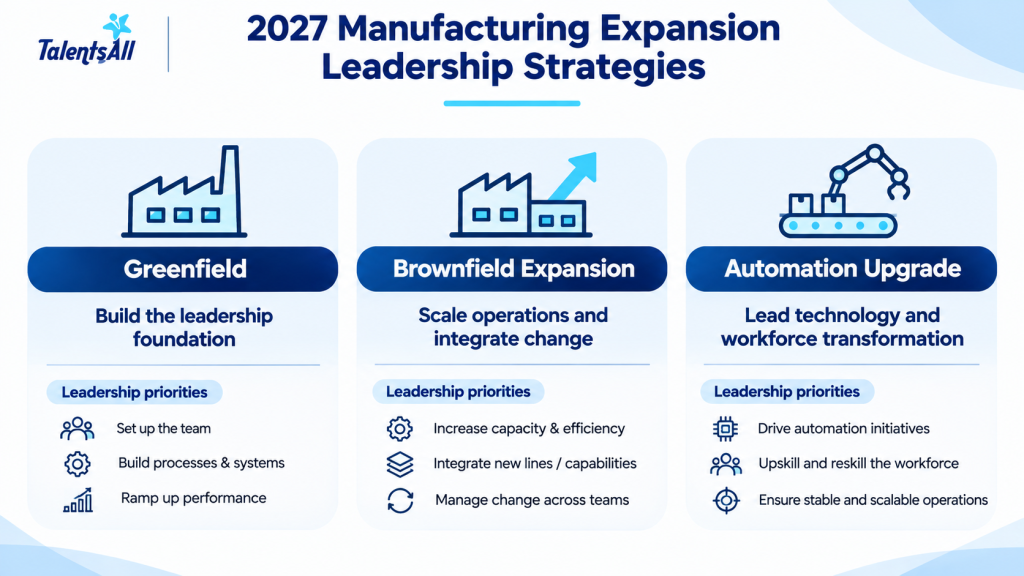
4. Three Manufacturing Expansion Scenarios That Require Different Hiring Strategies in 2027
Not every manufacturing expansion planned for 2027 will involve constructing a new factory. Some organizations may establish entirely new facilities, while others increase capacity within existing operations or introduce new technologies.
These scenarios require different leadership capabilities. Applying one standardized recruitment plan across all expansion projects can result in over-hiring some functions while leaving critical skill gaps elsewhere.
4.1. Greenfield Investment: Building a New Factory Organization
A greenfield project requires the organization to establish operating systems, management structures and local capabilities that may not previously exist. Leaders need to contribute to decisions about production readiness, team design, process implementation and accountability across functions.
The hiring priority is to secure people who can build and coordinate an operating organization, not simply manage one that is already established. Previous factory startup or major facility launch experience may be particularly relevant, but employers should examine the candidate’s actual responsibilities during those projects. A leader who joined after commissioning may have a different capability profile from someone who managed the transition from project planning to operational startup.
4.2. Brownfield Expansion: Scaling an Existing Manufacturing Operation
When an FDI manufacturer expands an existing plant, the leadership challenge is often more selective. The organization may already have capable managers, established systems and an operational workforce. Adding another production line does not necessarily justify duplicating every management position.
The company should assess whether existing leaders can absorb additional responsibilities without weakening performance. New appointments may be necessary in Production, Maintenance, Engineering or Quality, depending on the operational bottlenecks created by expansion. The priority is identifying which responsibilities are becoming more complex and where additional management capability will create measurable value.
4.3. Automation and Technology Upgrades: Recruiting for New Capabilities
Expansion involving automation or advanced manufacturing technology may change the skills required from existing leaders. A facility introducing more automated equipment could need stronger maintenance engineering, process integration, data interpretation or technical change-management capabilities.
In this scenario, employers should avoid assuming that every skill gap requires a new senior hire. Some capabilities may be developed through training, transferred from regional teams or supported by technical specialists. Others may require external recruitment where the organization lacks the experience to implement and sustain new systems. The hiring decision should follow a capability assessment rather than a general commitment to increasing headcount.
5. Critical Hiring Risks FDI Companies Should Address Before 2027
A well-designed hiring sequence can still fail if the organization has not resolved the underlying recruitment and decision-making risks.
For multinational manufacturers, these risks often arise at the intersection of regional expectations, local talent availability and project execution requirements.
5.1. Misalignment Between Regional Headquarters and Local Management
Regional headquarters may define leadership roles around long-term operational standards, while local management focuses on the immediate challenges of bringing a factory into production. Both perspectives are necessary, but they can produce different expectations about the same position.
For example, a Regional Operations Director may seek a Plant Manager with transformation experience, while the local project team needs someone skilled in startup execution and workforce development. Before approaching candidates, the company should agree on the role’s initial mandate, reporting authority and expected outcomes. Otherwise, the search may produce technically suitable candidates who are rejected because decision-makers are evaluating different roles.
5.2. Assuming the Required Talent Will Be Available Locally
An approved investment budget does not guarantee access to the leadership talent needed to execute it. Availability varies by manufacturing sector, location, operating complexity and compensation expectations.
The risk becomes greater when several companies target professionals with similar experience, such as greenfield Plant Managers, automation specialists or senior Quality leaders. Employers should validate market availability before setting final hiring deadlines. Early talent mapping may reveal that recruitment requires a wider geographic search, more flexible industry requirements or different relocation arrangements.
5.3. Using the Same Recruitment Approach for Every Position
A factory expansion project may involve hiring hundreds of production employees alongside a smaller number of business-critical managers. These requirements should not automatically be managed through the same recruitment process.
High-volume hiring may benefit from scalable sourcing and recruitment operations, while senior leadership appointments may require targeted research, confidential engagement and more extensive assessment. For employers comparing these approaches, TalentsAll’s Recruitment Services cover Executive Search and Recruitment Process Outsourcing for different hiring needs.
The appropriate model should be determined by the business importance, complexity and available candidate pool for each position.
5.4. Confusing Seniority With Greenfield or Expansion Readiness
A candidate with extensive experience managing a large factory may not have previously established operating systems, recruited an initial management team or coordinated production startup. Conversely, a professional from a smaller organization may have relevant experience managing significant operational changes.
Hiring teams should investigate specific achievements rather than relying on job titles or employer reputation. For a 2027 factory expansion mandate, relevant evidence may include equipment commissioning, management-team development, process stabilization or production ramp-up. The assessment must distinguish personal contribution from outcomes delivered primarily by corporate or project teams.
6. Turning the 2027 Expansion Plan Into an Executable Hiring Mandate
Once the business has identified its expansion priorities, HR and Operations need to translate the project roadmap into recruitment decisions.
A useful hiring mandate should clarify the responsibilities required at each stage, the candidate capabilities needed and the actions available if recruitment does not progress as expected.
6.1. Define Five Elements Before Launching Each Leadership Search
For every business-critical role, employers should agree on the operational milestone it supports, the capabilities required, the authority available, the expected joining timeline and the consequences of delayed appointment.
The following framework can be used during planning discussions.
| Planning Question | What the Hiring Team Should Confirm |
|---|---|
| Why is the role needed? | Which 2027 business outcome or project milestone depends on the position? |
| When must the leader be effective? | What is the required date for meaningful contribution, allowing for onboarding? |
| Which capabilities are essential? | What experience is non-negotiable, and which requirements can be flexible? |
| What authority will the leader have? | Which decisions belong to local management and which require regional approval? |
| What happens if hiring is delayed? | Is there an approved interim arrangement, revised milestone or escalation process? |
This framework also helps prevent unnecessary recruitment. If the business cannot establish why a new leadership role is required, it may need to reconsider the organization design before opening the position.
6.2. Establish a Clear Hiring Governance Process
Regional HR, local management and functional leaders should agree on shortlist criteria, interview responsibilities, compensation approval and final decision authority before recruitment begins.
This is particularly important for international organizations where senior hiring decisions involve several countries or reporting levels. Delayed feedback and changing requirements can reduce candidate engagement and create avoidable uncertainty. A defined governance process allows the recruitment team to escalate concerns early and maintain consistency throughout the search.
6.3. Decide When Executive Search Can Add Value
External Executive Search support may be appropriate when a critical role requires specialized manufacturing experience, confidential outreach or access to senior professionals outside the company’s existing networks.
For new manufacturing sites, a search partner may also support early talent mapping before an individual position becomes urgent. This can help the business understand candidate availability, assess requirements against the market and plan realistic recruitment lead times.
TalentsAll provides Industrial & Manufacturing recruitment expertise, supporting specialized and leadership positions across Operations, Engineering, Quality, Supply Chain, Maintenance and related functions.
The objective is not to outsource every recruitment requirement. It is to identify where dedicated market access and structured candidate assessment can help reduce uncertainty around business-critical appointments.
7. Leadership Readiness Should Be Part of the 2027 Manufacturing Plan
For FDI manufacturers preparing new facilities or production expansion in Vietnam, 2027 leadership planning should begin with the business roadmap rather than a list of vacancies.
The right management team must be available at the right stage of project development. Some leaders need to influence decisions before construction or commissioning, while others become essential as the organization approaches trial production and commercial operations.
A practical 2027 leadership hiring plan should therefore connect three elements: factory milestones, critical management capabilities and recruitment readiness.
Companies that make these connections early are better positioned to identify potential leadership gaps, adjust recruitment strategies and avoid unnecessary pressure as operational deadlines approach.
TalentsAll works with FDI manufacturers seeking experienced leaders and specialized professionals in Vietnam. For organizations preparing greenfield investments, capacity expansion or new operational leadership appointments in 2027, contact TalentsAll to discuss your hiring priorities and explore an appropriate search strategy.
Frequently Asked Questions
When should FDI companies start leadership recruitment for a 2027 factory project?
Recruitment should begin early enough for critical leaders to contribute before the operational milestones that depend on them. Companies should work backward from the required effective date and account for sourcing, assessment, notice periods and onboarding.
Which manufacturing leadership positions should be prioritized in 2027?
Priorities depend on the project. Site leadership, HR and competent EHS coverage, Engineering, Quality and Supply Chain often require early consideration. Production leadership should be established in time to support workforce training, trial production and ramp-up.
Is leadership recruitment different for greenfield and brownfield expansion?
Yes. Greenfield projects generally require stronger capabilities in establishing systems, building teams and preparing new operations. Brownfield expansion often focuses on scaling an existing organization and addressing specific operational capacity or capability gaps.
How can FDI manufacturers reduce leadership hiring risks in 2027?
Employers should align regional and local hiring expectations, validate talent availability, define role authority and establish realistic recruitment lead times. Recruitment progress should also be monitored against project readiness milestones, not only the number of completed hires.
When should a manufacturer consider Executive Search for its 2027 expansion?
Executive Search may be valuable when the project requires scarce manufacturing leadership capabilities, passive candidate engagement or specialized assessment. It can also support early market mapping for roles whose delayed appointment could affect critical project milestones.
Connect With TalentsAll
TalentsAll connects organizations with experienced professionals through Executive Search, Headhunting and specialized recruitment solutions in Vietnam.
For professionals: Explore senior-level career opportunities at TalentsAll Careers.
Stay connected: Follow TalentsAll Global on LinkedIn for hiring insights, market perspectives and career updates.
Talents for All, All for Talents.