
Hiring a Plant Manager in Vietnam requires more than reviewing production targets or years of factory experience. For FDI manufacturers, a candidate who consistently delivers output may still lack the broader capabilities needed to manage cost, quality, safety, people and operational risks across an entire facility.
The real challenge for HR Directors and Regional Operations leaders is determining whether a candidate can take ownership of the plant’s overall performance. This guide outlines six critical assessment areas, practical interview questions and a structured scorecard to help FDI manufacturers make more informed leadership hiring decisions.
1. Why Strong Production Results Do Not Always Indicate Plant Leadership Readiness
A Production Manager may demonstrate impressive results in output, efficiency and delivery. These achievements provide valuable evidence of operational capability, but they do not automatically establish readiness for a Plant Manager position.
The distinction lies in the scope of responsibility. Production leadership typically focuses on manufacturing execution, while plant leadership may involve broader accountability for engineering, quality, maintenance, cost, workforce management and coordination with other business functions.
For FDI manufacturers in Vietnam, the challenge becomes more complex when plant-level decisions must align with regional or global requirements.
1.1. Production Performance and Plant Performance Are Not the Same
Consider two candidates who have both achieved strong production targets. The first improved line efficiency and reduced downtime within an established operating system. The second delivered similar results while also restructuring maintenance planning, resolving cross-functional quality issues and developing a stronger supervisory team.
Both candidates demonstrate operational competence, but their experience reflects different levels of leadership ownership. When hiring a Plant Manager, employers should examine which decisions the candidate personally made, what functions they controlled and whether their improvements were sustained beyond a single production team.
1.2. A Strong Candidate Must Match the Actual Plant Mandate
Plant Manager responsibilities vary significantly across organizations. In one factory, the role may hold broad financial and operational accountability. In another, major investment, sourcing and engineering decisions may remain with regional departments, leaving the local leader responsible primarily for execution.
This distinction matters because employers sometimes assess candidates against responsibilities they will not actually control. Before launching a search, the hiring team should clarify the position’s decision-making authority, reporting relationships and first-year priorities.
The objective is to select a leader suited to the company’s operating model, rather than relying on a generic definition of Plant Manager.
For additional context, TalentsAll explores how business priorities and role scope influence senior hiring in its Executive Hiring Strategy for FDI Companies.
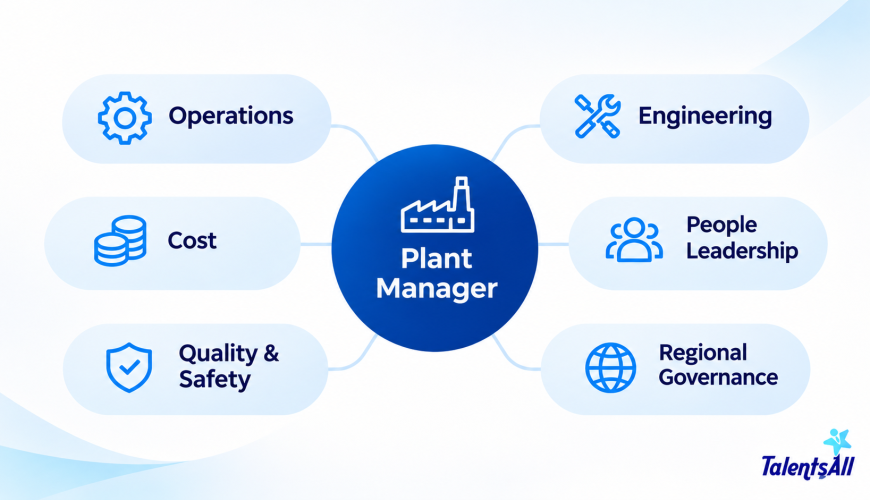
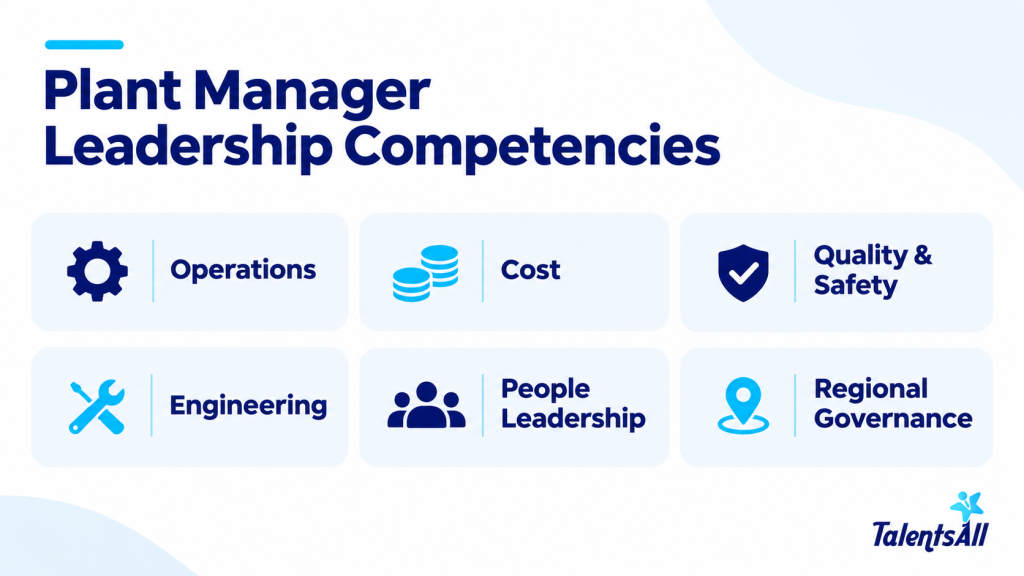
2. Six Critical Competencies to Assess When Hiring a Plant Manager
A reliable Plant Manager assessment should examine the capabilities required to manage an entire manufacturing operation, not simply individual production metrics.
The following six dimensions provide a starting point for evaluating candidates. Their relative importance should be adjusted according to the factory’s industry, maturity, operating model and business priorities.
2.1. Plant-wide Operational Ownership
A Plant Manager must understand how different functions contribute to overall plant performance. Production output may depend on equipment reliability, material availability, process capability, workforce planning and quality decisions. Improving one department’s KPI while creating problems elsewhere does not necessarily improve the factory’s results.
During assessment, employers should investigate how candidates have handled operational problems involving multiple functions. A strong candidate should explain the decisions made, the trade-offs considered and how teams were coordinated to resolve the underlying issue. Experience managing only production targets should not be treated as equivalent to responsibility for the entire manufacturing system.
2.2. Financial Accountability and Cost Management
Operational leaders need to understand how manufacturing decisions affect financial performance. Depending on the role’s authority, this may include responsibility for operating budgets, conversion costs, material losses, labor productivity, inventory or capital expenditure proposals. Full P&L ownership should only be required when it genuinely forms part of the mandate.
A candidate may report successful cost reductions without explaining how those savings were achieved. Employers should determine whether improvements resulted from better processes, changes in product mix, reduced staffing or decisions that introduced longer-term risks. The strongest evidence connects financial outcomes to sustainable operating improvements and clearly identifies the candidate’s contribution.
2.3. Quality, Safety and Risk Governance
Manufacturing performance cannot be assessed through productivity alone. A plant may achieve its output target while experiencing recurring quality defects, customer complaints or unsafe working conditions. For FDI manufacturers serving international customers, these issues can affect business continuity, customer confidence and operational compliance.
Employers should examine how candidates manage quality and safety as part of daily operations rather than treating them solely as the responsibility of specialist departments. Relevant evidence includes escalation decisions, root-cause analysis, corrective actions and the prevention of recurring incidents. International frameworks such as ISO 9001 and ISO 45001 can provide useful reference points for assessing management-system awareness, although certification experience alone does not demonstrate effective leadership.
2.4. Engineering, Maintenance and Continuous Improvement
A Plant Manager does not need to be the most technically specialized person in every department. However, the role requires sufficient understanding of manufacturing processes to evaluate technical risks, challenge assumptions and allocate resources effectively.
Assessment should focus on how the candidate has worked with engineering, maintenance and continuous improvement teams to solve persistent problems. Experience with automation, Lean Manufacturing or digital systems becomes more meaningful when the candidate can explain the business problem, implementation constraints and measurable operational impact.
2.5. People Leadership and Organizational Capability
A factory’s performance depends heavily on the capability of its management and supervisory teams. Strong Plant Managers establish accountability across functions, develop successors and create systems that reduce unnecessary dependence on individual leaders.
Employers should explore how candidates have handled underperforming managers, workforce changes and conflicts between departments. Evidence of effective leadership includes improvements in management capability, stronger operating routines and teams that continue performing without constant executive intervention. Workforce size alone is not sufficient proof of leadership effectiveness.
2.6. Regional Stakeholder Management and Governance
For many multinational manufacturers, the Plant Manager operates between local execution requirements and regional business expectations. Decisions involving investment, production capacity, customer commitments or organizational changes may require coordination with overseas stakeholders.
This capability extends beyond English fluency or presentation skills. Employers should assess whether candidates can explain operational trade-offs, escalate risks with evidence and negotiate realistic commitments while respecting corporate governance. A leader who reports information clearly but struggles to influence decisions may encounter difficulties in a complex regional structure.
3. How Plant Manager Assessment Should Change Across Different Factory Stages
Two factories within the same manufacturing sector may require very different leadership profiles.
A newly established plant needs capabilities that differ from those required to optimize a mature operation or stabilize a struggling facility. Applying the same assessment criteria to every Plant Manager vacancy can lead employers to overlook candidates who are better suited to the actual business challenge.
3.1. Greenfield and New Factory Setup
A greenfield facility may require a leader who can build operating processes, recruit functional managers, coordinate equipment readiness and prepare the organization for production launch. The ability to make decisions under uncertainty can be particularly important when systems and teams are not fully established.
Employers should seek evidence of previous setup or launch responsibilities, including how the candidate managed dependencies between engineering, production, quality and workforce readiness. Experience leading a mature factory does not automatically demonstrate the ability to build a new operation.
3.2. Expansion and Production Ramp-up
An expanding factory may already have established processes but struggle to maintain consistency as production volumes increase. Higher capacity can expose weaknesses in equipment reliability, production planning, training or supplier coordination.
The assessment should examine whether candidates have successfully scaled operations without allowing quality, cost or safety performance to deteriorate. Employers should investigate how additional capacity was introduced, which operational bottlenecks emerged and how the candidate adapted management systems to support growth.
3.3. Mature Manufacturing and Operational Optimization
A mature factory often needs a leader capable of improving performance within an established structure. Business priorities may include reducing conversion costs, improving yield, upgrading equipment or strengthening operational resilience.
In this environment, employers should distinguish between candidates who have maintained strong performance and those who have delivered meaningful improvements. Both capabilities matter, but they require different evidence. A candidate’s ability to prioritize investment, manage change and sustain improvements becomes particularly relevant.
3.4. Turnaround and Operational Stabilization
A factory experiencing repeated quality failures, delivery problems or leadership instability may require a different type of Plant Manager. The challenge is not simply to increase production but to diagnose problems, establish priorities and restore management discipline.
Candidates should demonstrate how they have handled difficult operating conditions, made decisions with incomplete information and rebuilt accountability across teams. Employers should also determine whether previous turnaround achievements resulted from the candidate’s leadership or from broader changes controlled by corporate headquarters.
The hiring mandate should reflect the plant’s current business stage, not merely the experience of its previous Plant Manager.
4. A Practical Plant Manager Assessment Scorecard for FDI Employers
A structured scorecard can help HR Directors, Factory GMs and Regional Operations leaders compare candidates against consistent requirements.
Instead of relying on overall interview impressions, assessors should identify the competencies needed for the mandate, define observable evidence and document their evaluation before comparing candidates.
The principles of job-related competencies, structured questions and consistent rating scales are supported by the U.S. Office of Personnel Management’s guidance on structured interviews.
4.1. Start With Evidence, Not Job Titles
The first step is to establish what each candidate actually controlled. A Plant Manager title may represent full-site accountability in one company and a narrower operations role in another.
Interviewers should investigate the scale and complexity of previous assignments, the candidate’s formal decision-making authority and the results attributable to their actions. These details provide the context required to interpret performance claims fairly.
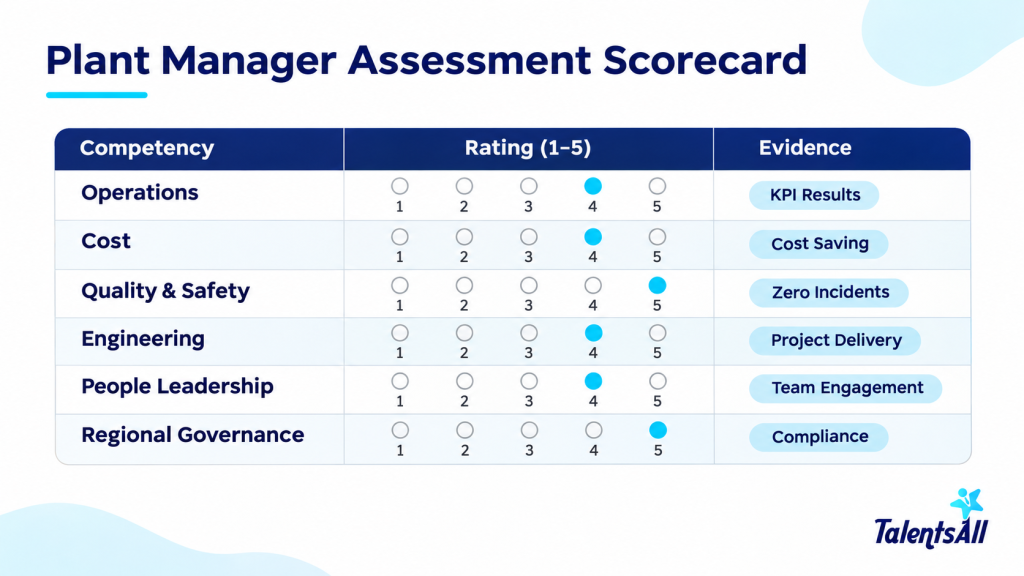
The following scorecard is an illustrative starting point. It is not a validated assessment instrument, and employers should adapt it to their particular mandate.
| Assessment Dimension | Evidence to Request | Interview Question |
|---|---|---|
| Operational Ownership | Examples of cross-functional decisions affecting site-wide performance | Tell us about a plant-wide problem you resolved that involved multiple departments. |
| Financial Management | Budget responsibilities, cost improvement projects and financial trade-offs | Describe a major cost decision you made and how you assessed its operational consequences. |
| Quality & Safety | Incident response, corrective actions, audit findings and risk escalation | Describe a time you prioritized quality or safety despite pressure to maintain output. |
| Engineering & Improvement | Process upgrades, reliability improvements and technology implementation | What operational improvement did you personally lead, and how was its impact measured? |
| People Leadership | Management development, succession planning and organizational changes | Tell us about a management team you strengthened and the changes that followed. |
| Regional Governance | Escalation decisions, stakeholder alignment and cross-border reporting | Describe a disagreement with regional leadership and how you reached a decision. |
4.2. Use Consistent Scoring Anchors
Employers can use a five-point scale to document the quality of evidence across the selected competencies. Interviewers should evaluate responses against predefined expectations, rather than scoring candidates based on confidence, presentation style or personal similarity.
| Score | Evidence-based Interpretation |
|---|---|
| 1 – Insufficient | Little relevant evidence or inability to explain personal contribution |
| 2 – Limited | Some relevant exposure, but responsibility or outcomes remain unclear |
| 3 – Meets Requirements | Credible examples of independent responsibility at the required scope |
| 4 – Strong | Clear ownership of complex decisions with measurable, sustained results |
| 5 – Exceptional | Extensive evidence of leading complex situations, managing trade-offs and building repeatable improvements |
These descriptions are illustrative. They should be refined into role-specific behavioral anchors before the scorecard is used for actual selection decisions.
A consistent scoring approach is particularly useful when local and regional interviewers assess candidates independently. Scores should be supported by documented examples, and differences should be discussed against the same criteria.
4.3. Adjust the Scorecard to Business Priorities
A company hiring for a greenfield factory may place greater emphasis on execution under uncertainty, team building and production readiness. A turnaround mandate may require stronger evidence of risk management, cross-functional problem-solving and organizational change.
Weights can be adjusted where there is a documented business rationale. However, changing the evaluation criteria after interviewing candidates can undermine consistency and make comparisons less reliable.
Certain requirements should also be treated as essential rather than averaged into an overall score. For example, serious unresolved concerns about safety leadership should not automatically be offset by strong cost-reduction results. The hiring team should define critical requirements and the evidence needed to satisfy them before assessing applicants.
4.4. Validate Claims Through Follow-up Questions
Candidates may describe impressive achievements using figures such as productivity improvements, cost savings or reductions in defects. These numbers are valuable only when employers understand the circumstances behind them.
A useful follow-up sequence should establish the baseline, the candidate’s decision-making role, the actions taken, the resources involved and how the results were verified. Employers should also ask what happened after the initial improvement and what the candidate would do differently.
For example, a candidate claiming to have reduced downtime should explain whether the improvement resulted from preventive maintenance, equipment upgrades, process changes or operational support from another function. This helps assess both the achievement and the capability behind it.
5. Common Mistakes FDI Manufacturers Make When Hiring Plant Managers
Even experienced hiring teams can make inconsistent decisions when the assessment process is not aligned with the actual business mandate.
Several recurring risks deserve particular attention.
5.1. Overvaluing Previous Employer Reputation
Experience at a well-known multinational manufacturer can indicate exposure to established systems and international standards. However, it does not reveal how much responsibility the candidate personally held or how they performed when conditions were difficult.
A leader from a highly structured organization may have relied on extensive regional resources, while a candidate from a smaller manufacturer may have managed broader responsibilities with greater autonomy. Employers should compare actual responsibilities and achievements rather than using company reputation as a substitute for evidence.
5.2. Confusing Production Scale With Leadership Complexity
Managing a workforce of 2,000 employees does not necessarily require the same capabilities as leading a smaller facility with multiple product lines, frequent engineering changes or demanding customer requirements.
Plant complexity depends on factors such as process variation, automation, supply chain exposure, regulatory requirements and organizational structure. Employers should evaluate the nature of the candidate’s operating environment instead of using headcount or production volume as the primary measure of seniority.
5.3. Underestimating Cross-functional Leadership
A candidate may demonstrate deep expertise in production while having limited experience influencing engineering, quality, supply chain or finance. This gap becomes important when the Plant Manager must resolve problems that no single department can address independently.
Hiring teams should investigate situations where departments had competing priorities and the candidate needed to establish a plant-wide solution. Evidence of negotiation, escalation and shared accountability is often more useful than a description of routine management meetings.
5.4. Ignoring the Gap Between Accountability and Authority
Some Plant Manager positions carry responsibility for output, cost and delivery while major decisions remain with regional headquarters or separate functional leaders. If this operating model is not communicated clearly, candidates may accept the position with unrealistic expectations about their authority.
Before making an offer, employers should confirm which decisions the Plant Manager can make independently, which require approval and where accountability is shared. A strong candidate cannot consistently deliver outcomes without the resources and authority needed to influence them.
6. When Can Executive Search Add Value to Plant Manager Recruitment?
A structured assessment framework improves hiring decisions, but it does not automatically solve the challenge of identifying suitable candidates.
Some FDI manufacturers have strong internal recruitment teams and established succession pipelines. Others need additional market access, specialist research or independent assessment support for a particular mandate.
6.1. When the Talent Market Requires Targeted Mapping
Plant Manager searches may become difficult when employers require an uncommon combination of technical knowledge, factory leadership and international exposure. Suitable professionals may already be employed and may not respond to conventional job advertisements.
A specialized search partner can help identify relevant talent pools, explore adjacent manufacturing sectors and assess candidates whose experience may not match the job description exactly. This approach is most useful when the employer has clearly defined which competencies are essential and which industry experiences may be transferable.
6.2. When Candidate Assessment Requires Industry Context
A candidate’s results must be interpreted within the manufacturing environment in which they were achieved. Productivity improvements, cost savings and quality performance can have different meanings depending on the product, production process and operating model.
An experienced manufacturing recruitment consultant can support the hiring team by examining candidate responsibilities, validating relevant achievements and identifying questions that require deeper assessment. The employer should retain ownership of technical validation and the final appointment decision.
6.3. When Local and Regional Hiring Expectations Differ
A local Factory GM may prioritize immediate operational stability, while Regional Operations expects the new leader to deliver transformation and stronger governance. Both objectives may be reasonable, but they can lead to conflicting candidate evaluations.
A well-managed Executive Search process can help translate these expectations into a consistent hiring mandate and candidate assessment framework. This alignment is particularly important before approaching senior professionals who may require a clear understanding of the role’s scope and authority.
TalentsAll provides Industrial & Manufacturing recruitment expertise, covering critical functions such as operations, engineering, quality, supply chain and continuous improvement. Its Executive Search and Headhunting services support employers seeking senior and specialized talent.
7. Hiring the Right Plant Manager Starts With the Right Assessment
A successful Plant Manager appointment requires more than finding someone with an impressive manufacturing background.
For FDI manufacturers, the most important question is whether the candidate has demonstrated the capabilities needed to manage the specific plant, under its actual business conditions.
A strong assessment should connect three elements: the company’s operational priorities, the candidate’s demonstrated leadership experience and the level of authority available in the new role.
When these factors are clearly defined, employers can move beyond job titles and production figures to make more informed hiring decisions.
TalentsAll works with organizations seeking senior and specialized manufacturing professionals in Vietnam. If your business is evaluating a Plant Manager appointment or facing difficulties identifying suitable leadership candidates, contact TalentsAll to discuss your hiring requirements.
Frequently Asked Questions
What is the most important competency when hiring a Plant Manager?
There is no single competency that applies equally to every manufacturing environment. Employers should prioritize the capabilities most closely connected to the factory’s business objectives. Plant-wide operational ownership, risk management and people leadership are often important areas to evaluate.
How is a Plant Manager different from a Production Manager?
A Production Manager generally focuses on manufacturing execution within a defined operational scope. A Plant Manager may have broader responsibility for cross-functional performance, cost, quality, safety and site leadership. The exact distinction depends on the company’s organizational structure.
Should FDI manufacturers prioritize candidates from the same industry?
Direct industry experience can reduce certain technical and operational learning requirements. However, candidates from adjacent industries may possess transferable leadership capabilities. Employers should determine which technical requirements are essential and which experiences can be adapted.
How can employers verify a Plant Manager candidate’s achievements?
Structured interviews should examine the business context, the candidate’s decisions and the evidence supporting reported results. Relevant work samples, authorized references and consistent assessment criteria can provide additional information, subject to appropriate candidate consent and confidentiality controls.
Connect With TalentsAll
TalentsAll connects organizations with experienced professionals through Executive Search, Headhunting and specialized recruitment solutions in Vietnam.
For professionals: Explore senior-level career opportunities at TalentsAll Careers.
Stay connected: Follow TalentsAll Global on LinkedIn for hiring insights, market perspectives and career updates.
Talents for All, All for Talents.