

1. Introduction: Growth Is No Longer the Hard Part
By the end of 2025, Vietnam’s electronics manufacturing sector had entered a clear recovery phase, supported by concrete indicators highlighted in the November 2025 update from Vietnam Briefing, alongside data from S&P Global and the General Statistics Office of Vietnam.
As companies move into 2026 planning cycles, a less obvious paradox is emerging. Despite continued growth in production, exports, and foreign direct investment, manufacturing hiring in electronics is becoming more complex rather than easier, particularly at senior and middle management levels.
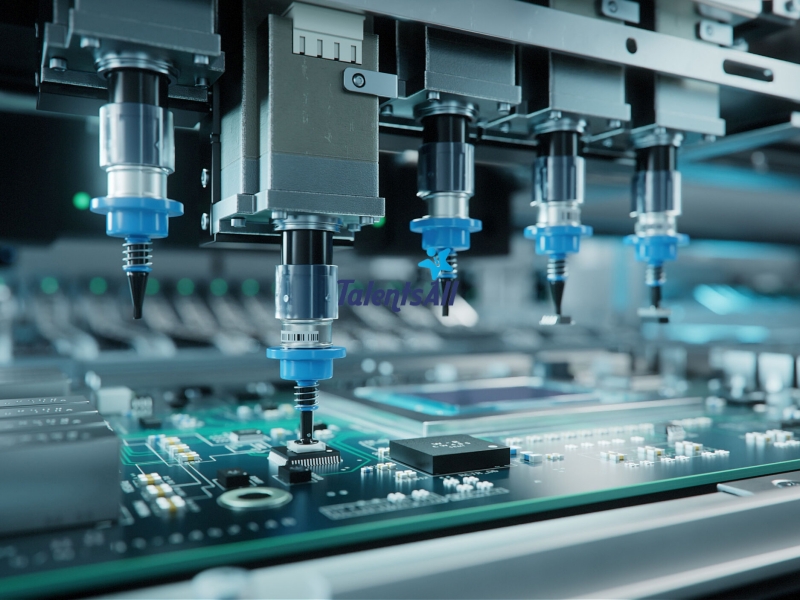
This article examines key manufacturing hiring trends in Vietnam for 2026, with a focus on electronics manufacturing, and translates macro manufacturing indicators into practical leadership and workforce planning implications for CEOs, HRDs, and regional decision-makers responsible for operational continuity.
2. Vietnam Electronics Manufacturing in 2025: What the Data Actually Shows
2.1 PMI Signals Momentum, Not Stability
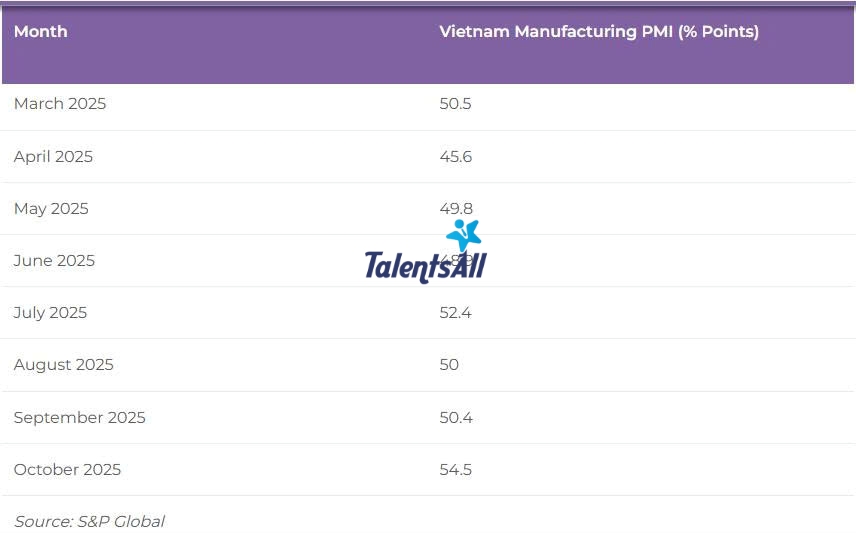
Vietnam’s Manufacturing Purchasing Managers’ Index (PMI), published by S&P Global, reached 54.5 in October 2025, up from 50.4 in September. A PMI above 50 indicates expansion, while readings above 54 typically reflect strong momentum driven by new orders and rising production expectations.
From a manufacturing hiring perspective, PMI should not be interpreted as an immediate signal for headcount expansion. Instead, it reflects anticipated workload pressure.
In electronics manufacturing, a rising PMI usually translates into:
- Higher export order volumes
- Shorter delivery timelines
- Increased operational strain on existing plant and operations leaders
At this stage, pressure builds inside the factory before staffing levels or leadership structures are formally adjusted. This is why PMI often rises ahead of approved manufacturing hiring plans.
2.2 IIP Shows Growth, But at a Controlled Pace
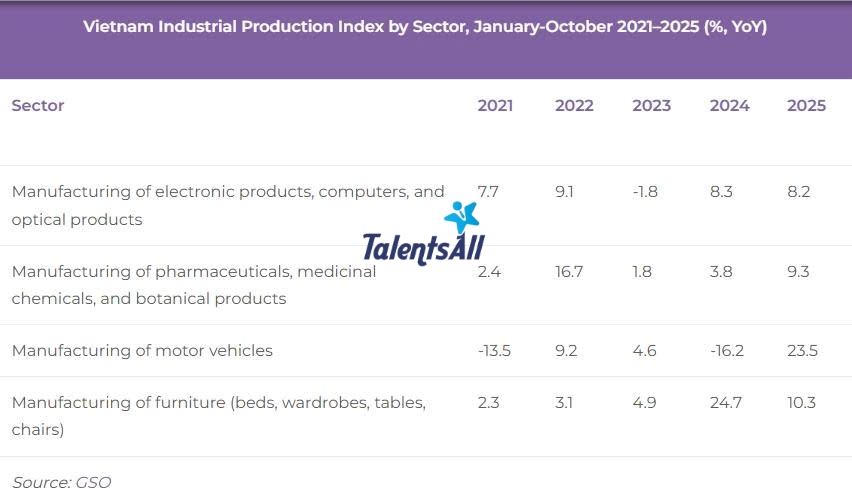
According to the General Statistics Office of Vietnam, the Industrial Production Index (IIP) for electronics, computers, and optical products grew by approximately 8 percent year on year in the first ten months of 2025. This confirms that electronics manufacturing output is increasing in real terms.
However, this level of IIP growth reflects controlled expansion rather than aggressive scale-up.
When PMI accelerates faster than IIP, manufacturers are typically meeting demand through:
- Efficiency improvements
- Optimization of existing production lines
- More intensive use of current capacity
rather than by opening new factories or rapidly expanding manufacturing hiring.
This divergence between PMI and IIP is important. It indicates that growth is being absorbed internally, causing pressure to surface first in leadership capacity, decision-making speed, and cross-functional coordination, rather than in workforce size.
3. Why Growth in 2026 Does Not Lead to Easier Manufacturing Hiring
3.1 From Restart to Optimization
Earlier growth cycles in Vietnam’s electronics manufacturing sector—particularly between 2017 and 2019—were driven by factory build-outs and volume expansion. Manufacturing hiring during that period focused primarily on scale: adding production lines, shifts, and supervisory layers.
The post-2025 recovery marks a structural shift. Growth is now driven by:
- Capacity optimization rather than greenfield projects
- Tighter buyer requirements on quality, compliance, and ESG
- Deeper integration with regional and global supply chains
As a result, electronics manufacturing hiring in 2026 requires a different leadership profile from previous expansion cycles.
3.2 Leadership Roles Have Expanded Faster Than Job Design
In many electronics manufacturers, leadership roles have expanded informally in response to rising operational complexity, while job design and authority structures have not evolved at the same pace.
A Plant Manager in 2026 is often expected to:
- Maintain throughput and yield under volatile demand
- Manage audits, compliance, and ESG reporting
- Coordinate closely with supply chain and finance
- Serve as the primary interface with regional or global headquarters
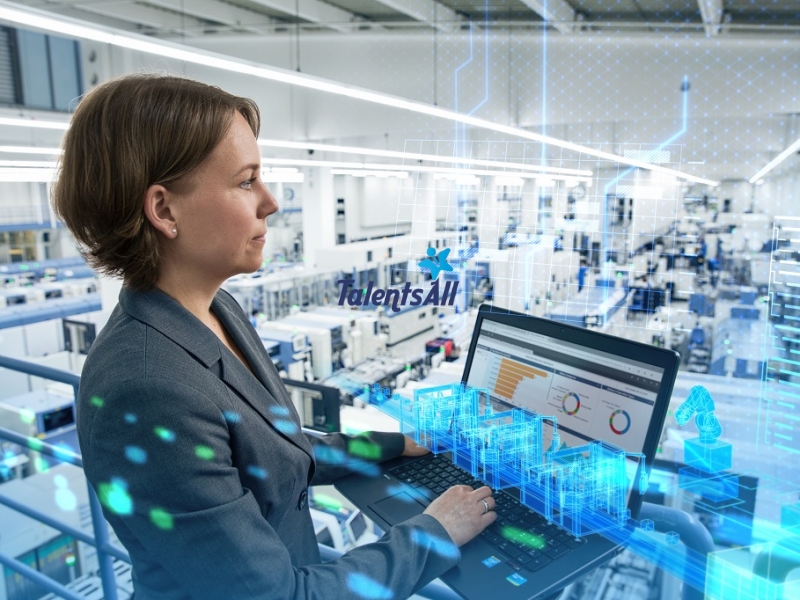
Yet decision authority often remains centralized. This mismatch between responsibility and control is a key driver of manufacturing leadership hiring failures, particularly at the plant manager and operations director level.
4. The Real Manufacturing Hiring Bottleneck: Leadership Readiness, Not Talent Supply
4.1 Why Talent Exists but Manufacturing Hiring Still Fails
Vietnam does not lack experienced electronics manufacturing professionals. Over the past decade, the country has developed a solid base of engineers, production managers, and plant leaders.
The constraint in manufacturing hiring lies in deployable leadership readiness. Most candidates fall into one of three categories:
- Leaders shaped by rapid expansion but less suited to optimization and compliance-heavy environments
- Strong technical managers with limited cross-functional or regional exposure
- Senior leaders who are retained aggressively by current employers to minimize disruption during recovery
As a result, even when manufacturing hiring budgets increase, the pool of candidates aligned with the current operating phase remains narrower than expected.
4.2 Middle Management as the Primary Pressure Point
The most acute strain in electronics manufacturing hiring emerges at the middle-to-senior management layer, including:
- Plant Managers and Factory Directors
- Operations Directors
- Engineering Managers
- Quality and Compliance leaders
These roles absorb operational stress first. When leadership capacity at this level is insufficient, performance issues tend to surface well before workforce shortages become visible in manufacturing hiring data.
5. Why Electronics Manufacturing Hiring Becomes Riskier After Recovery
5.1 The Rising Cost of a Wrong Hire
During downturns, leadership missteps are often masked by lower activity levels. During recovery, the same missteps become significantly more expensive.
In electronics manufacturing, a failed leadership hire can result in:
- Production instability
- Audit failures or compliance findings
- Increased workforce turnover
- Loss of preferred supplier status with key customers
Replacing a Plant Manager or Operations Director after stabilization has begun is typically far more disruptive than delaying hiring to clarify role scope and authority.

5.2 Speed Without Clarity Leads to Manufacturing Hiring Failure
Many leadership hiring failures at this stage stem from a small set of structural gaps:
- Unclear or fragmented decision rights
- Blurred reporting lines between local management and regional or global headquarters
- Performance expectations misaligned with the company’s operating phase
When leaders are held accountable for outcomes they cannot fully control, performance issues emerge regardless of individual capability. These situations are often misdiagnosed as talent problems, when the root cause lies in role design and organizational structure.
6. How Leading Electronics Manufacturers Are Adjusting Their Manufacturing Hiring Approach
6.1 Market Mapping Before Role Activation
Rather than opening roles immediately, more disciplined manufacturers begin with market mapping. The objective is not speed, but clarity.
Market mapping helps organizations understand:
- Who is realistically available in the electronics manufacturing talent market
- Which candidates are genuinely movable without creating risk elsewhere
- What trade-offs exist between capability, compensation, and timing
This approach reduces downstream hiring risk and prevents searches driven by urgency rather than readiness.
6.2 Defining Leadership Scope Before Recruiting Begins
Leading manufacturers no longer assume that a job title alone defines a role. Before engaging candidates, they clarify:
- Which decisions the role can make independently
- How success will be measured during stabilization or optimization phases
- Where accountability sits across production, quality, supply chain, and finance
Clear role definition at this stage significantly improves manufacturing hiring outcomes, shortening time to impact and reducing early attrition risk.
6.3 Executive Recruitment as Risk Management
In 2026, executive recruitment in electronics manufacturing is increasingly viewed as operational risk management, rather than a transactional hiring activity.
Hiring decisions are evaluated based on their ability to:
- Absorb volatility during demand fluctuations
- Protect customer commitments and compliance standards
- Support sustainable performance rather than short-term expansion
This perspective explains why some manufacturers hire more cautiously despite strong growth indicators. The priority is resilience, not speed.

7. What This Means for Manufacturing Hiring Planning in 2026
Electronics manufacturing in Vietnam continues to grow, but organizational complexity is rising faster than headcount. As a result, leadership and manufacturing hiring decisions made in 2026 will shape operational stability well into 2027.
For many decision-makers, the core question has shifted. It is no longer whether the market supports hiring, but whether current leadership capability is aligned with the company’s actual operating phase.
Market data can explain trends, but it rarely provides clear answers on when to hire, what roles to prioritize, or how to structure leadership responsibilities. This is where uncertainty often emerges inside organizations.
8. Conclusion: Growth Builds Confidence, Precision Builds Resilience
Manufacturing recovery naturally increases confidence. In electronics manufacturing, this often translates into faster manufacturing hiring.
In 2026, speed alone is insufficient. The most resilient organizations will be those that hire with clarity and discipline, not those that move the fastest.
For many electronics manufacturers, the most critical hiring conversations will begin quietly. They start with assessing leadership capacity, clarifying decision authority, and aligning roles with operational realitylong before a job is posted.
TalentsAll – Connecting global talent with visionary companies to drive mutual success
Email: trang@talentsall.com.vn
Website: https://talentsall.com.vn
LinkedIn: https://www.linkedin.com/company/talentsall