
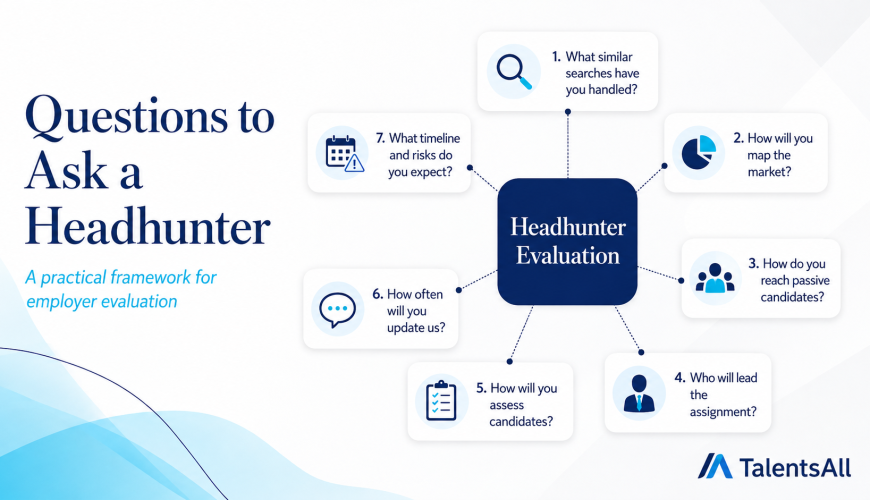
Choosing a headhunter should involve more than reviewing a company profile, client portfolio or recruitment fee. Before signing an agreement, employers should test how the headhunter understands the mandate, searches the market, assesses candidates and responds when the search becomes difficult.
A polished proposal can explain credentials and commercial terms, but it may reveal little about how the assignment will actually be handled.
The better question is therefore not “Does this headhunter look reputable?” but “What evidence shows this headhunter can solve our specific hiring problem?”
1. What Should Employers Understand About a Headhunter Before Working Together?
A headhunter helps companies identify and approach targeted professionals for senior, specialized or hard-to-fill roles. The value lies in search depth, market access, candidate judgment and the ability to represent the opportunity credibly.
A headhunter usually becomes relevant when normal candidate flow is insufficient or the target talent pool is narrow. This is especially common in senior searches, where suitable professionals may already be successful in their current roles and are not actively applying for new opportunities.
For these assignments, receiving CVs is only one part of the process. A headhunter may also help clarify the mandate, define the relevant talent market, assess candidate motivation and provide market feedback during the search. Employers should therefore look beyond delivery speed and understand how the headhunter approaches the role, the market and the overall search strategy.
For a broader explanation of the model, TalentsAll has covered what a headhunter does and how headhunters operate.
2. Why Are Portfolio and Fee Not Enough to Evaluate a Headhunter?
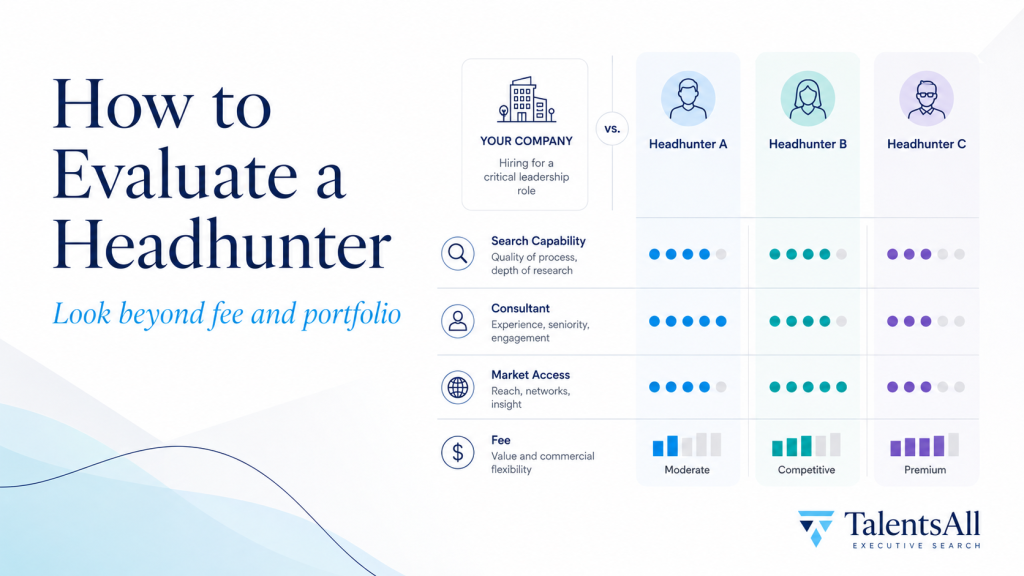
A portfolio and recruitment fee provide useful information, but they do not show how a headhunter will handle a specific mandate. Senior hiring also depends on consultant capability, talent access, search methodology and market judgment.
A strong client portfolio can indicate relevant experience, but two assignments within the same industry may require very different searches. A manufacturer hiring a Plant Manager for a stable facility faces a different challenge from one seeking a leader to restructure operations and improve productivity.
Recruitment fee has similar limitations. A lower fee may represent good value for a straightforward search, but it may be less suitable when the role requires intensive market mapping and passive outreach. The consultant assigned to the project also matters because a strong company brand does not automatically reveal who will speak with candidates every day.
This is why supplier evaluation needs to move from credentials to execution.
TalentsAll’s guide on how to shortlist Executive Search firms in Vietnam provides a broader five-factor framework. The questions below take the next step by testing those capabilities during the actual supplier discussion.
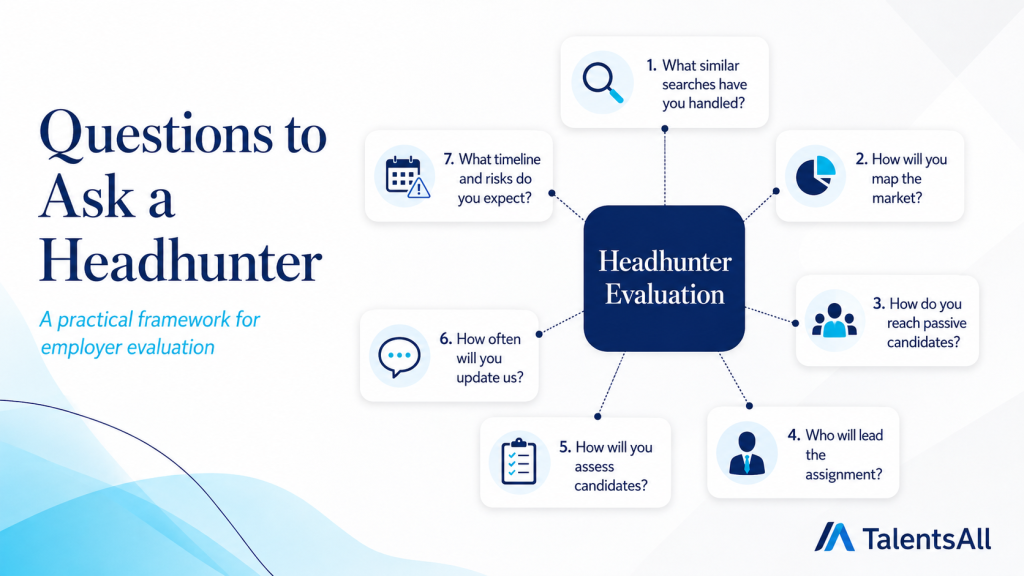
3. Seven Questions to Ask a Headhunter Before Signing
The most useful questions test how a headhunter would approach the real hiring mandate. They should reveal market understanding, search capability, consultant ownership, assessment quality and commercial clarity.
3.1. Which Talent Pools Would This Headhunter Target First?
A headhunter should be able to form an initial view of where relevant candidates may exist and explain the reasoning behind it.
For a Sales Director search in industrial B2B, the first target market may include direct competitors. It may also include adjacent sectors with similar customers, sales cycles or technical complexity. The headhunter does not need to know every candidate before the assignment starts, but the firm should have a logical hypothesis about the market.
A response focused only on database size gives less information. The real test is whether the headhunter can connect the mandate with relevant companies, industries and candidate backgrounds. For complex senior searches, Executive Talent Mapping in Vietnam explains why defining the market early can improve the search.
3.2. How Will the Headhunter Search Beyond the Existing Database?
A headhunter should explain how the search expands when existing candidate records do not produce the right profile.
Many strong senior professionals are not active jobseekers. They may never have applied through the headhunter or interacted with the firm before. In these cases, the search may require direct market research to identify relevant organizations and professionals with the required scope and experience.
The specific sourcing tools can vary. What matters is whether the headhunter can continue searching beyond readily available candidates and create enough interest for passive professionals to consider a conversation.
3.3. Who Will Personally Manage the Headhunter Assignment?
Employers should know which consultant will understand the mandate, approach candidates and communicate market feedback during the assignment.
The person presenting the proposal may not always manage the search, so this distinction should be clear before the agreement is signed. A senior candidate may ask detailed questions about reporting lines, business expectations or why the role is open. The consultant needs enough context to answer credibly.
Continuity also matters for the employer. The person providing market feedback should understand the original discussions and business priorities. The key question is therefore: Who will actually own this search from briefing to placement?
3.4. How Will the Headhunter Assess Candidates Before Presentation?
A headhunter should explain what will be assessed before a candidate reaches the employer and why that assessment matters for the mandate.
A senior shortlist needs more context than job title and years of experience. Two Finance Directors may have similar career histories, while one has mainly managed established operations and the other has led transformation, built teams and worked directly with regional leadership.
The right profile depends on the business problem. Candidate assessment should therefore clarify previous responsibility, relevant outcomes, motivation and career context. The employer should understand why each candidate has been presented before the first interview takes place.
3.5. What Will the Headhunter Do If the Market Does Not Match the Brief?
A strong headhunter should explain how market feedback will change the search when the original mandate proves too narrow or unrealistic.
Senior searches do not always validate the first assumptions. Compensation may be below candidate expectations, the target industry may contain too few suitable professionals or location may reduce mobility. Candidates may also reject the role because decision authority is unclear.
Repeating the same sourcing activity will not solve these issues. The headhunter should identify the constraint and explain available trade-offs, which may involve seniority, compensation, location or industry requirements. This shows whether the supplier acts mainly as a CV provider or as a search advisor.
3.6. How Will the Headhunter Manage Confidentiality and Candidate Ownership?
A headhunter should define how confidential information is handled and how candidate ownership is managed before the search starts.
A candidate may already be known to the employer or introduced by another supplier. Clear ownership rules help prevent disputes later. Confidentiality becomes even more important when the vacancy involves an executive replacement, restructuring or an unannounced market entry.
In these situations, candidate communication needs tighter control. The headhunter should explain who receives which information, when it can be shared and how the employer’s identity or business context will be protected.
3.7. What Happens If the Candidate Leaves After Joining?
A headhunter should explain the guarantee or replacement terms clearly before the employer signs the recruitment agreement.
Employers need to understand what happens if the selected candidate leaves during the agreed guarantee period and under what conditions a replacement will be provided. A longer guarantee does not automatically mean a better service because its practical value depends on the terms attached to it.
This question also tests commercial transparency. A strong headhunter should be comfortable explaining both the scope of service and its limitations before a placement problem occurs.
4. What Does a Strong Headhunter Answer Sound Like?
A strong headhunter answer is specific to the mandate, grounded in market reality and clear about what the firm can and cannot control. Good answers explain the reasoning behind the search rather than relying on broad promises.
4.1. A Strong Headhunter Gives Specific Answers
Specificity shows that the headhunter is thinking about the actual role rather than repeating a standard sales presentation.
One firm may say it has a strong manufacturing network. Another may explain that it would initially examine three relevant talent pools and describe the strengths and limitations of each. The second answer gives the employer more useful information because it reveals how the firm is thinking about the search.
The same principle applies to timelines and candidate access. Specific reasoning makes capability easier to evaluate and creates clearer expectations before the assignment begins. TalentsAll’s article on Candidate Experience in Executive Search also explains why recruiter communication can shape senior talent engagement.
4.2. A Strong Headhunter Is Realistic About the Market
Market realism is a positive signal because difficult searches contain constraints that no supplier can simply remove.
A headhunter should be able to say when the proposed profile appears difficult or when compensation and location may limit the search. This is more useful than immediately promising that suitable candidates will be available.
Senior hiring always contains some uncertainty. A strong supplier helps the employer understand that uncertainty and make better decisions as evidence from the market emerges.
4.3. A Strong Headhunter Takes Clear Ownership
Clear ownership means the employer knows who runs the search, how communication works and what happens when the assignment encounters difficulty.
The process should remain clear after the contract is signed. The employer should know who provides updates, how often meaningful feedback will be shared and how candidate ownership or confidentiality issues will be handled.
Clear operating expectations reduce friction and help both sides respond faster when the search needs adjustment.
5. Which Headhunter Answers Should Make Employers Cautious?
Employers should be cautious when a headhunter relies heavily on guarantees, vague network claims or unclear consultant responsibilities. These answers may hide important gaps in the proposed search approach.
5.1. Be Cautious When a Headhunter Promises Results Before Understanding the Role
An immediate promise of fast delivery can be difficult to evaluate when the headhunter has not yet explored the mandate or talent market.
Speed can be valuable, but a realistic timeline depends on seniority, candidate availability and market complexity. A confidential leadership search should not be evaluated like a common professional vacancy.
Questions before promises are usually a healthier signal. They show that the headhunter is trying to understand the assignment before estimating the outcome.
5.2. Be Cautious When the Headhunter Cannot Explain Who Runs the Search
Unclear consultant ownership can create problems when the pitching team and delivery team operate very differently.
The employer should know who will speak with candidates, interpret market feedback and communicate with the hiring manager. A vague handover can weaken the context built during the initial discussion.
For senior hiring, that context is part of the service because both candidate engagement and market feedback depend on how well the consultant understands the role.
5.3. Be Cautious When Every Market Problem Has the Same Solution
A headhunter should not respond to every hiring problem by promising more sourcing activity.
Some searches struggle because too few candidates are approached. Others fail because compensation is uncompetitive, the profile is too narrow or the employer’s requirements do not match the available talent market.
The response should match the actual constraint. TalentsAll has explored the supplier-coverage question in One or Multiple Recruitment Agencies in Vietnam?.
6. How Should Employers Compare Headhunters After the Pitch?
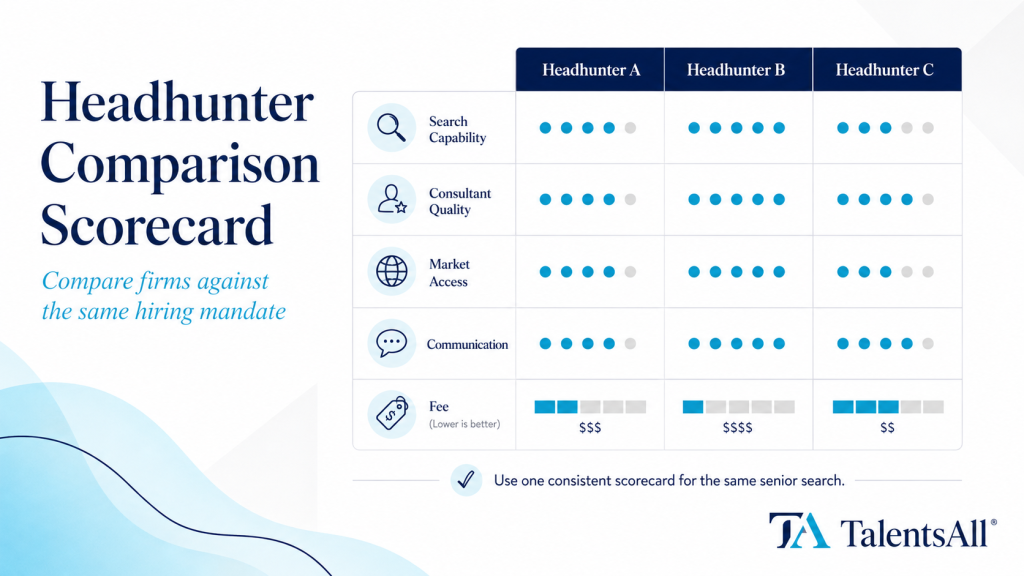
After pitching, employers should compare headhunters on the same criteria. The comparison should focus on mandate understanding, talent-market logic, consultant capability, search approach, transparency and commercial clarity.
A simple scorecard can make the comparison more consistent.
| Evaluation Area | Headhunter A | Headhunter B | Headhunter C |
|---|---|---|---|
| Understanding of the mandate | 1–5 | 1–5 | 1–5 |
| Talent-market hypothesis | 1–5 | 1–5 | 1–5 |
| Passive candidate access | 1–5 | 1–5 | 1–5 |
| Consultant capability | 1–5 | 1–5 | 1–5 |
| Candidate assessment | 1–5 | 1–5 | 1–5 |
| Transparency | 1–5 | 1–5 | 1–5 |
| Agreement clarity | 1–5 | 1–5 | 1–5 |
| Overall fit for the mandate | 1–5 | 1–5 | 1–5 |
The final score should not make the decision automatically. Its purpose is to keep the comparison on the same basis.
6.1. Compare the Headhunter Against the Hiring Problem
The weight of each criterion should reflect the risk and complexity of the specific mandate.
For a confidential Country Manager replacement, discretion and consultant seniority may carry greater weight. For another search, market reach or candidate access could matter more.
A fixed supplier scorecard can miss these differences. The hiring problem should determine which capabilities deserve the highest priority.
6.2. Compare Evidence From the Headhunter Pitch
Evidence from the discussion is more useful than broad claims about reputation, network size or recruitment experience.
Employers can compare how each firm defines the target talent market and what each headhunter plans to do if the initial search approach fails. Strong answers usually contain clear assumptions and explain how those assumptions will be tested.
This makes it easier to distinguish confident sales language from a credible search strategy.
6.3. Compare Commercial Terms After Search Capability Is Clear
Fee becomes easier to evaluate once the employer understands what each headhunter will actually deliver.
A lower fee may be appropriate when the search is straightforward. A more complex mandate may require greater consultant involvement, market research and passive candidate engagement.
Commercial comparison should therefore follow service comparison rather than replace it. Employers still deciding how many suppliers to appoint can refer to TalentsAll’s guide on working with one or multiple recruitment agencies.
7. Discuss Your Hiring Brief With TalentsAll
TalentsAll supports companies with headhunting and Executive Search for senior, specialized and hard-to-fill roles in Vietnam. The process starts by understanding the hiring problem before defining the search approach.
A useful hiring brief includes more than responsibilities listed in a job description. Business context, role scope, decision authority and expected outcomes all influence the type of candidate the company needs. Candidate availability may then change how the search should be structured.
TalentsAll works with enterprises, FDI companies and global organizations on senior recruitment assignments. The approach combines market understanding, targeted search and candidate assessment.
Hiring a senior or hard-to-fill role? Share your hiring brief with TalentsAll to discuss the talent market and search approach before starting the assignment.
8. Frequently Asked Questions About Working With a Headhunter
The questions below cover common employer concerns before appointing a headhunter for senior or specialized recruitment.
8.1. What Should I Ask a Headhunter Before Signing an Agreement?
Ask how the headhunter understands the talent market, searches beyond its database, assesses candidates and manages the assignment when problems appear.
The discussion should also clarify consultant ownership, confidentiality and guarantee terms. These questions provide more practical information than company credentials alone.
8.2. How Can I Tell Whether a Headhunter Has a Strong Network?
A strong network is most useful when the headhunter can explain which parts of that network are relevant to the specific mandate.
Ask which talent pools the firm would approach first and how the search would expand beyond existing relationships. Network size alone does not show whether that network is relevant to the role.
8.3. Should I Choose the Headhunter With the Lowest Fee?
Not always. A lower fee may be suitable when the search is straightforward and requires limited advisory support.
A difficult senior search may require deeper market research, passive outreach and greater consultant involvement. Employers should therefore compare service scope before comparing the final fee.
8.4. Should a Headhunter Guarantee a Hiring Timeline?
A headhunter can provide an expected timeline, but senior search speed depends on market conditions, candidate availability and the complexity of the mandate.
An estimate becomes more credible after the firm understands the role. Employers should also ask what happens if the expected timeline is not achieved because the response reveals how the headhunter manages uncertainty.
8.5. Can a Headhunter Challenge the Employer’s Hiring Brief?
Yes. Constructive challenge can be valuable when market evidence shows that the original brief is restricting the search.
The issue may involve compensation, seniority, location or candidate requirements. The objective is not to change the mandate unnecessarily, but to make the search realistic enough to reach suitable talent.
TalentsAll | Talents for All, All for Talents
Explore TalentsAll Recruitment & Headhunting Services.
Follow recruitment and Vietnam talent-market updates on TalentsAll LinkedIn.