
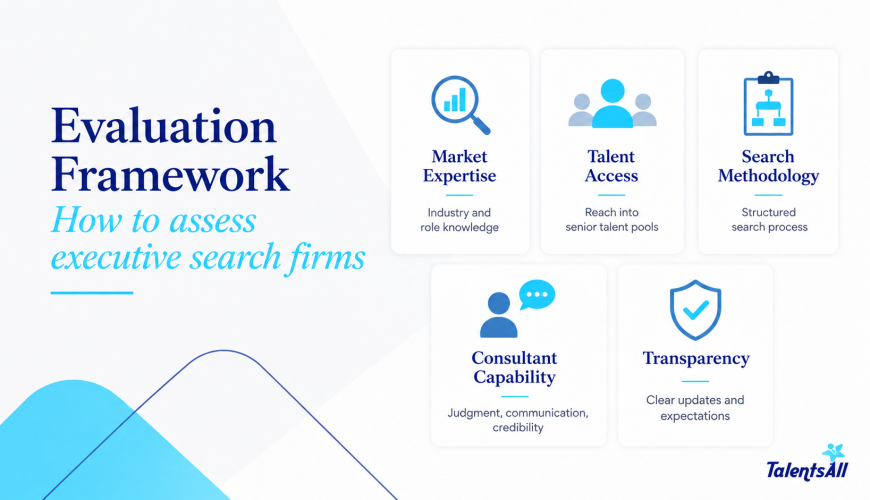
Choosing among executive search firms in Vietnam for senior hiring requires more than comparing brand reputation, candidate databases or recruitment fees. A strong shortlist should reflect five areas. These are market expertise, talent access, search methodology, consultant capability and transparency.
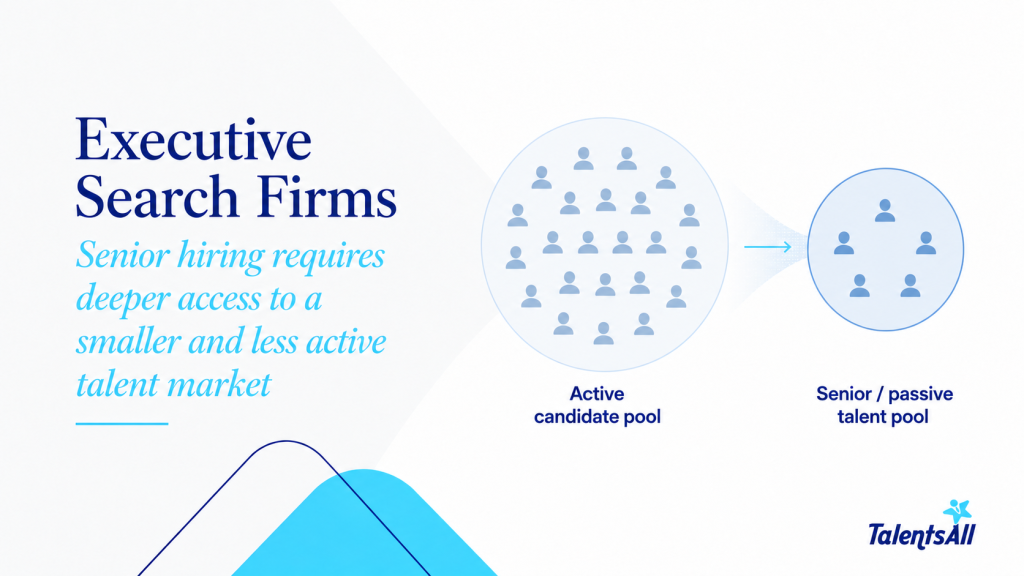
Senior hiring works differently from volume recruitment. The relevant candidate pool is often smaller. Many qualified professionals are also not actively looking for another role.
The challenge is therefore less about generating more CVs. It is about identifying which firm can reach, engage and assess the right people.
The key question is not “Which executive search firm looks strongest overall?” but “Which firm is best equipped to solve this specific hiring problem?”
1. What Types of Executive Search Firms in Vietnam Can Employers Work With?
Executive search firms in Vietnam can differ in industry focus, search depth, consultant experience and engagement model. Understanding these differences helps employers avoid comparing suppliers designed for different recruitment problems.
1.1. General Recruitment and Executive Search Serve Different Hiring Needs
General recruitment usually emphasizes sourcing coverage and candidate flow. Executive Search is more relevant when the role is senior, confidential or difficult to fill.
For relatively common positions, a recruitment agency may create value by expanding sourcing capacity. It can also screen candidates and introduce suitable profiles from an existing network.
Senior hiring often requires a different level of work.
A firm may need to understand the business mandate first. It may then map relevant companies and identify passive candidates. It must also explain the opportunity credibly to professionals who are not actively job searching.
The difference is therefore not simply the title or seniority of the candidate. It is also the depth of search required.
TalentsAll provides a broader comparison of these recruitment models in RPO vs Executive Search vs In-house Recruitment.
1.2. Specialist Executive Search Firms Can Offer Deeper Market Context
Specialist executive search firms focus on particular industries, functions or leadership segments. This can be valuable when the role depends heavily on market-specific experience.
For example, a firm may work regularly with manufacturing leadership. It may understand how Plant Manager and Operations Director roles differ across organizations.
The firm may also know which adjacent industries contain transferable talent. It can understand how expectations differ between local companies, FDI manufacturers and regional organizations.
However, specialization should not be judged only by sectors listed on a company profile.
The more useful question is whether that expertise improves the search. It should help the firm decide where to search and which candidates to prioritize. It should also improve candidate assessment.
1.3. Executive Search Is Most Relevant When Search Depth Matters
Executive Search becomes more valuable when the hiring challenge cannot be solved effectively through broader sourcing alone.
This often happens when the position has a narrow talent pool. It can also apply to confidential searches or roles that depend on passive candidates.
A structured search may begin by defining the target market. The firm can then identify relevant organizations before approaching candidates.
The next stages may include direct outreach, candidate assessment, market feedback and shortlist development.
Before comparing executive search firms in Vietnam, companies should clarify the real problem. They need to know whether candidate flow is simply too low. They should also consider whether the role requires a deeper market search.
2. Why Does Senior Hiring Require a Different Way to Shortlist Executive Search Firms?
Senior hiring requires a different shortlist because search quality depends on several factors. The firm must understand the business context, identify a limited talent pool and engage experienced candidates.
2.1. Senior Candidate Pools Become Narrow Quickly
The more specific the leadership mandate becomes, the smaller the number of professionals who genuinely fit it.
Consider a manufacturing company looking for an Operations Director. The company may need someone who has managed several functions and led a large workforce.
It may also require FDI experience and a strong transformation background.
A long list of candidates may hold the title “Operations Director”. Only a smaller group may have the right combination of scale, industry exposure and leadership experience.
At this level, a large database becomes less important. The greater value lies in knowing where relevant talent sits. It also lies in identifying adjacent profiles that could succeed.
2.2. Strong Candidates May Not Be Looking for a New Job
Many qualified senior professionals are already employed. They may only explore a move when the opportunity improves responsibility, authority or career direction.
A recruiter therefore needs to explain more than the job title and salary range.
A candidate may want to know why the role is open. They may ask what business challenge the new leader will inherit. Reporting lines and first-year expectations may also influence the decision.
This means the consultant becomes part of the hiring experience.
Access to the candidate alone may not be enough. The consultant must understand the mandate well enough to hold a credible conversation.
2.3. The Cost of a Weak Senior Hire Extends Beyond Recruitment
A senior hiring mistake can affect team performance, strategic decisions, customer relationships and business execution. Assessment quality therefore matters as much as shortlist speed.
Two candidates may have similar titles and years of experience. Their capabilities can still be very different.
One may have managed a stable organization with mature systems. Another may have built a new function or led a major transformation.
If the company needs a change leader, those profiles are not interchangeable.
A strong Executive Search firm should understand this difference before candidates reach the interview stage.
3. Five Criteria for Evaluating Executive Search Firms in Vietnam
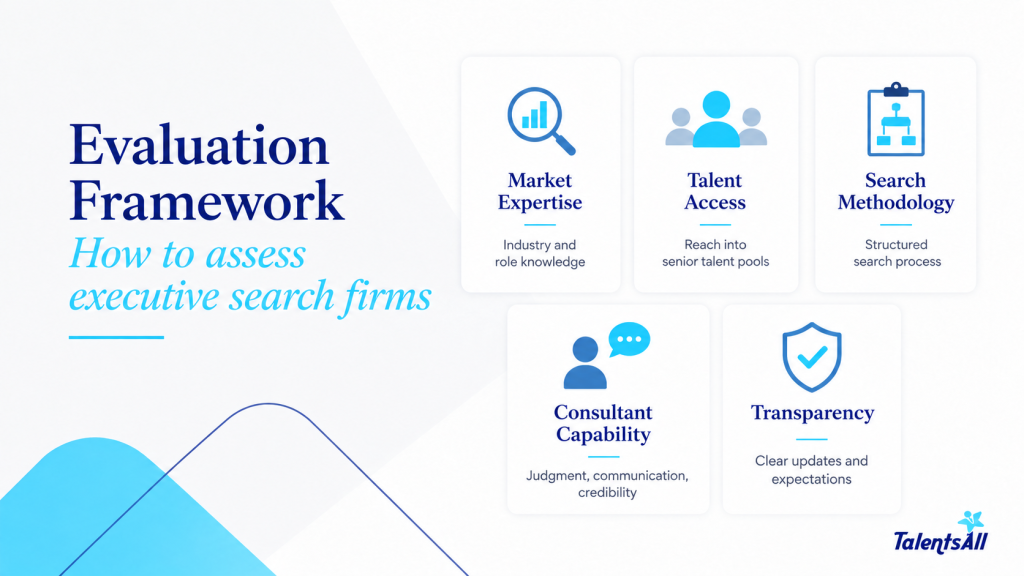
Executive search firms in Vietnam should be evaluated across five areas. These are Market Expertise, Talent Access, Search Methodology, Consultant Capability and Transparency. Together, they provide a stronger basis for comparison than fee or company size alone.
3.1. Market Expertise: Does the Firm Understand the Relevant Talent Market?
Market Expertise connects the hiring mandate with the reality of the candidate market. This includes talent availability, career paths, compensation and relevant competitor organizations.
A strong firm should know where comparable talent is likely to be found. It should also assess whether the original brief is realistic.
For example, a search may become difficult because the target industry is too narrow. In another case, the job title may not match the actual responsibility.
Compensation and location can also reduce the available talent pool before sourcing begins.
Market Expertise is therefore more than experience with similar job titles. It is the ability to turn market knowledge into a better search strategy.
TalentsAll discusses this issue further in Why Job Descriptions Fall Short in Executive Search.
3.2. Talent Access: Can the Firm Reach Beyond Its Existing Database?
Talent Access reflects the firm’s ability to identify and engage the relevant market. This includes professionals who are not already active candidates.
A database can provide a useful starting point. Difficult senior searches often require more.
The right candidate may currently work for a competitor. They may never have spoken with the search firm. They may also have no immediate intention of changing jobs.
In that situation, the firm must identify organizations with relevant talent. It then needs to find suitable individuals and create enough interest for a conversation.
This is where talent mapping and direct search become more important than database size.
TalentsAll explains this approach in more detail in Executive Talent Mapping in Vietnam.
3.3. Search Methodology: How Will the Assignment Actually Be Run?
A clear Search Methodology shows how an Executive Search firm moves from understanding the business need to presenting suitable candidates.
The exact process may differ between firms. Employers should still understand the logic behind it.
A credible search usually begins with clarifying the mandate. The firm then defines the relevant market.
Candidate identification and outreach follow once the firm has a working search hypothesis.
Assessment then determines whether each profile matches the real scope and business context. Only then should a shortlist be presented.
The most important question is what happens when the initial assumptions do not work.
A strong methodology should adapt to candidate feedback and market response. It should not simply repeat the same sourcing activity.
3.4. Consultant Capability: Who Will Actually Represent the Search?
The reputation of the firm and the capability of the consultant should be assessed separately. The consultant directly influences candidate engagement and market feedback.
The person presenting the proposal may not always speak with candidates.
For senior hiring, this distinction matters.
The consultant handling the mandate should understand the industry. They should ask the right questions about the business.
They must also explain the opportunity credibly to experienced professionals.
A capable consultant should challenge unrealistic assumptions when needed. Market evidence may show that the original brief requires adjustment.
A well-known firm can still deliver an inconsistent experience. This can happen when the assigned consultant lacks enough context or seniority.
3.5. Transparency: Will the Firm Explain What the Market Is Saying?
Transparency means giving employers a realistic view of candidate availability, search constraints and market response. It should go beyond reporting positive activity.
A difficult senior search does not always mean the supplier is underperforming.
Sometimes compensation is below market expectations. The target profile may also be too narrow. Location can further reduce candidate mobility.
In other cases, suitable candidates may question the reporting structure. They may also see little difference between the new opportunity and their current role.
This feedback helps the company decide whether to adjust the search. It is more useful than simply waiting for more CVs.
TalentsAll explores transparency and market understanding further in What Truly Defines a Leading Executive Search Firm.
4. Five Questions to Ask Before Shortlisting Executive Search Firms
Before placing a firm on the shortlist, employers should test how it thinks about the specific mandate. Credentials, client logos and network claims are not enough.
4.1. Which Talent Pools Would You Target First?
The answer should show whether the firm already has a logical view of where relevant talent may exist.
For a Plant Manager search, company and industry targets matter more than database size.
A thoughtful answer should identify relevant competitors or adjacent manufacturing segments. It should also explain why those talent pools matter.
4.2. How Would You Search Beyond Your Existing Database?
This question helps determine whether the firm can search beyond candidates who are already easy to reach.
A strong answer may involve competitor mapping or direct search. It can also include industry referrals, passive outreach or adjacent-sector research.
The goal is not to require one specific sourcing method.
It is to understand what happens when the obvious candidates are not enough.
4.3. Who Will Personally Manage the Search?
Knowing who will run the assignment helps employers assess whether the consultant has enough market context and credibility for the hire.
The person pitching the account may differ from the consultant executing the search.
If so, the company should understand how the mandate will be transferred.
Senior candidates need consistent information. Differences in role scope, reporting line or expectations can reduce confidence in the opportunity.
4.4. How Will Candidates Be Assessed Before Presentation?
The answer should show whether the firm evaluates business fit and career context before forwarding a candidate profile.
For senior hiring, useful assessment may cover responsibility scale and measurable outcomes. It can also include leadership, decision authority, motivation and compensation expectations.
The employer should receive enough context to understand why each candidate belongs on the shortlist.
4.5. What Happens If the Market Does Not Match the Original Brief?
A strong Executive Search partner should challenge the mandate when market evidence shows that the original assumptions are limiting the search.
The issue may involve compensation or seniority. Location, industry background and excessive must-have criteria can also create problems.
The answer helps distinguish two types of firms.
One simply continues sourcing. The other helps the employer improve the search strategy.
5. When Is a Lower Executive Search Fee Not the Better Choice?
A lower Executive Search fee is not automatically better. Some mandates require deeper market mapping, experienced consultants and more intensive passive-candidate engagement.
Imagine two firms proposing different terms for the same Sales Director search.
The first offers a lower fee. Its service focuses mainly on sourcing and candidate presentation.
The second charges more. It includes market calibration, competitor mapping, passive outreach, structured assessment and regular market feedback.
The first proposal is clearly cheaper.
Whether it represents better value depends on the role.
If the talent pool is broad, the lower-cost model may be sufficient. This is especially true when the internal team can handle deeper assessment.
If the role has been open for months, the situation changes. Relevant candidates may be difficult to reach. In that case, additional search depth may justify a higher fee.
The more useful comparison is:
What level of search work is included in the fee, and does it match the complexity of the mandate?
Commercial terms still matter. They should simply be evaluated alongside search capability, consultant involvement and candidate assessment.
6. How Should Employers Compare Executive Search Firms in Vietnam?
Employers should compare executive search firms in Vietnam using the same decision framework. This prevents one attractive feature from dominating the supplier decision.
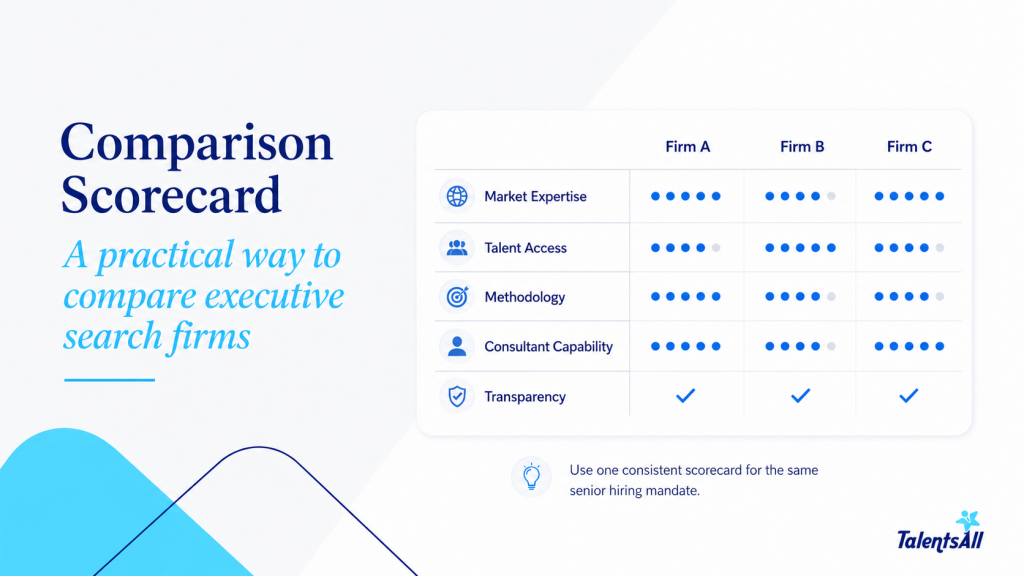
The five criteria above can become a practical comparison scorecard.
| Evaluation Area | Firm A | Firm B | Firm C |
|---|---|---|---|
| Market Expertise | 1–5 | 1–5 | 1–5 |
| Talent Access | 1–5 | 1–5 | 1–5 |
| Search Methodology | 1–5 | 1–5 | 1–5 |
| Consultant Capability | 1–5 | 1–5 | 1–5 |
| Transparency | 1–5 | 1–5 | 1–5 |
| Commercial Terms | 1–5 | 1–5 | 1–5 |
| Overall Fit for the Mandate | 1–5 | 1–5 | 1–5 |
The score itself is not the final decision.
Its purpose is to ensure each firm is evaluated on the same basis.
6.1. Weight the Criteria According to the Hiring Problem
The importance of each criterion should change with the mandate. A confidential leadership replacement creates different risks from a broader management search.
For a Country Manager replacement, confidentiality may carry more weight. Consultant capability and access to senior passive talent may also be critical.
For a less sensitive search, speed may matter more. Commercial terms may also carry greater weight.
The scorecard should reflect the business problem. It should not become a fixed procurement template.
6.2. Compare Evidence Rather Than General Claims
Specific evidence is more useful than broad claims such as “strong network”, “large database” or “fast turnaround”.
Instead of asking whether a firm understands manufacturing, ask something more specific.
“Which talent pools would you prioritize for this Plant Manager role, and why?”
Instead of asking whether it has senior candidates, ask:
“How would you identify relevant professionals who have never entered your database?”
Specific questions make the comparison more useful.
6.3. Select the Firm for the Mandate, Not for Every Future Vacancy
The strongest Executive Search firm for one assignment is not automatically the best supplier for every senior hire.
Different firms may have different strengths across sectors and functions. They may also perform differently across geographies or leadership levels.
A company may use one partner for a confidential executive role. Another firm may be more suitable for a broader professional search.
The decision should answer:
Which firm is best suited to this mandate?
rather than:
Which firm is best overall?
7. Working With TalentsAll for Executive Search in Vietnam
TalentsAll supports enterprises, FDI companies and global organizations with senior and hard-to-fill recruitment. The approach combines role clarification, talent-market understanding, targeted search and candidate assessment.
For critical positions, the process starts with understanding what the business expects the new leader to deliver.
Role scope and decision authority influence the search. Required experience and candidate availability matter as well.
Compensation expectations and market constraints can also affect the final approach.
This context helps define a realistic talent market before sourcing begins.
TalentsAll also uses talent mapping when companies need deeper market visibility. It can help assess whether the intended leadership profile is available. It can also show where relevant professionals may be located.
This process may reveal assumptions that need adjustment before the search progresses.
Hiring a senior or hard-to-fill role in Vietnam? Discuss the mandate with TalentsAll to assess the market and determine whether our Executive Search approach fits your hiring requirements.
8. Frequently Asked Questions About Executive Search Firms in Vietnam
The questions below address common concerns when comparing executive search firms in Vietnam for senior and leadership hiring.
8.1. How Many Executive Search Firms in Vietnam Should an Employer Shortlist?
There is no universal number. Employers usually gain more value from evaluating a small number of relevant firms in depth.
The more specialized the vacancy, the more important relevance becomes.
A focused shortlist also supports better conversations. Employers can explore the talent market, search strategy and consultant capability in more depth.
8.2. Should Executive Search Firms Have Industry Experience?
Industry experience is valuable when it improves understanding of talent pools, career paths, role differences and candidate expectations.
The employer should examine what that experience changes about the proposed search.
Previous sector experience is useful only when it leads to better search and assessment decisions.
8.3. Is a Large Candidate Database Important When Comparing Executive Search Firms?
A large database can support the search. It does not prove that the firm can reach the full senior talent market.
Many suitable executives may never have interacted with the firm.
For hard-to-fill roles, external identification and direct outreach can matter more than database size.
8.4. Should Employers Always Choose Specialist Executive Search Firms?
No. Specialist firms are most valuable when sector or functional expertise improves candidate identification, assessment or engagement.
A broader firm may still be appropriate for roles with a wider talent pool.
The mandate should determine the choice.
8.5. What Is the Most Important Factor When Choosing Executive Search Firms in Vietnam?
The most important factor is whether the firm can solve the specific hiring problem. That requires market understanding, talent access, methodology, consultant capability and transparent communication.
No single factor should determine the decision.
A lower fee may be appropriate for one search. Deeper market access may matter more for another.
The strongest shortlist is built around the mandate. It should not rely on a universal definition of the “best” Executive Search firm.
TalentsAll | Talents for All, All for Talents