How to Evaluate an Executive Search Proposal Beyond the Fee
An Executive Search proposal should be evaluated on more than recruitment fee. Employers should compare the search scope, talent-market coverage, consultant involvement, candidate assessment and commercial terms behind each proposal.
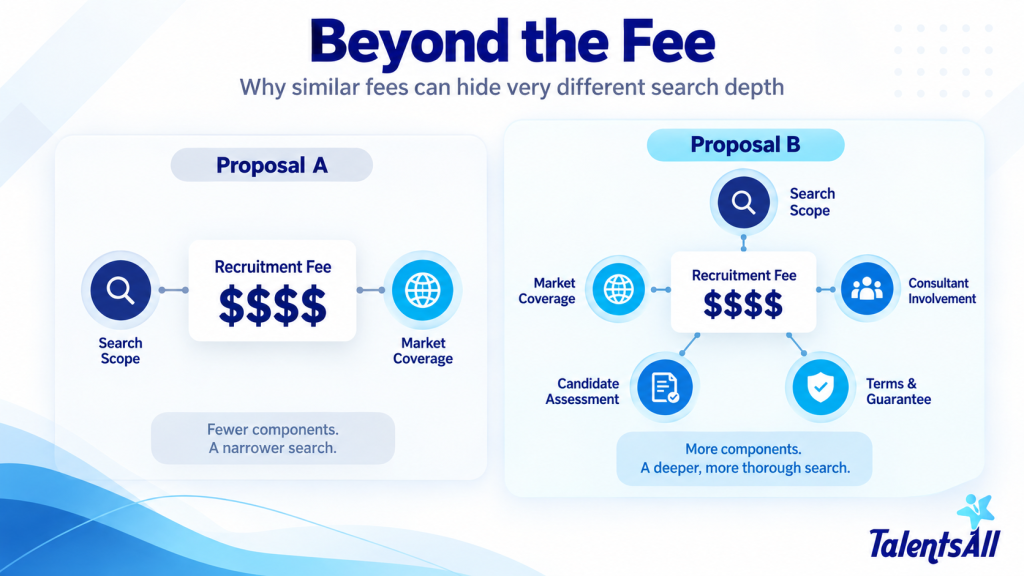
Two firms may quote different fees for the same senior role. The lower figure may look more attractive, but it may also include a narrower search or less consultant involvement.
The better question is not “Which Executive Search proposal costs less?” but “Which proposal gives us the right level of search for this mandate?”
1. What Does an Executive Search Proposal Usually Include?
An Executive Search proposal usually explains the hiring mandate, proposed search approach, scope of work, consultant involvement, commercial terms and guarantee conditions. The level of detail can vary significantly between firms.
A basic proposal may focus on the company profile, service description, fee and payment terms. A more detailed version can also explain how the firm defines the target market, approaches passive candidates and assesses profiles before presentation.
This difference matters because a proposal is more than a price quotation. It also gives employers an early indication of how the Executive Search firm understands the assignment and plans to execute it.
1.1. The Executive Search Proposal Should Reflect the Actual Mandate
A useful Executive Search proposal should show that the firm understands why the role exists and what the employer needs the new hire to achieve.
A Plant Manager search for a stable factory differs from a search for a leader expected to improve productivity and restructure operations. The title may be identical, but the target profiles can be very different. Therefore, the proposal should reflect the business context, role scope and search difficulty. If it appears interchangeable with a proposal for any other vacancy, the employer may need to clarify how deeply the mandate has been understood.
1.2. Commercial Terms Are Only One Part of the Proposal
Fee, payment schedule and guarantee terms are important, but they do not explain the full search process.
Employers also need to understand what happens before a shortlist is presented. This includes how the talent market will be defined, how candidates will be identified and how much assessment the firm will conduct. Once the work behind the fee becomes clear, the commercial proposal becomes much easier to evaluate.
2. Why Does Recruitment Fee Not Show the Full Value of an Executive Search Proposal?
Recruitment fee shows the commercial cost of the assignment, but it does not reveal the depth of search, quality of assessment or level of consultant involvement included in the proposal.
Imagine two Executive Search firms quoting for the same Commercial Director role. The first charges a lower percentage and focuses mainly on sourcing, candidate screening and profile presentation. The second charges more but includes market calibration, competitor mapping, passive outreach and regular market feedback.
The first proposal is clearly cheaper. Whether it provides better value depends on the actual hiring problem.
2.1. Similar Fees Can Cover Different Levels of Search
Two Executive Search proposals with similar fees can still represent very different levels of work.
One firm may begin with its existing candidate network, while another builds a target-company map before approaching candidates. Similarly, one may present CVs after basic screening, while another assesses role scope, career motivation and leadership experience first. The fee alone does not reveal these differences.
2.2. The Cost of the Search Should Match the Complexity of the Role
A more complex mandate may justify a deeper and more expensive search when the additional work improves access to the right talent.
A broad professional role may not require intensive mapping. A confidential Country Manager replacement is different because the candidate pool is smaller, discretion matters and passive engagement may require more time. The right comparison is therefore the relationship between search complexity and service depth, not simply the percentage fee.
3. How to Read an Executive Search Proposal in Five Layers
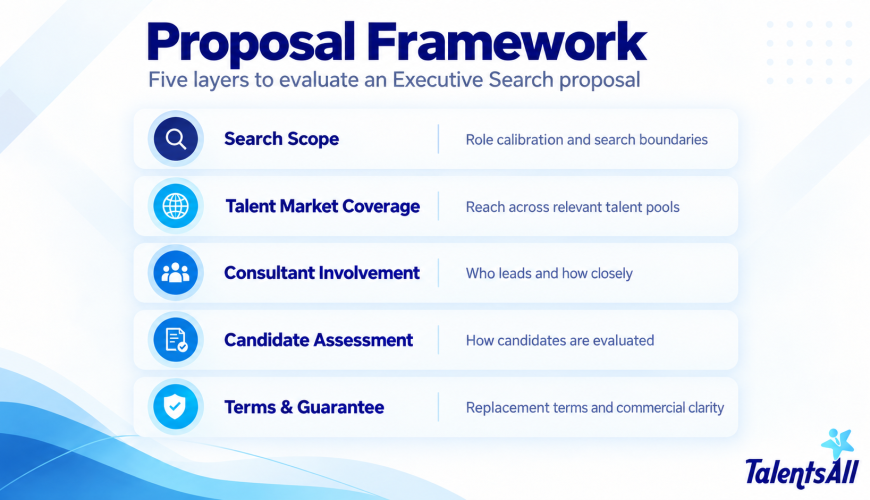
Employers can evaluate an Executive Search proposal through five layers: Search Scope, Talent Market Coverage, Consultant Involvement, Candidate Assessment and Terms & Guarantee. Together, these areas show what the firm will actually deliver.
3.1. Search Scope: What Work Is Included in the Executive Search Proposal?
Search Scope defines what the firm will do from the initial briefing until the assignment is completed.
The proposal should show whether the firm only sources candidates or also supports role calibration, talent mapping and candidate assessment. It should also explain what happens after the shortlist. Some firms remain involved through interviews and offer negotiation, while others reduce their role once profiles are presented.
A wider scope is not automatically better. The important question is whether that scope matches what the employer actually needs.
3.2. Talent Market Coverage: How Broadly Will the Firm Search?
Talent Market Coverage shows how the Executive Search firm intends to define and explore the relevant candidate market.
For difficult senior roles, the search may need to extend beyond active candidates and existing databases. The firm may start with direct competitors, then consider adjacent industries with similar business models or customer groups. Location can also shape the strategy, so the proposal should show that the relevant talent market has been considered deliberately.
3.3. Consultant Involvement: Who Will Actually Run the Search?
Consultant Involvement shows how much senior attention the assignment receives and who will represent the employer to candidates.
The person presenting the proposal may not always manage the search. Employers should therefore know who will lead the briefing, approach candidates and provide market feedback. This matters because senior candidates often ask detailed questions before agreeing to an interview.
A capable consultant should understand the business context well enough to explain the opportunity credibly. They should also be able to challenge unrealistic assumptions when market feedback points in another direction.
3.4. Candidate Assessment: What Happens Before a Profile Is Presented?
Candidate Assessment explains how the firm decides whether a professional fits the business mandate before recommending that person to the employer.
A CV can confirm previous employers, titles and career history, but it cannot fully show leadership scope or motivation. For a senior search, the firm may need to understand team size, decision authority, business impact and measurable outcomes. If the company needs a transformation leader, for example, change experience may matter more than years spent in the same industry.
The proposal should make this assessment logic clear enough for the employer to understand what happens before a profile reaches the shortlist.
3.5. Terms & Guarantee: What Happens After the Search Starts?
Terms and Guarantee define the commercial rules of the assignment and what happens if the placement does not work as expected.
Payment structure, candidate ownership and guarantee period should all be clear. Employers also need to know when payment becomes due, what counts as a successful introduction and how duplicate candidates are handled. A longer guarantee is not automatically better because its real value depends on the replacement conditions attached to it.
4. Four Questions to Clarify Before Comparing Executive Search Proposals
Before comparing two proposals, employers should clarify what is included, who will execute the search, how the market will be approached and what happens if the original mandate does not work.
4.1. What Is Included in the Quoted Executive Search Fee?
The employer should understand what level of work sits behind the quoted fee before comparing percentages.
The proposal may include market mapping, direct passive outreach or candidate assessment, but these services should not be assumed. Clarifying the scope allows employers to compare like with like because two similar-looking fees can cover very different levels of service.
4.2. Who Will Personally Run the Assignment?
The employer should know who will manage the search after the proposal is accepted.
A senior partner may lead the pitch while another consultant handles delivery. That structure can work well, but responsibilities should remain clear. Employers need to know who speaks with candidates and who provides market feedback because consultant quality is part of the proposal value.
4.3. How Will the Search Expand If the Initial Talent Pool Is Too Narrow?
The proposal should explain how the firm will respond when the first search assumptions do not produce enough qualified candidates.
A search may begin with direct competitors and later expand into adjacent sectors. The firm may also review location, compensation or seniority if market feedback shows that these factors are limiting the pool. This question helps employers understand whether the methodology can adapt rather than simply repeat the same sourcing activity.
4.4. What Information Will We Receive During the Search?
A useful Executive Search process should provide market feedback, not only candidate profiles.
The employer may need to understand why candidates are declining or which requirements are restricting the pool. This information can help improve the mandate while the search is still active. Therefore, the proposal should explain how updates will work and what level of market insight will be shared.
5. When Can a Higher Executive Search Fee Still Be Worth Considering?
A higher Executive Search fee can be justified when the proposal provides deeper market access, stronger consultant involvement or more relevant assessment for a difficult mandate.
Consider a company replacing a confidential senior executive. One firm quotes a lower fee and relies mainly on its existing network. Another proposes a higher fee but includes market mapping, targeted passive outreach and senior consultant involvement throughout the assignment.
The higher fee may represent better value when those capabilities directly address the difficulty of the search.
5.1. When the Relevant Talent Pool Is Limited
A higher fee may be reasonable when finding the right candidate requires more research and direct market engagement.
A narrow talent pool cannot be solved simply by increasing CV volume. The firm may need to identify professionals who have never interacted with a recruiter before, which requires more search depth than a database-led assignment.
5.2. When Consultant Seniority Matters
A more experienced consultant can add value when the mandate requires complex candidate conversations or sensitive market feedback.
Senior candidates may ask about reporting lines, business risk and decision authority before agreeing to continue. The consultant must represent the employer accurately and may also need to help the hiring manager recalibrate the brief when market evidence suggests an adjustment.
5.3. When the Business Cost of a Wrong Hire Is High
The value of deeper search can increase when the role has significant influence on business results.
A failed senior hire can disrupt a team, delay transformation and weaken business continuity. In these cases, paying more for a stronger search may be reasonable when the additional work reduces meaningful hiring risks.
6. How to Compare Two Executive Search Proposals on the Same Basis
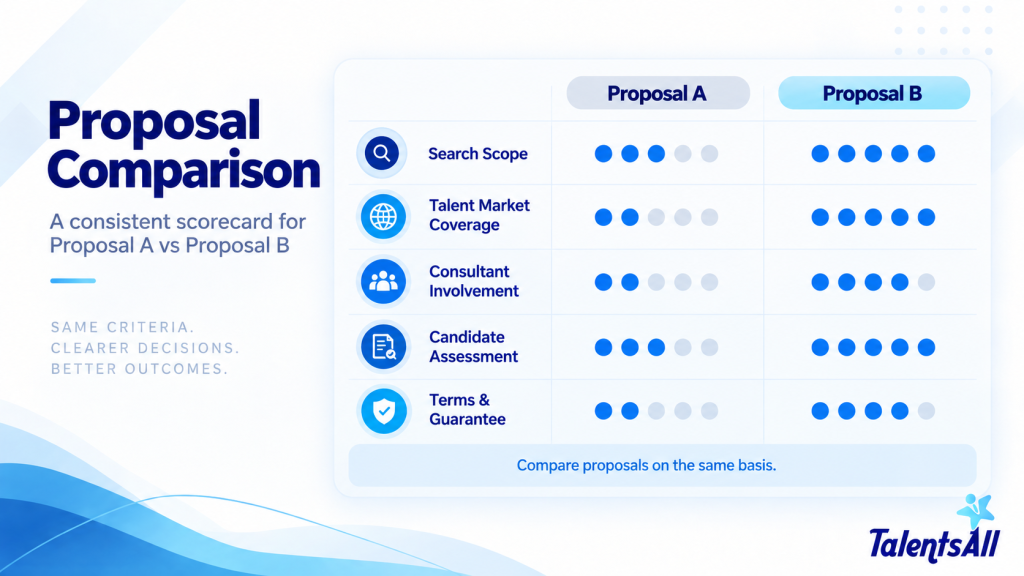
Two Executive Search proposals should be compared using the same criteria. This prevents recruitment fee from dominating the decision before service depth is understood.
A simple scorecard can help:
Evaluation Area
Proposal A
Proposal B
Search Scope
1–5
1–5
Talent Market Coverage
1–5
1–5
Consultant Involvement
1–5
1–5
Candidate Assessment
1–5
1–5
Market Feedback
1–5
1–5
Terms & Guarantee
1–5
1–5
Recruitment Fee
1–5
1–5
Overall Fit for the Mandate
1–5
1–5
The score should not make the decision automatically. Its purpose is to place both proposals on the same basis.
6.1. Compare the Executive Search Proposal Against the Hiring Problem
The proposal should be evaluated against the specific difficulty of the mandate rather than against a fixed procurement template.
For a confidential leadership replacement, market coverage and consultant involvement may deserve more weight. For another senior search, assessment quality or geographic reach may matter more. The scorecard should reflect these differences rather than apply the same weighting to every assignment.
6.2. Separate Search Value From Commercial Cost
Search value and commercial cost should be compared separately before the final decision is made.
A low fee does not automatically indicate weak value, just as a high fee does not guarantee a better search. The employer first needs to understand what each proposal will actually deliver. Only then can the commercial difference be evaluated fairly.
6.3. Look for the Best Fit, Not the Most Impressive Proposal
The strongest proposal is the one that fits the mandate, not necessarily the one with the most detailed presentation or broadest service list.
A sophisticated methodology may be unnecessary for a relatively straightforward role, while a minimal search model may be insufficient for a confidential senior hire. The proposal should solve the actual hiring problem without adding unnecessary complexity.
7. TalentsAll Executive Search in Vietnam
TalentsAll supports senior and hard-to-fill recruitment by combining mandate clarification, talent-market understanding, targeted search and candidate assessment.
The process starts by understanding what the business expects the new hire to deliver. Role scope, decision authority and target talent availability all influence the search, while market feedback can reveal whether compensation, location or candidate requirements need adjustment.
TalentsAll works with enterprises, FDI companies and global organizations on senior recruitment and Executive Search assignments in Vietnam.
Considering an Executive Search proposal for a senior hire? Discuss the mandate with TalentsAll to understand the talent market and the level of search the role may require.
8. Frequently Asked Questions About Executive Search Proposals
The questions below address common issues employers may encounter when reviewing an Executive Search proposal for senior hiring.
8.1. What Should an Executive Search Proposal Include?
An Executive Search proposal should explain the scope of work, search approach, consultant involvement, candidate assessment, commercial terms and guarantee conditions.
For difficult senior roles, it may also explain how the target market will be defined. The proposal should give the employer enough information to understand what happens after the agreement is signed.
8.2. Should Employers Choose the Executive Search Proposal With the Lowest Fee?
Not always. The lowest fee can be appropriate when the role is relatively straightforward and requires limited search depth.
A more complex mandate may require deeper market mapping, direct passive outreach and greater consultant involvement. Employers should therefore compare the service behind the fee before making the final decision.
8.3. How Important Is Market Mapping in an Executive Search Proposal?
Market mapping becomes more important when the relevant talent pool is narrow or difficult to access.
It helps the employer understand where suitable candidates may be found and whether the original hiring assumptions are realistic. For broader candidate markets, extensive mapping may be less necessary.
8.4. Should an Executive Search Proposal Include a Guarantee?
Yes. Most proposals should clearly explain any guarantee or replacement conditions that apply to the assignment.
The employer should understand both the guarantee period and the situations covered. A longer period does not automatically provide stronger protection because the practical conditions matter more than the number of months alone.
8.5. Can Employers Negotiate an Executive Search Proposal?
Yes. Employers can clarify or negotiate commercial terms, service scope and operating expectations before signing.
The discussion should not focus only on fee. Reporting frequency, consultant involvement and candidate ownership may also need clarification. A good proposal discussion helps both sides understand what the assignment requires before the search begins.
TalentsAll | Talents for All, All for Talents
Explore TalentsAll’s Executive Search solutions for senior and hard-to-fill roles in Vietnam.
Follow recruitment and Vietnam talent-market updates on TalentsAll LinkedIn.