
A confidential executive search in Vietnam requires more than discreetly approaching potential candidates. When an FDI company or multinational corporation needs to replace a senior leader before announcing the decision internally, the search becomes a matter of information control, stakeholder alignment and business continuity. A poorly managed process can create uncertainty among employees, expose sensitive plans or damage the trust of both current executives and prospective candidates.
For CEOs, Country Managers and HR Directors, the challenge is balancing confidentiality with a credible recruitment process. Who should know about the mandate? When can the employer’s identity be disclosed? How should candidate information be protected, and who has authority to approve each stage? This guide outlines a practical governance framework for managing confidential executive replacement in Vietnam, from the initial mandate to leadership transition.
1. Why Confidential Executive Replacement Requires a Different Approach
Replacing an existing executive is fundamentally different from recruiting for an openly vacant position. The company may need to evaluate successors while the current leader remains responsible for operations, employees and key business relationships.
In this situation, the recruitment process creates risks beyond whether the company can identify qualified candidates. Even an early indication that a leadership change is being considered may affect internal confidence, external perceptions or the working relationship with the incumbent executive.
1.1. Confidentiality Is About Controlled Disclosure, Not Complete Secrecy
Confidential recruitment does not mean withholding information from everyone throughout the process. Certain stakeholders must understand the mandate to authorize the search, assess candidates and prepare the eventual transition. Candidates also need sufficient information to evaluate whether the opportunity is credible and relevant.
The objective is to establish clear rules governing what information can be disclosed, to whom and at which stage. A well-managed confidential search limits unnecessary exposure while ensuring that authorized decision-makers and candidates receive the information required to make informed decisions.
1.2. Three Groups Face Different Confidentiality Risks
The employer faces the risk of premature disclosure affecting business continuity, internal relationships and organizational stability. The incumbent executive may face professional or reputational consequences if unconfirmed replacement discussions become known. Prospective candidates face a different concern: their current employment could be affected if their interest in another opportunity is disclosed without authorization.
These risks cannot be managed through a general instruction to keep the assignment confidential. Each group requires appropriate safeguards, communication boundaries and clearly assigned responsibilities. The Association of Executive Search and Leadership Consultants (AESC) emphasizes confidentiality as an obligation to both clients and candidates, including protecting a candidate’s interest in an opportunity.
2. Establish the Confidentiality Framework Before Launching the Search
The most effective time to establish confidentiality rules is before market mapping or candidate outreach begins. Once information enters the market, employers may have limited control over how it is interpreted or shared.
For FDI and MNC organizations, the framework should clarify the business mandate, authorized stakeholders, disclosure permissions and escalation procedures.
2.1. Confirm the Mandate and Decision Authority
Before contacting candidates, the employer should establish whether the assignment involves a confirmed leadership replacement, contingency succession planning or exploration of alternative leadership capabilities. These situations have different implications for search timing, candidate communication and internal approval.
The CEO, Board or other authorized decision-maker should approve the assignment’s purpose and scope. HR should also confirm the incumbent executive’s contractual position, applicable employment requirements and any internal governance obligations with qualified legal advisers. An Executive Search partner can support the recruitment process, but it should not determine whether or how the employment relationship with the incumbent will end.
2.2. Define a Need-to-Know Confidentiality Circle
A confidential search should operate within a deliberately limited group of stakeholders. Depending on the mandate, this may include the CEO or Board representative, Regional HR Director, designated local HR leader and an authorized Executive Search consultant.
The group should be small enough to control information but sufficiently qualified to make decisions. Additional stakeholders may be introduced when their participation becomes necessary for assessment or approval. Employers should avoid including individuals simply because they would normally participate in an open recruitment process.
2.3. Classify Information by Disclosure Level
Not all information involved in an executive replacement carries the same sensitivity. A general description of leadership responsibilities may be suitable for initial market discussions, while the employer’s identity, incumbent’s position and internal business circumstances may require stricter controls.
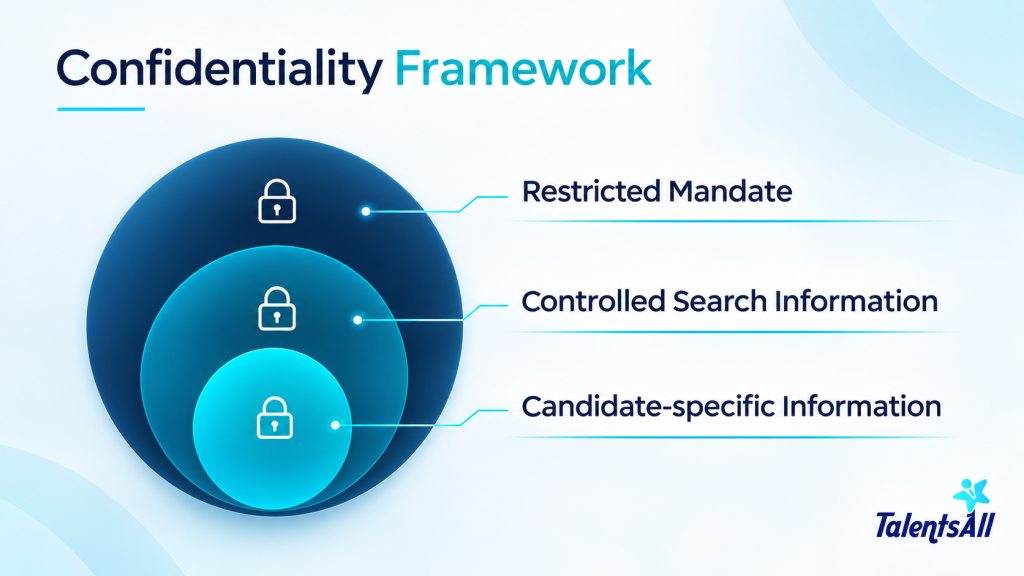
A practical confidentiality structure can use three levels:
| Disclosure Level | Information | Recommended Control |
|---|---|---|
| Level 1: Restricted Mandate | Replacement rationale, incumbent information, Board discussions and sensitive business plans | Limited to explicitly authorized decision-makers |
| Level 2: Controlled Search Information | Role requirements, industry context, leadership expectations and approved opportunity description | Shared through the authorized search team under defined disclosure rules |
| Level 3: Candidate-specific Information | Candidate identity, career history, compensation expectations, assessments and references | Shared only with authorized recipients, subject to applicable privacy requirements and candidate permissions |
Employers should also recognize that information may become identifiable when combined. A description containing the industry, location, reporting line and unusual role requirements could reveal the organization even without mentioning its name.
The search team must assess disclosure risk in context rather than assuming that removing names makes information anonymous.
2.4. Establish One Authorized Communication Channel
Confidential executive recruitment can become difficult to control when multiple HR staff, external agencies or senior executives independently approach the same market.
The employer should appoint a search owner responsible for maintaining the approved mandate, candidate-contact records and information-sharing decisions. Communications should use authorized systems, restricted access and documented responsibilities.
For highly sensitive assignments, a consistent communication protocol can reduce duplicated outreach and conflicting messages. The aim is to prevent information fragmentation while maintaining an auditable recruitment process.
3. How to Approach Executive Candidates Without Compromising Confidentiality
Senior executives are often employed in visible leadership positions and may have limited interest in actively searching for new opportunities. Their willingness to enter a confidential recruitment process depends partly on the credibility of the approach and the confidence that their information will be handled appropriately.
For confidential replacement mandates, candidate engagement should therefore be structured around selective market mapping, transparent communication boundaries and permission-based information sharing.
3.1. Begin With Targeted Market Mapping
The search process should identify relevant leadership talent pools before approaching individuals. This may involve analyzing companies with comparable business models, assessing transferable industry experience and determining which professionals have managed responsibilities similar to the target mandate.
Market mapping does not require distributing the employer’s sensitive information across a wide network. The search team should initially work with approved role criteria and limited market intelligence, separating general research from identifiable candidate records. Employers can learn more about the market-mapping and candidate-assessment process in TalentsAll’s guide to Executive Search Progress Reports.
3.2. Use Discreet but Truthful Candidate Outreach
Initial outreach may describe an executive opportunity without immediately disclosing the employer’s name. For example, a consultant might explain that the assignment concerns a senior manufacturing leadership position within an international organization operating in Vietnam, subject to the information approved for release.
However, discretion should not become misrepresentation. Candidates should not be given false information about the employer, role status or reason the opportunity is confidential. If the consultant cannot yet disclose a material detail, the appropriate response is to explain the limitation and when further information may become available.
3.3. Agree on the Identity Disclosure Point
There should be a defined stage at which shortlisted candidates can receive sufficient information about the employer and mandate to make an informed decision about continuing.
The timing may vary according to the sensitivity of the assignment. Early exploratory conversations can remain limited, but meaningful interviews, compensation discussions and final assessments generally require increasingly specific information.
The employer and search partner should agree on this progression before outreach begins. Candidates should also understand what confidentiality commitments apply to the information they receive.
3.4. Protect Candidate Identity and Reference Information
A candidate’s willingness to explore a confidential opportunity should not automatically authorize the search consultant to share a full profile with multiple stakeholders. Identifiable information should be disclosed only through approved processes and in accordance with applicable data protection requirements.
Reference checks are particularly sensitive. Contacting a candidate’s current employer, colleagues or professional network without appropriate permission could expose the individual’s interest in leaving. Employers should establish clear candidate authorization and reference-checking procedures rather than relying on informal background inquiries.
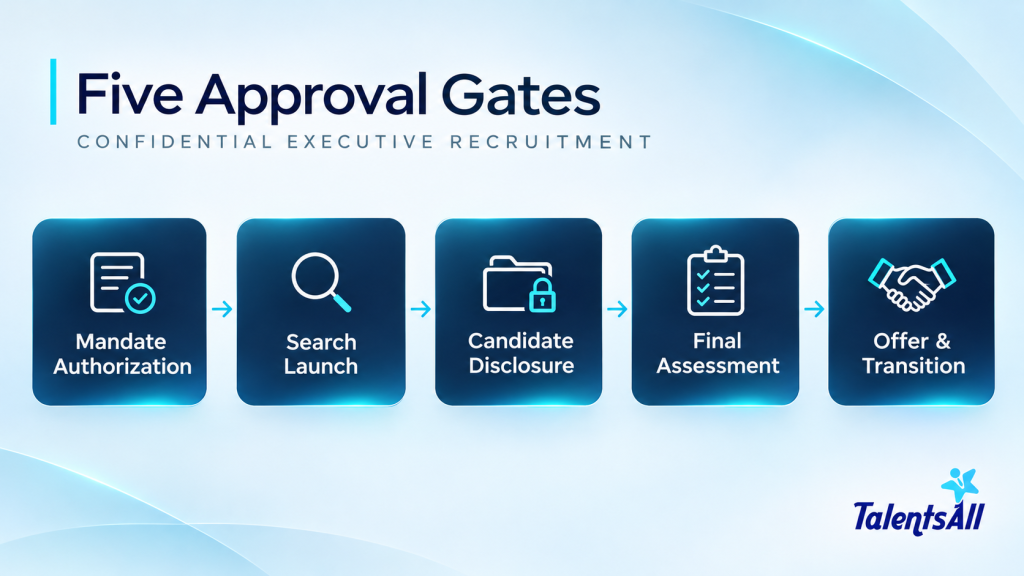
4. Five Approval Gates for Managing a Confidential Executive Search
A confidential search requires more than restricted communications. It needs defined decision points at which the company can confirm that the process remains authorized, appropriately controlled and aligned with the business mandate.
These approval gates create a practical way to manage accountability throughout the assignment.
| Approval Gate | Key Decision | Authorized Owner | Required Control |
|---|---|---|---|
| Gate 1 – Mandate Authorization | Has the confidential replacement or succession search been formally approved? | CEO, Board or designated authority | Approved scope, business rationale and confidentiality requirements |
| Gate 2 – Search Launch | Is the market approach ready? | Search owner and Executive Search partner | Approved brief, target market, outreach protocol and disclosure boundaries |
| Gate 3 – Candidate Disclosure | Can candidate identities and employer details be shared? | Authorized HR/Search Lead | Candidate permissions, access controls and disclosure approval |
| Gate 4 – Final Assessment | Are decision-makers aligned on the shortlist and evaluation criteria? | Authorized hiring committee | Structured assessment, restricted information access and documented decisions |
| Gate 5 – Offer & Transition | Is the organization ready to proceed with an offer and leadership transition? | Final approving authority, HR and Legal | Employment review, offer authorization, communication and continuity plan |
The framework is designed for practical governance rather than as a universal legal requirement. Each organization should adapt the approval structure to its Board authority, reporting arrangements and applicable obligations.
4.1. Prevent Uncontrolled Expansion of the Decision-making Group
As a search progresses, additional executives may want to review candidates or participate in interviews. Although their involvement may be valuable, expanding the group without reviewing confidentiality risks can undermine the original controls.
The search owner should confirm why each new stakeholder is needed, what information they require and whether participation has been approved. Interview feedback should be consolidated through an authorized channel rather than distributed through unrestricted internal communication.
4.2. Define Escalation Triggers Before Problems Occur
Confidential searches may encounter unexpected developments, such as a candidate recognizing the employer, an unapproved disclosure, conflicting stakeholder instructions or a potential conflict of interest involving an interviewer.
These situations should trigger a predefined escalation process. The relevant decision-makers need to determine whether outreach should continue, whether access permissions must change and whether legal or privacy specialists need to intervene. A search should not proceed automatically when its confidentiality assumptions are no longer valid.
4.3. Measure Progress Without Exposing Unnecessary Information
Search reporting remains important, even when only a small leadership group can access the assignment. However, regular reports do not always need to include identifiable candidate information.
Early updates may focus on market coverage, candidate availability, response patterns and obstacles to engagement. Identifiable profiles can be reserved for approved shortlist discussions. This enables business oversight without distributing sensitive information more widely than necessary.
5. Candidate Data Protection in Confidential Executive Search
Confidentiality obligations extend beyond keeping the employer’s identity undisclosed. Executive Search also involves collecting, evaluating and sharing personal information about candidates, including employment history, professional achievements, compensation expectations and assessment results.
For international organizations operating in Vietnam, personal data governance should be included in the search design from the beginning.
5.1. Vietnam’s Personal Data Protection Requirements
Vietnam’s Law on Personal Data Protection, No. 91/2025/QH15, took effect on January 1, 2026. Article 25 addresses personal data protection in recruitment, including limiting requested information to recruitment purposes, processing applicant information in accordance with the law and with candidate consent, and deleting or destroying information about unsuccessful applicants unless otherwise agreed.
For confidential executive assignments, employers and recruitment partners should review how candidate information is collected, shared and retained. This is particularly important when candidate profiles are distributed across several authorized stakeholders or retained for future search assignments. The full requirements should be reviewed with qualified legal and privacy advisers rather than treating confidentiality agreements as a substitute for data protection compliance.
Reference: Vietnam Law on Personal Data Protection – Law No. 91/2025/QH15.
5.2. Review Cross-border Information Access
Many multinational organizations involve regional headquarters in executive appointments. Candidate information may therefore be accessed by HR teams, senior executives or decision-makers located outside Vietnam.
The employer and search partner should establish who will access personal data, for what purpose and through which approved systems. Any cross-border processing or transfer requirements should be assessed under applicable law, including Vietnam’s current data protection framework.
The practical objective is to ensure that an otherwise discreet recruitment process does not create uncontrolled exposure through document sharing, email forwarding or unrestricted system access.
6. Planning the Leadership Transition Before the Final Offer
Confidential Executive Search does not end when a preferred candidate is identified. For a replacement mandate, the transition from the incumbent executive to the incoming leader can be one of the most sensitive stages of the process.
A company may identify a strong successor but still face operational disruption if employment decisions, handover responsibilities and communication arrangements are poorly coordinated.
6.1. Separate Recruitment Decisions From Employment Actions
The employer should distinguish the decision to explore potential successors from the legal and organizational steps associated with changing an incumbent executive’s employment.
Recruitment activity should not be treated as authorization to disregard contractual obligations, internal procedures or applicable employment requirements. HR and Legal should determine how any proposed change will be managed, while the Executive Search partner remains responsible for activities within the agreed recruitment mandate.
This separation protects both the organization and individuals involved. It also prevents the search process from creating unrealistic expectations about when a leadership transition can legally and operationally occur.
6.2. Sequence Candidate Offers and Transition Commitments Carefully
A preferred candidate may need to resign from an existing employer, negotiate a notice period or relocate before joining. Meanwhile, the hiring organization may still need to complete internal approvals and manage the incumbent’s departure.
These dependencies should be examined before final negotiations. Employers should avoid communicating an unrealistic joining date or implying that internal employment decisions are complete when they remain conditional.
A controlled process should clarify which commitments are approved, what conditions remain outstanding and who can communicate them to the candidate.
6.3. Prepare a Stakeholder Communication Plan
The organization should determine when employees, customers, business partners and other relevant stakeholders need to be informed about the leadership change.
The communication plan should identify the authorized spokesperson, the message appropriate for each audience and the order in which information will be released. For an FDI company, regional and local management should coordinate these decisions to avoid inconsistent announcements.
Where possible, communication should also preserve the dignity of the incumbent executive and provide a clear explanation of operational continuity without disclosing unnecessary personal information.
6.4. Protect Business Continuity During Handover
The incoming executive may need access to operational priorities, financial information, key relationships and unresolved business risks. However, the organization should establish appropriate access permissions and handover arrangements rather than assuming that all information can be shared as soon as an offer is accepted.
If the incumbent cannot participate in a direct transition, the company should designate authorized interim leaders and document essential responsibilities. The goal is to transfer organizational knowledge and decision authority in a controlled manner, reducing dependence on informal arrangements.
7. Confidential Executive Search Governance Checklist
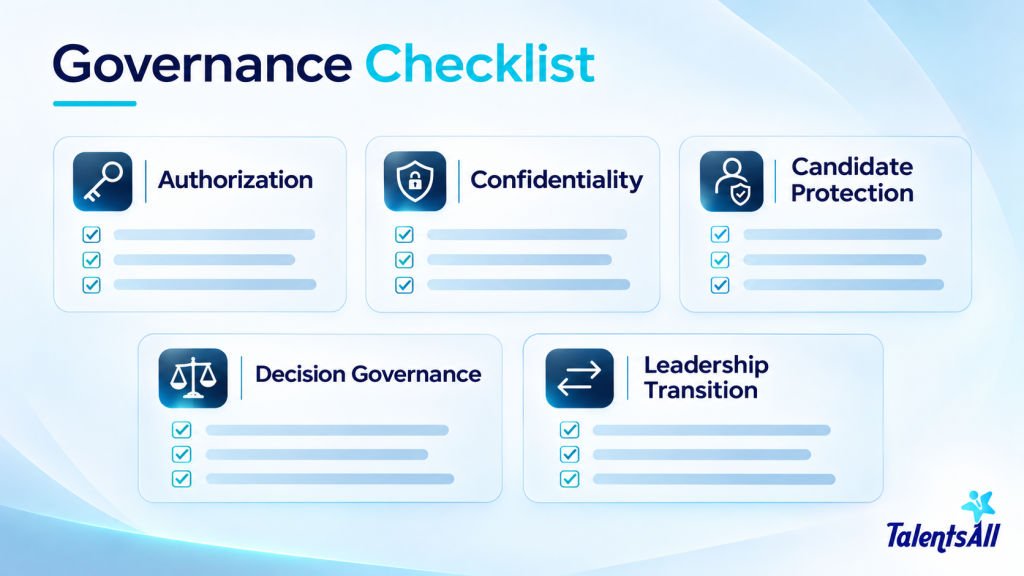
Before launching a confidential leadership replacement in Vietnam, CEOs and HR Directors can use the following checklist to test whether the organization is prepared.
| Governance Item | Key Question |
|---|---|
| 1. Mandate Approval | Has the search been authorized by the appropriate decision-maker? |
| 2. Employment Review | Have HR and Legal reviewed the relevant employment and governance considerations? |
| 3. Confidentiality Circle | Is there a defined group of stakeholders authorized to know about the assignment? |
| 4. Disclosure Rules | Is it clear what information may be shared at each stage? |
| 5. Search Ownership | Has one person been assigned responsibility for coordinating the mandate? |
| 6. Market Outreach | Is candidate engagement based on an approved, discreet and truthful approach? |
| 7. Candidate Data | Are consent, privacy, access and retention requirements addressed? |
| 8. Approval Gates | Are shortlist, interview, offer and transition decisions assigned to authorized owners? |
| 9. Incident Escalation | Is there a process for responding to disclosure risks or confidentiality concerns? |
| 10. Transition Readiness | Is there a documented plan for employment decisions, communications and business continuity? |
7.1. How to Use the Checklist
The checklist should be reviewed jointly by the executive sponsor, designated HR leader and relevant legal or privacy advisers before the search is launched. Where external Executive Search support is involved, responsibilities should be reflected in the agreed search process.
Not every item will require a lengthy document, but each should have an accountable owner and a clear decision. If a critical control remains unresolved, the company should determine whether the assignment can safely proceed or whether the search design needs adjustment.
8. What Should Employers Expect From a Confidential Executive Search Partner?
A confidential executive replacement requires an external partner to balance market access with disciplined communication and information handling.
The value of the search partner should therefore be assessed through more than the number of senior profiles available in its network.
8.1. A Clear Confidential Search Methodology
An Executive Search partner should be able to explain how it will identify relevant candidates, manage discreet outreach and control information sharing throughout the assignment.
Employers should ask practical questions about access permissions, candidate disclosure, reporting and escalation procedures. A consultant’s seniority and sector knowledge are important, but the organization also needs confidence that the proposed methodology fits the confidentiality risks of the mandate.
TalentsAll’s guide to How to Shortlist Executive Search Firms in Vietnam provides a broader framework for evaluating search partners.
8.2. Market Intelligence Without Unnecessary Disclosure
A search partner can support employer decision-making by providing information about candidate availability, relevant leadership backgrounds and the attractiveness of the role.
This feedback can be delivered in stages, without circulating identifiable candidate records before appropriate approvals. Employers should expect meaningful insight into search progress while maintaining the confidentiality of both the organization and candidates.
8.3. Alignment With the Employer’s Governance Requirements
The search partner must understand the organization’s approval structure, communication expectations and responsibilities before contacting the market.
For multinational businesses, this may involve coordinating with local HR, regional leadership and legal or compliance teams. The consultant should be able to identify when instructions are unclear and when an issue requires escalation, rather than allowing recruitment activity to continue without proper authorization.
TalentsAll provides Executive Search and Headhunting services for senior leadership and specialized appointments in Vietnam. For organizations evaluating a confidential replacement mandate, the first discussion should clarify the business requirements, confidentiality expectations and appropriate scope of the search.
9. Confidentiality Should Be Designed Into the Search Process
A confidential executive replacement is not successful simply because a leadership appointment remains undisclosed until the final announcement.
The recruitment process must also protect candidate information, preserve appropriate decision-making controls and prepare the organization for a responsible transition.
For FDI companies and multinational corporations in Vietnam, effective governance depends on four elements: a clearly authorized mandate, controlled information disclosure, documented approval gates and a coordinated leadership transition.
These practices can reduce avoidable risks while allowing the organization to engage suitable leadership talent and make informed decisions.
If your organization is preparing a business-critical or confidential executive appointment, contact TalentsAll to discuss your hiring requirements and assess an appropriate Executive Search approach.
Frequently Asked Questions
What is confidential executive search?
Confidential Executive Search is a recruitment process in which information about the hiring organization, leadership position or recruitment mandate is deliberately restricted. It is commonly considered when a company needs to replace an incumbent executive, plan succession or recruit for a sensitive business initiative.
Can an Executive Search firm approach candidates without revealing the employer’s name?
Yes, initial discussions may take place without identifying the employer, provided the communication is truthful and follows the agreed confidentiality requirements. Candidates should receive sufficient information to evaluate the opportunity before progressing into more substantive recruitment stages.
Who should be involved in a confidential executive replacement?
The appropriate group depends on the organization’s governance structure. It may include the CEO, Board representative, authorized HR leader, relevant legal advisers and designated Executive Search consultant. Access should be limited to stakeholders with a legitimate role in the process.
How can FDI companies protect candidate information during a confidential search?
Companies should establish appropriate candidate permissions, restricted information access, secure communication procedures and retention controls. Processing must comply with applicable personal data protection requirements, including Vietnam’s Law on Personal Data Protection where relevant.
When should the employer plan the executive transition?
Transition planning should begin before the final offer, once the organization has a sufficiently developed and authorized replacement strategy. Employment decisions, candidate commitments, internal communications and business-continuity arrangements should be coordinated through the appropriate decision-makers.
Connect With TalentsAll
TalentsAll connects organizations with experienced professionals through Executive Search, Headhunting and specialized recruitment solutions in Vietnam.
For professionals: Explore senior-level career opportunities at TalentsAll Careers.
Stay connected: Follow TalentsAll Global on LinkedIn for hiring insights, market perspectives and career updates.
Talents for All, All for Talents.